ProductsCock BrandRaviolis Aux Crevettes Ha Cao
Raviolis Aux Crevettes Ha Cao
Barcode 3364699130989
Cock Brand

Raviolis Aux Crevettes Ha Cao

1kg
BARCODE:3364699130989
CATEGORIES:Meals, Pasta Dishes, Stuffed Pastas, Ravioli, Chinese Raviolis, Ravioli A La Crevette
LABELS:Triman
COUNTRIES:France

Health

Nutrition

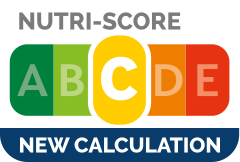
Nutri-Score

CAverage nutritional quality

Nutri-Score data warning

Warning: the amount of fruits, vegetables and nuts is not specified on the label, it was estimated from the list of ingredients: 6

Nutrient levels

Fat in moderate quantity (6.8%)
What you need to know • A high consumption of fat, especially saturated fats, can raise cholesterol, which increases the risk of heart diseases. Recommendation: Limit the consumption of fat and saturated fat • Choose products with lower fat and saturated fat content. Source: National Health Service UK (NHS) - Fat: the facts
Saturated fat in low quantity (1%)
What you need to know • A high consumption of fat, especially saturated fats, can raise cholesterol, which increases the risk of heart diseases. Recommendation: Limit the consumption of fat and saturated fat • Choose products with lower fat and saturated fat content. Source: National Health Service UK (NHS) - Fat: the facts
Sugars in low quantity (1.4%)
What you need to know • A high consumption of sugar can cause weight gain and tooth decay. It also augments the risk of type 2 diabetes and cardio-vascular diseases. Recommendation: Limit the consumption of sugar and sugary drinks • Sugary drinks (such as sodas, fruit beverages, and fruit juices and nectars) should be limited as much as possible (no more than 1 glass a day). • Choose products with lower sugar content and reduce the consumption of products with added sugars. Source: National Health Service UK (NHS) - Sugar: the facts
Salt in moderate quantity (1%)
What you need to know • A high consumption of salt (or sodium) can cause raised blood pressure, which can increase the risk of heart disease and stroke. • Many people who have high blood pressure do not know it, as there are often no symptoms. • Most people consume too much salt (on average 9 to 12 grams per day), around twice the recommended maximum level of intake. Recommendation: Limit the consumption of salt and salted food • Reduce the quantity of salt used when cooking, and don't salt again at the table. • Limit the consumption of salty snacks and choose products with lower salt content. Source: World Health Organization (WHO) - Fact sheet - Salt reduction Source: National Health Service UK (NHS) - Salt: the facts

Nutrition label

Raviolis Aux Crevettes Ha Cao nutrition label

Nutrition facts

Nutrition factsAs sold for 100 g / 100 mlCompared to: Chinese shrimp dumplings
Energy~ 856.8 kJ (203 kcal)733.488 kJ (172 kcal) (+17%)
Fat6.8 g5.285 g (+29%)
Saturated fat1 g1.252 g (-20%)
Carbohydrates26.6 g23.315 g (+14%)
Sugars1.4 g2.214 g (-37%)
Dietary fiber??
Proteins9 g7.995 g (+13%)
Salt1 g1.01 g (-1%)
Sodium0.4 g0.405 g (-1%)
Fruits, vegetables and legumes~ 6.225 %?

Nutrition facts (Detailed data)

Nutrition factsAs sold for 100 g / 100 mlAs sold Per 100 g (packaging)As sold Per 100 g (estimate)
Energy~ 856.8 kJ (203 kcal)? (203 kcal)?
Fat6.8 g6.8 g?
Saturated fat1 g1 g?
Carbohydrates26.6 g26.6 g?
Sugars1.4 g1.4 g?
Dietary fiber???
Proteins9 g9 g?
Salt1 g1 g?
Sodium0.4 g0.4 g?
Fruits, vegetables and legumes~ 6.225 %?~ 6.225 %

Serving size

25g

Ingredients

Ingredients image

Raviolis Aux Crevettes Ha Cao ingredients image

Ingredients list

Eau, crevettes 25,1%, amidon de blé tendre, pousses de bambou, pangasius (poisson), fécule de tapioca, fécule de pomme de terre, huile de soja, sucre, exhausteur de goût (E621), sel, huile de sésame, graines de sésame, épaississant (E466), chapelure «Panko» (farine de blé, fécule de tapioca, sucre, levure, sel), poivre blanc.

Ingredient information

Water
50% (estimate)
Shrimp
25.1%
Amidon De Ble Tendre
12.45% (estimate)
Bamboo Shoot
6.23% (estimate)
Pangas
3.11% (estimate)
Tapioca
1.56% (estimate)
Potato Starch
0.78% (estimate)
Soya Oil
0.39% (estimate)
Sugar
0.19% (estimate)
Flavour Enhancer
0.1% (estimate)
E621
0.1% (estimate)
Salt
0.05% (estimate)
Sesame Oil
0.02% (estimate)
Sesame Seeds
0.01% (estimate)
Thickener
0.01% (estimate)
E466
0.01% (estimate)
Chapelure Panko
0% (estimate)
Wheat Flour
0% (estimate)
Tapioca
0% (estimate)
Sugar
0% (estimate)
Yeast
0% (estimate)
Salt
0% (estimate)
White Pepper
0% (estimate)

Added sugars

Contains added sugars (0%) Added sugars: sugar Quantity of added sugars: 0%

Allergens

CrustaceansEggsFishGlutenSesame SeedsSoybeans

Ingredients analysis

Palm oil free
Yes

No ingredients containing palm oil.

Vegan
No

Contains non-vegan ingredients.

Unrecognized: fr:amidon-de-ble-tendre

Vegetarian
No

Contains non-vegetarian ingredients.

Unrecognized: fr:amidon-de-ble-tendre


Food Processing

NOVA group

4Ultra-processed food and drink products

Elements that indicate the product is in NOVA group 4

Additives
E466 - Sodium carboxy methyl cellulose
Additives
E621 - Monosodium glutamate
Ingredients
Flavour Enhancer
Ingredients
Thickener

How NOVA works

The NOVA classification assigns food products into 4 groups based on their degree of processing: 1. Unprocessed or minimally processed foods 2. Processed culinary ingredients 3. Processed foods 4. Ultra-processed food and drink products

Additives

E466 - Sodium carboxy methyl celluloseEmulsifierHumectantStabiliserThickener

Carboxymethyl cellulose (CMC) or cellulose gum or tylose powder is a cellulose derivative with carboxymethyl groups (-CH2-COOH) bound to some of the hydroxyl groups of the glucopyranose monomers that make up the cellulose backbone. It is often used as its sodium salt, sodium carboxymethyl cellulose.

E621 - Monosodium glutamate EFSA overexposure risk: highFlavour Enhancer

Monosodium glutamate (MSG), or E621, is the sodium salt of glutamic acid, an amino acid found naturally in many foods.

It is widely used as a flavor enhancer to provide an "umami" or savory taste to a variety of processed foods, including soups, snack chips, and frozen meals.

MSG is generally recognized as safe (GRAS) by food authorities. However, some people report sensitivity to MSG, experiencing short-term symptoms like headaches and flushing, though scientific studies have not shown a consistent link.

Environment

Green-Score, origins bonus, and transportation impact are shown for Worldwide .

Green Score

Overall grade

FVery high environmental impact

About Green-Score

The Green-Score is an experimental score that summarizes the environmental impacts of food products.

Current scope

The Green-Score was initially developed for France and it is being extended to other European countries. The Green-Score formula is subject to change as it is regularly improved to make it more precise and better suited to each country. Select a country to include the full impact of transportation in the final score.

Life cycle analysis

Average impact of the category

FDumplings, steamed, with shrimps, cooked • Score: 14/100

Life-cycle reference

Category: Dumplings, steamed, with shrimps, cooked PEF environmental score: 1.88 Climate change impact: 11.60 kg CO2 eq / kg product The overall environmental impact figure (PEF) comes from ADEME's Agribalyse database, for the category: Dumplings, steamed, with shrimps, cooked. Source: ADEME Agribalyse Database.

Overall environmental impact by stage (PEF)

The overall environmental impact figure (PEF) comes from ADEME's Agribalyse database, for the category: Dumplings, steamed, with shrimps, cooked. Source: ADEME Agribalyse Database.

StageImpact
Agriculture86.7 %
Processing3.6 %
Packaging6.1 %
Transportation2.9 %
Distribution0.4 %
Consumption0.4 %

Bonuses and maluses

Declared origins

Origins of ingredients are missing for this product. Ingredients need to be completed before the transportation bonus can be computed precisely.

Packaging impact

Packaging with a high impact Malus: -15 Packaging score: -100.8

Green-Score for this product

Green-Score for this product

FFinal score: 0/100

Final score breakdown

Life cycle analysis score: 14 Sum of bonuses and maluses: -20 Final score: 0/100

Carbon footprint

Carbon footprint

Equivalent to driving 6.0 km in a petrol car. 1160 g CO2e per 100g of product. Reference category: Dumplings, steamed, with shrimps, cooked. The carbon emission figure comes from ADEME's Agribalyse database, for the category: Dumplings, steamed, with shrimps, cooked. Source: ADEME Agribalyse Database.

Climate impact by stage (CO2e)

The carbon emission figure comes from ADEME's Agribalyse database, for the category: Dumplings, steamed, with shrimps, cooked. Source: ADEME Agribalyse Database.

StageImpact
Agriculture80.9 %
Processing4.7 %
Packaging7.9 %
Transportation6.0 %
Distribution0.2 %
Consumption0.2 %

Packaging

Raviolis Aux Crevettes Ha Cao packaging image

Packaging impact

Packaging with a high impact Malus: -15 Packaging score: -100.8

Packaging materials

Material%Packaging weightPackaging weight per 100 g of product
Plastic94 %49 g4.9 g
Paper or cardboard6 %3.13 g0.31 g
Total100 %52.13 g5.21 g

Packaging components

ShapeMaterialRecyclingImpact
1 BAGPlasticRecycleHigh
1 LabelCardboardRecycleLow
1 TrayPlasticRecycleHigh

Transportation

Declared origins

Origins of ingredients are missing for this product. Ingredients need to be completed before the transportation bonus can be computed precisely.

Forest footprint

Forest footprint

No deforestation risk No ingredient associated with a deforestation risk. Forest Footprint The Forest Footprint is a methodology developed by the association Envol Vert to estimate the risk of deforestation related to our consumption. → More information on the methodology Forest Footprint grade: A No ingredient associated with a deforestation risk. Total Forest Footprint: 0.000 m² per kg of food

Deforestation risk details

Labels The presence of certain labels can greatly help reduce the risk of deforestation, through the presence of environmental criteria and/or through better remuneration of producers.

Data Source

Product data comes from Open Food Facts. Food Benchmark also adds translations, category comparisons and explanatory calculations.

The database is licensed under ODbL 1.0, individual contents under DbCL 1.0, and product photos under CC BY-SA 3.0.

Product added on December 19, 2017 at 6:09:03 PM UTC by kiliweb .

Last edit on March 17, 2026 at 11:36:55 PM UTC by new-nutrition-bot .

Product page also edited by beniben, date-limite-app, kiliweb, moon-rabbit, morrison, new-nutrition-bot, openfoodfacts-contributors, roboto-app, yuka.YVlrdURKVmZtOThJcFAweDhqREx4WWg1eTc2RlhqNkZEZUZCSUE9PQ, yuka.sY2b0xO6T85zoF3NwEKvllVZc4rz-Bb7GD3lv0jQ-dKLEoXObv9Qs6uqMqs.