ProductsCoq au vin et écrasé de pommes de terre
Coq au vin et écrasé de pommes de terre
Barcode 3356067772549

Coq au vin et écrasé de pommes de terre

300 g
BARCODE:3356067772549
CATEGORIES:Meats And Their Products, Meals, Meals With Meat, Poultry Meals, Cockerel In Red Wine Sauce
LABELS:Made In France
COUNTRIES:France

Labels

Nutri-Score
Nutri-ScoreModerate nutritional quality
NOVA Group
NOVA GroupUltra-processed food and drink products
Green-Score
FVery high environmental impact

Health

Nutrition

Label

CModerate nutritional quality

Nutrient levels

Fat in moderate quantity (5.3%)
What you need to know • A high consumption of fat, especially saturated fats, can raise cholesterol, which increases the risk of heart diseases. Recommendation: Limit the consumption of fat and saturated fat • Choose products with lower fat and saturated fat content. Source: National Health Service UK (NHS) - Fat: the facts
Saturated fat in moderate quantity (2.1%)
What you need to know • A high consumption of fat, especially saturated fats, can raise cholesterol, which increases the risk of heart diseases. Recommendation: Limit the consumption of fat and saturated fat • Choose products with lower fat and saturated fat content. Source: National Health Service UK (NHS) - Fat: the facts
Sugars in low quantity (0.9%)
What you need to know • A high consumption of sugar can cause weight gain and tooth decay. It also augments the risk of type 2 diabetes and cardio-vascular diseases. Recommendation: Limit the consumption of sugar and sugary drinks • Sugary drinks (such as sodas, fruit beverages, and fruit juices and nectars) should be limited as much as possible (no more than 1 glass a day). • Choose products with lower sugar content and reduce the consumption of products with added sugars. Source: National Health Service UK (NHS) - Sugar: the facts
Salt in moderate quantity (0.79%)
What you need to know • A high consumption of salt (or sodium) can cause raised blood pressure, which can increase the risk of heart disease and stroke. • Many people who have high blood pressure do not know it, as there are often no symptoms. • Most people consume too much salt (on average 9 to 12 grams per day), around twice the recommended maximum level of intake. Recommendation: Limit the consumption of salt and salted food • Reduce the quantity of salt used when cooking, and don't salt again at the table. • Limit the consumption of salty snacks and choose products with lower salt content. Source: World Health Organization (WHO) - Fact sheet - Salt reduction Source: National Health Service UK (NHS) - Salt: the facts

Nutrition label

Coq au vin et écrasé de pommes de terre nutrition label

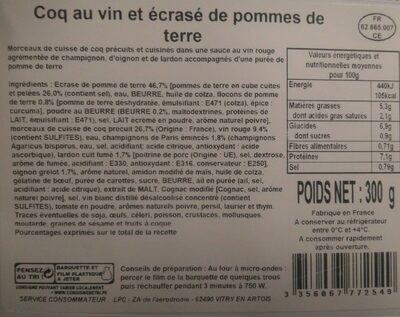
Nutrition facts

Nutrition factsAs sold for 100 g / 100 ml
Energy~ 434.1 kJ (105 kcal)
FAT5.3 g
Saturated fat2.1 g
Carbohydrates6.9 g
Sugars0.9 g
Dietary fiber?
Proteins7.1 g
Salt0.79 g
Sodium0.32 g
Minerals
Fruits, vegetables and legumes~ 3.5 %

Nutrition facts (Detailed data)

Nutrition factsAs sold for 100 g / 100 mlAs sold Per 100 g (packaging)As sold Per 100 g (estimate)
Energy~ 434.1 kJ (105 kcal)? (105 kcal)?
FAT5.3 g5.3 g?
Saturated fat2.1 g2.1 g?
Carbohydrates6.9 g6.9 g?
Sugars0.9 g0.9 g?
Added sugars~ 0 g?~ 0 g
Dietary fiber???
Proteins7.1 g7.1 g?
Salt0.79 g0.79 g?
Sodium0.32 g0.32 g?
Minerals
Fruits, vegetables and legumes~ 3.5 %?~ 3.5 %

Estimated Activity Time

Approximate time needed to burn the energy in 100 g / 100 ml: 434 kJ. Reference adult weight: 70 kg. Energy density: Low.

Walking
25 min (~2,531 steps)
Swimming
15 min
Bicycling
12 min
Running
9 min

Ingredients

Ingredients image

Coq au vin et écrasé de pommes de terre ingredients image

Ingredients list

Ecrase de pomme de terre 46,7% [pommes de terre en cube cuites et pelées 26,0% (contient sel), eau, BEURRE, huile de colza, flocons de pomme de terre 0,8% [pomme de terre déshydratée, émulsifiant: E471 (colza), épice: curcuma], poudre au BEURRE (BEURRE 0,2%, maltodextrines, protéines de LAIT, émulsifiant: E471), sel, LAIT écrémé en poudre, arôme naturel poivre]. morceaux de cuisse de coq précuit 26,7% (Origine : France), vin rouge 9,4% (contient SULFITES), eau, champignons de Paris émincés 1,8% (champignons Agaricus bisporus, eau, sel, acidifiant: acide citrique, antioxydant: acide ascorbique), lardon cuit fumé 1,7% [poitrine de porc (Origine : UE), sel, dextrose. arôme de fumée, acidifiant: E330, antioxydant: E316, conservateur : E250], oignon grelot 1,7%, arôme naturel, amidon modifié de maïs, huile de colza. gélatine de bœuf, purée de carottes, sucre, BEURRE, ail en purée (ail, sel, acidifiant: acide citrique), extrait de MALT. Cognac modifié [Cognac, sel, arôme naturel poivre], sel, vin blanc distillé désalcoolisé concentré (contient SULFITES), tomate en poudre, arômes naturels poivre, persil, laurier et thym. Traces éventuelles de soja, œufs, céleri, poisson, crustacés, mollusques. moutarde, graines de sésame et fruits à coque Pourcentages exprimés sur le total de la recette

Ingredient information

Ecrase De Pomme De Terre
46.7%
Potato
26.0%
Salt
26% (estimate)
Water
10.35% (estimate)
Butter
5.18% (estimate)
Colza Oil
2.59% (estimate)
Potato Flakes
0.8%
Potato
0.89% (estimate)
Emulsifier
0.45% (estimate)
E471
0.45% (estimate)
Rapeseed
0.45% (estimate)
Spice
0.45% (estimate)
Turmeric
0.45% (estimate)
Poudre Au Beurre
26.65% (estimate)
Butter
0.2%
Maltodextrin
13.23% (estimate)
Milk Proteins
6.61% (estimate)
Emulsifier
6.61% (estimate)
E471
6.61% (estimate)
Salt
13.33% (estimate)
Skimmed Milk Powder
6.66% (estimate)
Natural Pepper Flavouring
3.33% (estimate)
Morceaux De Cuisse De Coq Precuit
26.7%
Red Wine
9.4%
Water
Unknown (not provided)
Champignons De Paris Eminces
1.8%
Champignons Agaricus Bisporus
Unknown (not provided)
Water
Unknown (not provided)
Salt
Unknown (not provided)
Acid
Unknown (not provided)
E330
Unknown (not provided)
Antioxidant
Unknown (not provided)
Vitamin C
Unknown (not provided)
Smoked Cooked Lardoons
1.7%
Pork Breast
Unknown (not provided)
Salt
Unknown (not provided)
Dextrose
Unknown (not provided)
Smoke Flavouring
Unknown (not provided)
Acid
Unknown (not provided)
E330
Unknown (not provided)
Antioxidant
Unknown (not provided)
E316
Unknown (not provided)
Preservative
Unknown (not provided)
E250
Unknown (not provided)
Pearl Onion
1.7%
Natural Flavouring
Unknown (not provided)
Modified Corn Starch
Unknown (not provided)
Colza Oil
Unknown (not provided)
Beef Gelatin
Unknown (not provided)
Carrot Puree
Unknown (not provided)
Sugar
Unknown (not provided)
Butter
Unknown (not provided)
Garlic Paste
Unknown (not provided)
Garlic
Unknown (not provided)
Salt
Unknown (not provided)
Acid
Unknown (not provided)
E330
Unknown (not provided)
Malt Extract
Unknown (not provided)
Modified Cognac
Unknown (not provided)
Cognac
Unknown (not provided)
Salt
Unknown (not provided)
Natural Pepper Flavouring
Unknown (not provided)
Salt
Unknown (not provided)
Vin Blanc Distille Desalcoolise Concentre
Unknown (not provided)
Tomato
Unknown (not provided)
Natural Pepper Flavouring
Unknown (not provided)
Parsley
Unknown (not provided)
Bay Leaf
Unknown (not provided)
Thyme
Unknown (not provided)
Mustard
Unknown (not provided)

Allergens

GlutenMilkMustardSulphur Dioxide And Sulphites

Traces

CeleryCrustaceansEggsFishMolluscsMustardSesame SeedsSoybeans

Ingredients analysis

Palm oil free
Unknown

Palm oil content unknown

Vegan
No

Contains non-vegan ingredients.

Unrecognized: fr:morceaux-de-cuisse-de-coq-precuit, fr:champignons-agaricus-bisporus, fr:vin-blanc-distille-desalcoolise-concentre, en:mustard

Vegetarian
No

Contains non-vegetarian ingredients.

Unrecognized: fr:morceaux-de-cuisse-de-coq-precuit, fr:champignons-agaricus-bisporus, fr:vin-blanc-distille-desalcoolise-concentre, en:mustard


Food Processing

NOVA group

4Ultra-processed food and drink products

Elements that indicate the product is in NOVA group 4

Additives
E14XX - Modified Starch
Additives
E428 - Gelatine
Additives
E471 - Mono- and diglycerides of fatty acids
Ingredients
Dextrose
Ingredients
Emulsifier
Ingredients
Flavouring
Ingredients
Glucose
Ingredients
Maltodextrin
Ingredients
Milk Proteins
Ingredients
Modified Starch

How NOVA works

The NOVA classification assigns food products into 4 groups based on their degree of processing: 1. Unprocessed or minimally processed foods 2. Processed culinary ingredients 3. Processed foods 4. Ultra-processed food and drink products

Additives

E14XX - Modified StarchEmulsifierStabiliserThickener

No additive description is available yet.

E250 - Sodium nitritePreservative

Sodium nitrite (E250) is a salt used for curing and preserving meat products.

It plays a critical role in preventing the growth of Clostridium botulinum, the bacterium responsible for botulism, in cured meats like bacon, ham, and sausages. It also provides the characteristic pink color and flavor.

However, nitrites can react with amines in the stomach to form nitrosamines, which are potent carcinogens. High intake of processed meats containing nitrites is associated with an increased risk of colorectal cancer. Regulatory bodies have set strict limits on its use in food.

E300 - Ascorbic acidAntioxidantSequestrant

No additive description is available yet.

E316 - sodium erythorbateAntioxidant

SODIUM ERYTHORBATE is the sodium salt of erythorbic acid. Sodium erythorbate is produced from sugars derived from different sources, such as beets, sugar cane, and corn. It is used predominantly in meats, poultry, and soft drinks.

E330 - Citric acidAntioxidantSequestrant

Citric acid is a natural organic acid found in citrus fruits such as lemons, oranges, and limes.

It is widely used in the food industry as a flavor enhancer, acidulant, and preservative due to its tart and refreshing taste.

Citric acid is safe for consumption when used in moderation and is considered a generally recognized as safe (GRAS) food additive by regulatory agencies worldwide.

E428 - Gelatine

No additive description is available yet.

E471 - Mono- and diglycerides of fatty acidsEmulsifierStabiliser

Mono- and diglycerides of fatty acids (E471), are food additives commonly used as emulsifiers in various processed foods.

These compounds consist of glycerol molecules linked to one or two fatty acid chains, which help stabilize and blend water and oil-based ingredients. E471 enhances the texture and shelf life of products like margarine, baked goods, and ice cream, ensuring a smooth and consistent texture.

It is generally considered safe for consumption within established regulatory limits.

Environment

Green-Score, origins bonus, and transportation impact are shown for Worldwide .

Green Score

Overall grade

FVery high environmental impact

About Green-Score

The Green-Score is an experimental score that summarizes the environmental impacts of food products.

Current scope

The Green-Score was initially developed for France and it is being extended to other European countries. The Green-Score formula is subject to change as it is regularly improved to make it more precise and better suited to each country. Select a country to include the full impact of transportation in the final score.

Life cycle analysis

Average impact of the category

DCockerel in red wine sauce • Score: 30/100

Life-cycle reference

Category: Cockerel in red wine sauce PEF environmental score: 1.03 Climate change impact: 6.41 kg CO2 eq / kg product The overall environmental impact figure (PEF) comes from ADEME's Agribalyse database, for the category: Cockerel in red wine sauce. Source: ADEME Agribalyse Database.

Overall environmental impact by stage (PEF)

The overall environmental impact figure (PEF) comes from ADEME's Agribalyse database, for the category: Cockerel in red wine sauce. Source: ADEME Agribalyse Database.

StageImpact
Agriculture81.3 %
Processing11.7 %
Packaging3.1 %
Transportation2.7 %
Distribution0.9 %
Consumption0.7 %

Bonuses and maluses

Origins of ingredients

Declared origins are missing for this product. Origins malus: -5 Transportation (Worldwide): 0 Environmental policy adjustment: -5 Select a country to include the full impact of transportation.

Packaging impact

Packaging with a high impact Malus: -15 The information about the packaging of this product is not filled in.

Green-Score for this product

Green-Score for this product

FFinal score: 10/100

Final score breakdown

Life cycle analysis score: 30 Sum of bonuses and maluses: -20 Final score: 10/100

Carbon footprint

Carbon footprint

Equivalent to driving 3.3 km in a petrol car. 641 g CO2e per 100g of product. Reference category: Cockerel in red wine sauce. The carbon emission figure comes from ADEME's Agribalyse database, for the category: Cockerel in red wine sauce. Source: ADEME Agribalyse Database.

Climate impact by stage (CO2e)

The carbon emission figure comes from ADEME's Agribalyse database, for the category: Cockerel in red wine sauce. Source: ADEME Agribalyse Database.

StageImpact
Agriculture70.0 %
Processing17.5 %
Packaging6.1 %
Transportation5.5 %
Distribution0.7 %
Consumption0.3 %

Packaging

Packaging impact

Packaging with a high impact Malus: -15 The information about the packaging of this product is not filled in.

Data precision

The packaging information is not sufficiently precise to compute the most accurate packaging impact. Exact shapes and materials of all packaging components help improve the Green-Score.

Transportation

Origins of ingredients

Declared origins are missing for this product. Origins malus: -5 Transportation (Worldwide): 0 Environmental policy adjustment: -5 Select a country to include the full impact of transportation.

Origins breakdown

OriginPercent of ingredientsImpact
Unknown97 %High
France3 %High
European Union0 %High

Data Source

Data presented on this page is sourced from the Open Food Facts database. This platform does not alter the original dataset; its purpose is solely to enhance data visualization and user accessibility.

Product added on October 31, 2019 at 9:55:52 AM UTC by kiliweb .

Last edit on March 17, 2026 at 11:08:43 PM UTC by new-nutrition-bot .

Product page also edited by kiliweb, new-nutrition-bot, roboto-app, sebleouf, teolemon, yuka.SDZrRElyMElvOWdqdTh3UTgwamMwKzFJOXNLRlJWNm9jZkFZSVE9PQ.