ProductsMonoprixLait frais microfiltré demi-écrémé
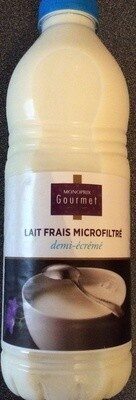
Lait frais microfiltré demi-écrémé
Barcode 3350030135775
Monoprix, Monoprix Gourmet

Lait frais microfiltré demi-écrémé

1 L
BARCODE:3350030135775
CATEGORIES:Dairies, Milks, Semi Skimmed Milks, Microfiltered Milks
LABELS:Made In France
PACKAGING:Plastic, Bottle
ORIGIN:France
MANUFACTURING:France
COUNTRIES:France
STORES:Monoprix

Labels

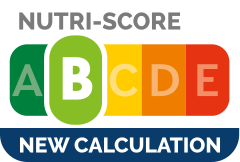
Nutri-Score
Nutri-ScoreGood nutritional quality
NOVA Group
NOVA GroupUnprocessed or minimally processed foods
Green-Score
Green-ScoreModerate environmental impact

Health

Nutrition

Label

BGood nutritional quality

Nutrient levels

Fat in low quantity (1.6%)
What you need to know • A high consumption of fat, especially saturated fats, can raise cholesterol, which increases the risk of heart diseases. Recommendation: Limit the consumption of fat and saturated fat • Choose products with lower fat and saturated fat content. Source: National Health Service UK (NHS) - Fat: the facts
Saturated fat in low quantity (1%)
What you need to know • A high consumption of fat, especially saturated fats, can raise cholesterol, which increases the risk of heart diseases. Recommendation: Limit the consumption of fat and saturated fat • Choose products with lower fat and saturated fat content. Source: National Health Service UK (NHS) - Fat: the facts
Sugars in low quantity (4.8%)
What you need to know • A high consumption of sugar can cause weight gain and tooth decay. It also augments the risk of type 2 diabetes and cardio-vascular diseases. Recommendation: Limit the consumption of sugar and sugary drinks • Sugary drinks (such as sodas, fruit beverages, and fruit juices and nectars) should be limited as much as possible (no more than 1 glass a day). • Choose products with lower sugar content and reduce the consumption of products with added sugars. Source: National Health Service UK (NHS) - Sugar: the facts
Salt in low quantity (0.1%)
What you need to know • A high consumption of salt (or sodium) can cause raised blood pressure, which can increase the risk of heart disease and stroke. • Many people who have high blood pressure do not know it, as there are often no symptoms. • Most people consume too much salt (on average 9 to 12 grams per day), around twice the recommended maximum level of intake. Recommendation: Limit the consumption of salt and salted food • Reduce the quantity of salt used when cooking, and don't salt again at the table. • Limit the consumption of salty snacks and choose products with lower salt content. Source: World Health Organization (WHO) - Fact sheet - Salt reduction Source: National Health Service UK (NHS) - Salt: the facts

Nutrition label

Lait frais microfiltré demi-écrémé nutrition label

Nutrition facts

Nutrition factsAs sold for 100 ml
Energy195 kJ (47 kcal)
FAT1.6 g
Saturated fat1 g
Carbohydrates4.8 g
Sugars4.8 g
Dietary fiber~ 0 g
Proteins3.2 g
Salt0.1 g
Sodium0.04 g
Minerals
Fruits, vegetables and legumes~ 0 %

Nutrition facts (Detailed data)

Nutrition factsAs sold for 100 mlAs sold Per 100 ml (packaging)As sold Per 100 g (estimate)
Energy195 kJ (47 kcal)195 kJ (47 kcal)~ 148 kJ (35 kcal)
FAT1.6 g1.6 g~ 0.19 g
Saturated fat1 g1 g~ 0.11 g
Cholesterol~ 0 g?~ 0 g
Carbohydrates4.8 g4.8 g~ 4.99 g
Sugars4.8 g4.8 g~ 4.93 g
Added sugars~ 0 g?~ 0 g
Sucrose~ 0 g?~ 0 g
Glucose~ 0 g?~ 0 g
Fructose~ 0 g?~ 0 g
Galactose~ 0 g?~ 0 g
Lactose~ 4.93 g?~ 4.93 g
Maltose~ 0 g?~ 0 g
Starch~ 0 g?~ 0 g
Polyols~ 0 g?~ 0 g
Dietary fiber~ 0 g?~ 0 g
Proteins3.2 g3.2 g~ 3.28 g
Salt0.1 g0.1 g~ 0.11 g
Sodium0.04 g0.04 g~ 0.04 g
Alcohol~ 0 % vol?~ 0 % vol
Vitamins
Vitamin A~ 0 g?~ 0 g
Beta-carotene~ 0 g?~ 0 g
Vitamin D~ 0 g?~ 0 g
Vitamin E~ 0 g?~ 0 g
Vitamin C~ 0 g?~ 0 g
Vitamin B1~ 0 g?~ 0 g
Vitamin B2~ 0 g?~ 0 g
Vitamin PP~ 0 g?~ 0 g
Vitamin B6~ 0 g?~ 0 g
Vitamin B9~ 0 g?~ 0 g
Vitamin B12~ 0 g?~ 0 g
Pantothenic acid~ 0 g?~ 0 g
Minerals
Potassium~ 0.16 g?~ 0.16 g
Calcium~ 0.12 g?~ 0.12 g
Phosphorus~ 0.1 g?~ 0.1 g
Iron~ 0 g?~ 0 g
Magnesium~ 0.01 g?~ 0.01 g
Zinc~ 0 g?~ 0 g
Copper~ 0 g?~ 0 g
Manganese~ 0 g?~ 0 g
Selenium~ 0 g?~ 0 g
Iodine~ 0 g?~ 0 g
Fruits, vegetables and legumes~ 0 %?~ 0 %
Phylloquinone~ 0 g?~ 0 g
Water~ 90.8 g?~ 90.8 g

Serving size

250 ml

Estimated Activity Time

Approximate time needed to burn the energy in 100 g / 100 ml: 195 kJ. Reference adult weight: 70 kg. Energy density: Low.

Walking
11 min (~1,137 steps)
Swimming
7 min
Bicycling
5 min
Running
4 min

Ingredients

Ingredients image

Lait frais microfiltré demi-écrémé ingredients image

Ingredients list

_Lait_ de vache.

Ingredient information

Cow S Milk
100% (estimate)

Allergens

Milk

Ingredients analysis

Palm oil free
Yes

No ingredients containing palm oil.

Vegan
No

Contains non-vegan ingredients.

Vegetarian
Yes

No non-vegetarian ingredients.


Food Processing

NOVA group

1Unprocessed or minimally processed foods

How NOVA works

The NOVA classification assigns food products into 4 groups based on their degree of processing: 1. Unprocessed or minimally processed foods 2. Processed culinary ingredients 3. Processed foods 4. Ultra-processed food and drink products

Additives

No additives detected or data is missing.

Environment

Green-Score, origins bonus, and transportation impact are shown for Worldwide .

Green Score

Overall grade

CModerate environmental impact

About Green-Score

The Green-Score is an experimental score that summarizes the environmental impacts of food products.

Current scope

The Green-Score was initially developed for France and it is being extended to other European countries. The Green-Score formula is subject to change as it is regularly improved to make it more precise and better suited to each country. Select a country to include the full impact of transportation in the final score.

Life cycle analysis

Average impact of the category

CMilk, semi-skimmed, UHT • Score: 58/100

Life-cycle reference

Category: Milk, semi-skimmed, UHT PEF environmental score: 0.12 Climate change impact: 1.27 kg CO2 eq / kg product The overall environmental impact figure (PEF) comes from ADEME's Agribalyse database, for the category: Milk, semi-skimmed, UHT. Source: ADEME Agribalyse Database.

Overall environmental impact by stage (PEF)

The overall environmental impact figure (PEF) comes from ADEME's Agribalyse database, for the category: Milk, semi-skimmed, UHT. Source: ADEME Agribalyse Database.

StageImpact
Agriculture74.8 %
Processing1.3 %
Packaging7.0 %
Transportation13.4 %
Distribution3.9 %
Consumption0.0 %

Bonuses and maluses

Origins of ingredients

Declared origins: France Origins bonus: +4 Transportation (Worldwide): 0 Environmental policy adjustment: +4 Select a country to include the full impact of transportation.

Packaging impact

Packaging with a medium impact Malus: -10 Packaging score: 0

Green-Score for this product

Green-Score for this product

CFinal score: 52/100

Final score breakdown

Life cycle analysis score: 58 Sum of bonuses and maluses: -6 Final score: 52/100

Carbon footprint

Carbon footprint

Equivalent to driving 0.7 km in a petrol car. 127 g CO2e per 100g of product. Reference category: Milk, semi-skimmed, UHT. The carbon emission figure comes from ADEME's Agribalyse database, for the category: Milk, semi-skimmed, UHT. Source: ADEME Agribalyse Database.

Climate impact by stage (CO2e)

The carbon emission figure comes from ADEME's Agribalyse database, for the category: Milk, semi-skimmed, UHT. Source: ADEME Agribalyse Database.

StageImpact
Agriculture73.5 %
Processing1.0 %
Packaging7.6 %
Transportation17.0 %
Distribution1.3 %
Consumption0.0 %

Packaging

Packaging impact

Packaging with a medium impact Malus: -10 Packaging score: 0

Packaging materials

Material%Packaging weightPackaging weight per 100 g of product
Plastic
Total

Declared packaging

Plastic, Bottle

Transportation

Manufacturing locations

France

Origins of ingredients

Declared origins: France Origins bonus: +4 Transportation (Worldwide): 0 Environmental policy adjustment: +4 Select a country to include the full impact of transportation.

Origins breakdown

OriginPercent of ingredientsImpact
France100 %Medium

Data Source

Data presented on this page is sourced from the Open Food Facts database. This platform does not alter the original dataset; its purpose is solely to enhance data visualization and user accessibility.

Product added on April 27, 2015 at 6:22:21 AM UTC by woshilapin .

Last edit on March 17, 2026 at 10:11:13 PM UTC by new-nutrition-bot .

Product page also edited by date-limite-app, elttor, kiliweb, new-nutrition-bot, nioff, packbot, quechoisir, roboto-app, tacite-mass-editor, teolemon, woshilapin, yuka.sY2b0xO6T85zoF3NwEKvlml7CMvRpmOYFTjRiXO67emocKLjb9Fr-bjkPag.