

2 Flamm'kueche
Labels
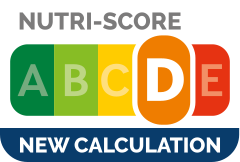 Poor nutritional quality
 Ultra-processed food and drink products
 Moderate environmental impact
Health
Nutrition
Label
Poor nutritional qualityNutrient levels
Fat in moderate quantity (15%)
Saturated fat in high quantity (8.6%)
Sugars in low quantity (2.3%)
Salt in moderate quantity (1.3%)
Nutrition label

Nutrition facts
| Nutrition facts | As sold for 100 g / 100 ml |
|---|---|
| Energy | 1,040 kJ (249 kcal) |
| FAT | 15 g |
| Saturated fat | 8.6 g |
| Carbohydrates | 22 g |
| Sugars | 2.3 g |
| Dietary fiber | 1.1 g |
| Proteins | 6 g |
| Salt | 1.3 g |
| Sodium | 0.52 g |
| Minerals | |
| Fruits, vegetables and legumes | ~ 16 % |
Nutrition facts (Detailed data)
| Nutrition facts | As sold for 100 g / 100 ml | As sold Per 100 g (packaging) | As sold Per 100 g (estimate) |
|---|---|---|---|
| Energy | 1,040 kJ (249 kcal) | 1,040 kJ (249 kcal) | ? |
| FAT | 15 g | 15 g | ? |
| Saturated fat | 8.6 g | 8.6 g | ? |
| Carbohydrates | 22 g | 22 g | ? |
| Sugars | 2.3 g | 2.3 g | ? |
| Added sugars | ~ 0.31 g | ? | ~ 0.31 g |
| Dietary fiber | 1.1 g | 1.1 g | ? |
| Proteins | 6 g | 6 g | ? |
| Salt | 1.3 g | 1.3 g | ? |
| Sodium | 0.52 g | 0.52 g | ? |
| Minerals | |||
| Fruits, vegetables and legumes | ~ 16 % | ? | ~ 16 % |
Serving size
Estimated Activity Time
Approximate time needed to burn the energy in 100 g / 100 ml: 1,040 kJ. Reference adult weight: 70 kg. Energy density: Moderate.
Ingredients
Ingredients image

Ingredients list
Ingredient information
Allergens
Traces
Ingredients analysis
No ingredients containing palm oil.
Contains non-vegan ingredients.
Unrecognized: fr:specialite-laitiere-a-base-de-creme-fraiche, fr:emulsifiant-mono-et-diglycerides-d-acides-gras, fr:pate-40-farine-de-ble
Contains non-vegetarian ingredients.
Unrecognized: fr:specialite-laitiere-a-base-de-creme-fraiche, fr:emulsifiant-mono-et-diglycerides-d-acides-gras, fr:pate-40-farine-de-ble
Food Processing
NOVA group
Ultra-processed food and drink productsElements that indicate the product is in NOVA group 4
How NOVA works
Additives
E250 - Sodium nitritePreservative
Sodium nitrite (E250) is a salt used for curing and preserving meat products.
It plays a critical role in preventing the growth of Clostridium botulinum, the bacterium responsible for botulism, in cured meats like bacon, ham, and sausages. It also provides the characteristic pink color and flavor.
However, nitrites can react with amines in the stomach to form nitrosamines, which are potent carcinogens. High intake of processed meats containing nitrites is associated with an increased risk of colorectal cancer. Regulatory bodies have set strict limits on its use in food.
E301 - Sodium ascorbateAntioxidant
SODIUM ASCORBATE is one of a number of mineral salts of ascorbic acid (vitamin C).
E330 - Citric acidAntioxidantSequestrant
Citric acid is a natural organic acid found in citrus fruits such as lemons, oranges, and limes.
It is widely used in the food industry as a flavor enhancer, acidulant, and preservative due to its tart and refreshing taste.
Citric acid is safe for consumption when used in moderation and is considered a generally recognized as safe (GRAS) food additive by regulatory agencies worldwide.
E440 - PectinsEmulsifierStabiliserThickener
Pectins (E440) are natural carbohydrates, predominantly found in fruits, that act as gelling agents in the food industry, creating the desirable jelly-like texture in jams, jellies, and marmalades.
Pectins stabilize and thicken various food products, such as desserts, confectioneries, and beverages, ensuring a uniform consistency and quality.
Recognized as safe by various health authorities, pectins have been widely used without notable adverse effects when consumed in typical dietary amounts.
Environment
Green-Score, origins bonus, and transportation impact are shown for Worldwide .
Green Score
Overall grade
Moderate environmental impactAbout Green-Score
Current scope
Life cycle analysis
Average impact of the category
 Flamed tart (thin-crusted onion tart with cream and lardoons) • Score: 65/100
Life-cycle reference
Overall environmental impact by stage (PEF)
The overall environmental impact figure (PEF) comes from ADEME's Agribalyse database, for the category: Flamed tart (thin-crusted onion tart with cream and lardoons). Source: ADEME Agribalyse Database.
| Stage | Impact |
|---|---|
| Agriculture | 60.8 % |
| Processing | 9.8 % |
| Packaging | 12.1 % |
| Transportation | 5.4 % |
| Distribution | 2.5 % |
| Consumption | 9.4 % |
Bonuses and maluses
Declared origins
Packaging impact
Green-Score for this product
Green-Score for this product
Final score: 45/100Final score breakdown
Carbon footprint
Carbon footprint
Climate impact by stage (CO2e)
The carbon emission figure comes from ADEME's Agribalyse database, for the category: Flamed tart (thin-crusted onion tart with cream and lardoons). Source: ADEME Agribalyse Database.
| Stage | Impact |
|---|---|
| Agriculture | 63.6 % |
| Processing | 6.6 % |
| Packaging | 15.6 % |
| Transportation | 9.3 % |
| Distribution | 1.4 % |
| Consumption | 3.2 % |
Packaging
Packaging impact
Data precision
Transportation
Declared origins
Data Source
Data presented on this page is sourced from the Open Food Facts database. This platform does not alter the original dataset; its purpose is solely to enhance data visualization and user accessibility.
Product added on August 17, 2017 at 6:40:59 PM UTC by kiliweb .
Last edit on March 17, 2026 at 8:08:51 PM UTC by new-nutrition-bot .
Product page also edited by date-limite-app, kiliweb, marmotte73, new-nutrition-bot, openfoodfacts-contributors, quechoisir, quentinbrd, teolemon, yuka.UJxEYM63Ev54OMHR8ZMJ5BOiL7-8J9YHQGJSow, yuka.sY2b0xO6T85zoF3NwEKvlnZaDuvuqziYbiHVomaVl-nSPK7nPe5ozI_fKas.