

4 Millefeuilles
Health
Nutrition
Nutri-Score
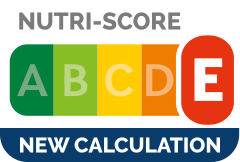 Lower nutritional quality
Nutri-Score data warning
Nutrient levels
Fat in moderate quantity (16.5%)
Saturated fat in high quantity (11.8%)
Sugars in high quantity (20.7%)
Salt in moderate quantity (0.49%)
Nutrition label

Nutrition facts
| Nutrition facts | As sold for 100 g / 100 ml | Compared to: Mille-feuille pastry |
|---|---|---|
| Energy | ~ 1334.3 kJ (319 kcal) | 1,288.556 kJ (304 kcal) (+4%) |
| Fat | 16.5 g | 14.721 g (+12%) |
| Saturated fat | 11.8 g | 9.056 g (+30%) |
| Carbohydrates | 38.2 g | 39.502 g (-3%) |
| Sugars | 20.7 g | 21.557 g (-4%) |
| Dietary fiber | 0.8 g | ? |
| Proteins | 4 g | 3.619 g (+11%) |
| Salt | 0.49 g | 0.445 g (+10%) |
| Sodium | 0.196 g | 0.179 g (+9%) |
| Fruits, vegetables and legumes | ~ 0 % | ? |
Nutrition facts (Detailed data)
| Nutrition facts | As sold for 100 g / 100 ml | As sold Per 100 g (packaging) | As sold Per 100 g (estimate) |
|---|---|---|---|
| Energy | ~ 1334.3 kJ (319 kcal) | ? (319 kcal) | ~ 821.056272565427 kJ (195 kcal) |
| Fat | 16.5 g | 16.5 g | ~ 6.580990981 g |
| Saturated fat | 11.8 g | 11.8 g | ~ 4.21765825380276 g |
| Carbohydrates | 38.2 g | 38.2 g | ~ 29.5711174 g |
| Sugars | 20.7 g | 20.7 g | ~ 12.7297514204307 g |
| Dietary fiber | 0.8 g | 0.8 g | ~ 1.63289900421474 g |
| Proteins | 4 g | 4 g | ~ 3.56864833188265 g |
| Salt | 0.49 g | 0.49 g | ~ 0.0815768487355784 g |
| Sodium | 0.196 g | 0.196 g | ~ 0.0268983383143356 g |
| Fruits, vegetables and legumes | ~ 0 % | ? | ~ 0 % |
Serving size
Ingredients
Ingredients image

Ingredients list
Ingredient information
Added sugars
Allergens
Ingredients analysis
Contains ingredients containing palm oil.
Contains non-vegan ingredients.
Contains non-vegetarian ingredients.
Food Processing
NOVA group
 Ultra-processed food and drink products
Elements that indicate the product is in NOVA group 4
How NOVA works
Additives
E14XX - Modified StarchEmulsifierStabiliserThickener
No additive description is available yet.
E160a - caroteneColour
β-Carotene is an organic, strongly colored red-orange pigment abundant in plants and fruits. It is a member of the carotenes, which are terpenoids (isoprenoids), synthesized biochemically from eight isoprene units and thus having 40 carbons. Among the carotenes, β-carotene is distinguished by having beta-rings at both ends of the molecule. β-Carotene is biosynthesized from geranylgeranyl pyrophosphate.β-Carotene is the most common form of carotene in plants. When used as a food coloring, it has the E number E160a. The structure was deduced by Karrer et al. in 1930. In nature, β-carotene is a precursor (inactive form) to vitamin A via the action of beta-carotene 15,15'-monooxygenase.Isolation of β-carotene from fruits abundant in carotenoids is commonly done using column chromatography. It can also be extracted from the beta-carotene rich algae, Dunaliella salina. The separation of β-carotene from the mixture of other carotenoids is based on the polarity of a compound. β-Carotene is a non-polar compound, so it is separated with a non-polar solvent such as hexane. Being highly conjugated, it is deeply colored, and as a hydrocarbon lacking functional groups, it is very lipophilic.
E263 - Calcium acetatePreservativeStabiliser
CALCIUM ACETATE is a chemical compound which is a calcium salt of acetic acid. Calcium acetate is used as a food additive, as a stabilizer, buffer and sequestrant, mainly in candy products.
E339 - Sodium phosphates EFSA overexposure risk: highEmulsifierHumectantPreservativeSequestrantStabiliserThickener
TRISODIUM PHOSPHATE is the inorganic compound with the chemical formula Na3PO4.
E428 - Gelatine
No additive description is available yet.
E450 - Diphosphates EFSA overexposure risk: highEmulsifierHumectantSequestrantStabiliserThickener
Diphosphates (E450) are food additives often utilized to modify the texture of products, acting as leavening agents in baking and preventing the coagulation of canned food.
These salts can stabilize whipped cream and are also found in powdered products to maintain their flow properties. They are commonly present in baked goods, processed meats, and soft drinks.
Derived from phosphoric acid, they're part of our daily phosphate intake, which often surpasses recommended levels due to the prevalence of phosphates in processed foods and drinks.
Excessive phosphate consumption is linked to health issues, such as impaired kidney function and weakened bone health. Though diphosphates are generally regarded as safe when consumed within established acceptable daily intakes, it's imperative to monitor overall phosphate consumption to maintain optimal health.
E471 - Mono- and diglycerides of fatty acidsEmulsifierStabiliser
Mono- and diglycerides of fatty acids (E471), are food additives commonly used as emulsifiers in various processed foods.
These compounds consist of glycerol molecules linked to one or two fatty acid chains, which help stabilize and blend water and oil-based ingredients. E471 enhances the texture and shelf life of products like margarine, baked goods, and ice cream, ensuring a smooth and consistent texture.
It is generally considered safe for consumption within established regulatory limits.
E472a - Acetic acid esters of mono- and diglycerides of fatty acidsEmulsifierSequestrantStabiliser
No additive description is available yet.
E472c - Citric acid esters of mono- and diglycerides of fatty acidsAntioxidantEmulsifierSequestrantStabiliser
No additive description is available yet.
E920 - l-cysteine
Cysteine (symbol Cys or C; ) is a semi-essential proteinogenic amino acid with the formula HO2CCH(NH2)CH2SH. The thiol side chain in cysteine often participates in enzymatic reactions, as a nucleophile. The thiol is susceptible to oxidation to give the disulfide derivative cystine, which serves an important structural role in many proteins. When used as a food additive, it has the E number E920. It is encoded by the codons UGU and UGC. Cysteine has the same structure as serine, but with one of its oxygen atoms replaced by sulfur; replacing it with selenium gives selenocysteine. (Like other natural proteinogenic amino acids cysteine has (L) chirality in the older D/L notation based on homology to D and L glyceraldehyde. In the newer R/S system of designating chirality, based on the atomic numbers of atoms near the asymmetric carbon, cysteine (and selenocysteine) have R chirality, because of the presence of sulfur (resp. selenium) as a second neighbor to the asymmetric carbon. The remaining chiral amino acids, having lighter atoms in that position, have S chirality.)
Environment
Green-Score, origins bonus, and transportation impact are shown for Worldwide .
Green Score
Overall grade
 Moderate environmental impact
About Green-Score
Current scope
Life cycle analysis
Average impact of the category
 Mille-feuille pastry • Score: 73/100
Life-cycle reference
Overall environmental impact by stage (PEF)
The overall environmental impact figure (PEF) comes from ADEME's Agribalyse database, for the category: Mille-feuille pastry. Source: ADEME Agribalyse Database.
| Stage | Impact |
|---|---|
| Agriculture | 54.7 % |
| Processing | 10.9 % |
| Packaging | 28.6 % |
| Transportation | 4.3 % |
| Distribution | 1.7 % |
| Consumption | 0.0 % |
Bonuses and maluses
Declared origins
Threatened species risk
Packaging impact
Green-Score for this product
Green-Score for this product
Final score: 47/100Final score breakdown
Carbon footprint
Carbon footprint
Climate impact by stage (CO2e)
The carbon emission figure comes from ADEME's Agribalyse database, for the category: Mille-feuille pastry. Source: ADEME Agribalyse Database.
| Stage | Impact |
|---|---|
| Agriculture | 63.6 % |
| Processing | 6.7 % |
| Packaging | 21.7 % |
| Transportation | 6.8 % |
| Distribution | 1.0 % |
| Consumption | 0.0 % |
Packaging
Packaging impact
Packaging components
| Shape | Material | Recycling | Impact |
|---|---|---|---|
| Unknown | Plastic | Unknown | High |
| Unknown | Cardboard | Unknown | Low |
Declared packaging
Data precision
Transportation
Manufacturing locations
Declared origins
Forest footprint
Forest footprint
Deforestation risk details
Data Source
Product data comes from Open Food Facts. Food Benchmark also adds translations, category comparisons and explanatory calculations.
The database is licensed under ODbL 1.0, individual contents under DbCL 1.0, and product photos under CC BY-SA 3.0.
Product added on February 11, 2018 at 11:39:30 AM UTC by kiliweb .
Last edit on March 17, 2026 at 11:57:18 PM UTC by new-nutrition-bot .
Product page also edited by beniben, date-limite-app, jeremy64, kiliweb, moon-rabbit, new-nutrition-bot, openfoodfacts-contributors, packbot, yuka.WDV3QkVvc2svZmRUa3NFeDFTM1IrdXBGL2FEeEJGT2NDODhmSWc9PQ.