
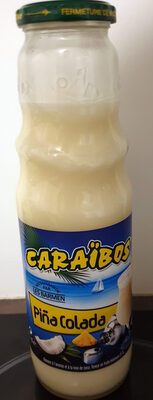
Piña colada
Labels
 Bad nutritional quality
 Ultra-processed food and drink products
 Low environmental impact
Health
Nutrition
Label
Bad nutritional qualityNutrient levels
Fat in low quantity (0.9%)
Saturated fat in low quantity (0.7%)
Sugars in high quantity (11%)
Salt in low quantity (0%)
Nutrition label

Nutrition facts
| Nutrition facts | As sold for 100 ml |
|---|---|
| Energy | ~ 254.3 kJ (62 kcal) |
| FAT | 0.9 g |
| Saturated fat | 0.7 g |
| Carbohydrates | 13 g |
| Sugars | 11 g |
| Dietary fiber | 0 g |
| Proteins | 0 g |
| Salt | 0 g |
| Sodium | 0 g |
| Minerals | |
| Fruits, vegetables and legumes | ~ 25 % |
Nutrition facts (Detailed data)
| Nutrition facts | As sold for 100 ml | As sold Per 100 ml (packaging) | As sold Per 100 g (estimate) |
|---|---|---|---|
| Energy | ~ 254.3 kJ (62 kcal) | ? (62 kcal) | ? |
| FAT | 0.9 g | 0.9 g | ? |
| Saturated fat | 0.7 g | 0.7 g | ? |
| Carbohydrates | 13 g | 13 g | ? |
| Sugars | 11 g | 11 g | ? |
| Added sugars | ~ 4.5 g | ? | ~ 4.5 g |
| Dietary fiber | 0 g | 0 g | ? |
| Proteins | 0 g | 0 g | ? |
| Salt | 0 g | 0 g | ? |
| Sodium | 0 g | 0 g | ? |
| Minerals | |||
| Fruits, vegetables and legumes | ~ 25 % | ? | ~ 25 % |
Estimated Activity Time
Approximate time needed to burn the energy in 100 g / 100 ml: 254 kJ. Reference adult weight: 70 kg. Energy density: High.
Ingredients
Ingredients image
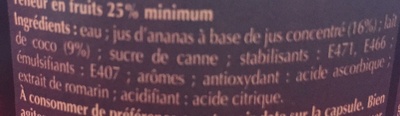
Ingredients list
Ingredient information
Ingredients analysis
Palm oil content unknown
Vegan status unknown
Vegetarian status unknown
Food Processing
NOVA group
Ultra-processed food and drink productsElements that indicate the product is in NOVA group 4
How NOVA works
Additives
E300 - Ascorbic acidAntioxidantSequestrant
No additive description is available yet.
E330 - Citric acidAntioxidantSequestrant
Citric acid is a natural organic acid found in citrus fruits such as lemons, oranges, and limes.
It is widely used in the food industry as a flavor enhancer, acidulant, and preservative due to its tart and refreshing taste.
Citric acid is safe for consumption when used in moderation and is considered a generally recognized as safe (GRAS) food additive by regulatory agencies worldwide.
E392 - Extracts of rosemary
No additive description is available yet.
E407 - CarrageenanCarrierEmulsifierHumectantStabiliserThickener
Carrageenan (E407), derived from red seaweed, is widely employed in the food industry as a gelling, thickening, and stabilizing agent, notably in dairy and meat products.
It can exist in various forms, each imparting distinct textural properties to food.
However, its degraded form, often referred to as poligeenan, has raised health concerns due to its potential inflammatory effects and its classification as a possible human carcinogen (Group 2B) by the International Agency for Research on Cancer (IARC).
Nevertheless, food-grade carrageenan has been deemed safe by various regulatory bodies when consumed in amounts typically found in food.
E466 - Sodium carboxy methyl celluloseEmulsifierHumectantStabiliserThickener
Carboxymethyl cellulose (CMC) or cellulose gum or tylose powder is a cellulose derivative with carboxymethyl groups (-CH2-COOH) bound to some of the hydroxyl groups of the glucopyranose monomers that make up the cellulose backbone. It is often used as its sodium salt, sodium carboxymethyl cellulose.
E471 - Mono- and diglycerides of fatty acidsEmulsifierStabiliser
Mono- and diglycerides of fatty acids (E471), are food additives commonly used as emulsifiers in various processed foods.
These compounds consist of glycerol molecules linked to one or two fatty acid chains, which help stabilize and blend water and oil-based ingredients. E471 enhances the texture and shelf life of products like margarine, baked goods, and ice cream, ensuring a smooth and consistent texture.
It is generally considered safe for consumption within established regulatory limits.
Environment
Green-Score, origins bonus, and transportation impact are shown for Worldwide .
Green Score
Overall grade
Low environmental impactAbout Green-Score
Current scope
Life cycle analysis
Average impact of the category
Fruit soft drink, still (fruit juice content unspecified), with sugar • Score: 69/100Life-cycle reference
Overall environmental impact by stage (PEF)
The overall environmental impact figure (PEF) comes from ADEME's Agribalyse database, for the category: Fruit soft drink, still (fruit juice content unspecified), with sugar. Source: ADEME Agribalyse Database.
| Stage | Impact |
|---|---|
| Agriculture | 41.7 % |
| Processing | 0.1 % |
| Packaging | 27.0 % |
| Transportation | 17.1 % |
| Distribution | 11.0 % |
| Consumption | 3.1 % |
Bonuses and maluses
Origins of ingredients
Packaging impact
Green-Score for this product
Green-Score for this product
Final score: 62/100Final score breakdown
Carbon footprint
Carbon footprint
Climate impact by stage (CO2e)
The carbon emission figure comes from ADEME's Agribalyse database, for the category: Fruit soft drink, still (fruit juice content unspecified), with sugar. Source: ADEME Agribalyse Database.
| Stage | Impact |
|---|---|
| Agriculture | 33.6 % |
| Processing | 0.0 % |
| Packaging | 24.4 % |
| Transportation | 34.5 % |
| Distribution | 6.4 % |
| Consumption | 1.2 % |
Packaging
Packaging impact
Packaging materials
| Material | % | Packaging weight | Packaging weight per 100 g of product |
|---|---|---|---|
| Glass | |||
| Total |
Declared packaging
Transportation
Origins of ingredients
Origins breakdown
| Origin | Percent of ingredients | Impact |
|---|---|---|
| Dominican Republic | 100 % | High |
Data Source
Data presented on this page is sourced from the Open Food Facts database. This platform does not alter the original dataset; its purpose is solely to enhance data visualization and user accessibility.
Product added on June 7, 2015 at 7:17:15 AM UTC by agamitsudo .
Last edit on March 17, 2026 at 8:30:34 PM UTC by new-nutrition-bot .
Product page also edited by agamitsudo, eatshalal, ecoscore-impact-estimator, inf, kiliweb, new-nutrition-bot, openfoodfacts-contributors, packbot, quentinbrd, tacite, yuka.UTRrSkRhb0ZoTkFObmZZajVUalhwOHRObnFXNVJVTzFjN0EzSVE9PQ, yuka.YUxzYVB2dGZpOHNNa2M4eDN3L04yY3RXNmNXSWIzT1ZLYlVkSVE9PQ, yuka.YllFQU03c2lxLzhuc01NOTBVT0kvdmxGeHFXa1JucXVJYlVOSVE9PQ, yuka.sY2b0xO6T85zoF3NwEKvlhZnTYrVmRnrGR3jkmug-PXRDZ3Ybcp2v7b6Iag.