

Pâte brisée
Health
Nutrition
Nutri-Score
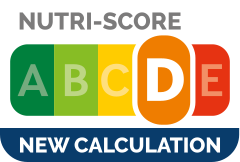 Lower nutritional quality
Nutri-Score data warning
Nutrient levels
Fat in moderate quantity (18%)
Saturated fat in high quantity (12%)
Sugars in low quantity (1.5%)
Salt in moderate quantity (0.93%)
Nutrition label

Nutrition facts
| Nutrition facts | As sold for 100 g / 100 ml | Compared to: Raw shortcrust pastry with pure butter |
|---|---|---|
| Energy | 1585 kJ (379 kcal) | 1,554.835 kJ (375 kcal) (+2%) |
| Fat | 18 g | 18.21 g (-1%) |
| Saturated fat | 12 g | 12.385 g (-3%) |
| Carbohydrates | 43 g | 43.4 g (-1%) |
| Sugars | 1.5 g | 1.985 g (-24%) |
| Dietary fiber | 1.5 g | ? |
| Proteins | 6.7 g | 6.28 g (+7%) |
| Salt | 0.93 g | 1.004 g (-7%) |
| Sodium | 0.372 g | 0.401 g (-7%) |
| Fruits, vegetables and legumes | ~ 0.465 % | ? |
Nutrition facts (Detailed data)
| Nutrition facts | As sold for 100 g / 100 ml | As sold Per 100 g (packaging) | As sold Per 100 g (estimate) |
|---|---|---|---|
| Energy | 1585 kJ (379 kcal) | 1585 kJ (379 kcal) | ~ 1447.0566 kJ (346 kcal) |
| Fat | 18 g | 18 g | ~ 17.8912485 g |
| Saturated fat | 12 g | 12 g | ~ 10.6844167 g |
| Carbohydrates | 43 g | 43 g | ~ 38.155125 g |
| Sugars | 1.5 g | 1.5 g | ~ 0.93666 g |
| Dietary fiber | 1.5 g | 1.5 g | ~ 4.15136 g |
| Proteins | 6.7 g | 6.7 g | ~ 6.07024 g |
| Salt | 0.93 g | 0.93 g | ~ 0.49859645 g |
| Sodium | 0.372 g | 0.372 g | ~ 0.18673385 g |
| Fruits, vegetables and legumes | ~ 0.465 % | ? | ~ 0.465 % |
Serving size
Ingredients
Ingredients image

Ingredients list
Ingredient information
Allergens
Traces
Ingredients analysis
No ingredients containing palm oil.
Contains non-vegan ingredients.
No non-vegetarian ingredients.
Food Processing
NOVA group
 Processed foods
Elements that indicate the product is in NOVA group 3
How NOVA works
Additives
E1510 - Ethanol
Ethanol, also called alcohol, ethyl alcohol, grain alcohol, and drinking alcohol, is a chemical compound, a simple alcohol with the chemical formula C2H5OH. Its formula can be also written as CH3−CH2−OH or C2H5−OH (an ethyl group linked to a hydroxyl group), and is often abbreviated as EtOH. Ethanol is a volatile, flammable, colorless liquid with a slight characteristic odor. It is a psychoactive substance and is the principal type of alcohol found in alcoholic drinks. Ethanol is naturally produced by the fermentation of sugars by yeasts or via petrochemical processes, and is most commonly consumed as a popular recreational drug. It also has medical applications as an antiseptic and disinfectant. The compound is widely used as a chemical solvent, either for scientific chemical testing or in synthesis of other organic compounds, and is a vital substance used across many different kinds of manufacturing industries. Ethanol is also used as a clean-burning fuel source.
Environment
Green-Score, origins bonus, and transportation impact are shown for Worldwide .
Green Score
Overall grade
 Low environmental impact
About Green-Score
Current scope
Life cycle analysis
Average impact of the category
Short crust pastry, raw • Score: 64/100Life-cycle reference
Overall environmental impact by stage (PEF)
The overall environmental impact figure (PEF) comes from ADEME's Agribalyse database, for the category: Short crust pastry, raw. Source: ADEME Agribalyse Database.
| Stage | Impact |
|---|---|
| Agriculture | 64.9 % |
| Processing | 9.6 % |
| Packaging | 8.0 % |
| Transportation | 5.7 % |
| Distribution | 2.5 % |
| Consumption | 9.3 % |
Bonuses and maluses
Origins of ingredients
Packaging impact
Green-Score for this product
Green-Score for this product
Final score: 61/100Final score breakdown
Carbon footprint
Carbon footprint
Climate impact by stage (CO2e)
The carbon emission figure comes from ADEME's Agribalyse database, for the category: Short crust pastry, raw. Source: ADEME Agribalyse Database.
| Stage | Impact |
|---|---|
| Agriculture | 69.6 % |
| Processing | 5.1 % |
| Packaging | 13.3 % |
| Transportation | 8.2 % |
| Distribution | 1.2 % |
| Consumption | 2.6 % |
Packaging
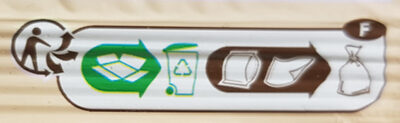
Packaging impact
Packaging components
| Shape | Material | Recycling | Impact |
|---|---|---|---|
| Film | Plastic | Unknown | High |
| Unknown | Paper | Unknown | Low |
| Unknown | Cardboard | Unknown | Low |
Declared packaging
Data precision
Transportation
Manufacturing locations
Origins of ingredients
Origins breakdown
| Origin | Percent of ingredients | Impact |
|---|---|---|
| France | 55 % | Medium |
| Unknown | 45 % | Medium |
Forest footprint
Forest footprint
Deforestation risk details
Additional information
- Other information
- 230g e Au beurre Fabriqué en France Blé origine France
- Preparation
- Pour des recettes salées ou sucrées. À savourer chaude ou froide. Préparation : 1- Sortez la pâte de son emballage 5 minutes avant utilisation, elle sera plus facile à manipuler. 2- Préchauffez votre four à 220°C (thermostat 7). 3- Déroulez et disposez la pâte avec sa feuille de cuisson directement dans le moule. 4- Découpez les excédents de papier. 5- Piquez le fond avec une fourchette. 6- Garnissez puis enfournez pendant 30 à 35 minutes à 180-200°C. (thermostat 6). Le temps de cuisson est à adapter en fonction de la coloration dorée de la pâte. Nous vous recommandons de ne pas congeler ou faire cuire au four à micro-ondes.
- Conservation conditions
- À conserver entre 0°C et +6°C. Conditionné sous atmosphère protectrice. Utilisez votre pâte dès l'ouverture, et consommez la après cuisson.
- Customer service
- Interdis - TSA 91431 - 91343 MASSY Cedex - France.
Data Source
Product data comes from Open Food Facts. Food Benchmark also adds translations, category comparisons and explanatory calculations.
The database is licensed under ODbL 1.0, individual contents under DbCL 1.0, and product photos under CC BY-SA 3.0.
Product added on February 24, 2014 at 11:35:12 AM UTC by chatainsim .
Last edit on March 17, 2026 at 11:56:28 PM UTC by new-nutrition-bot .
Product page also edited by aleene, carrefour, chatainsim, date-limite-app, desaalex8, desan, driveoff, ecoscore-impact-estimator, fgouget, foodless, jacob80, jesco, kiliweb, nanoouchka, new-nutrition-bot, org-carrefour, packbot, quechoisir, roboto-app, sebleouf, yuka.VjdnTU1vNG11dDRwbzhKZzhqSDg0TXRjK0lTMGJWNjFBT3NJSVE9PQ, yuka.WGJFZE1vNWFnZGhYdXNBNTBBcUY2c292bUo2MlluRzZLTW9USVE9PQ.
Source List
- Carrefour
- carrefour