
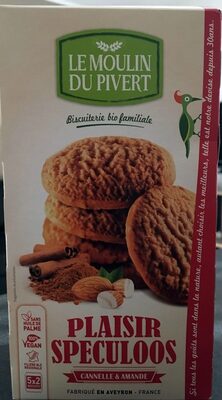
Sablés au spéculoos - Cannelle & amande
Labels
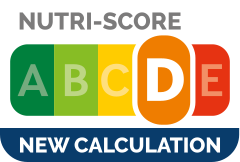 Poor nutritional quality
 Processed foods
 Low environmental impact
Health
Nutrition
Label
Poor nutritional qualityNutrient levels
Fat in moderate quantity (19%)
Saturated fat in moderate quantity (4.9%)
Sugars in high quantity (20%)
Salt in moderate quantity (0.4%)
Nutrition label
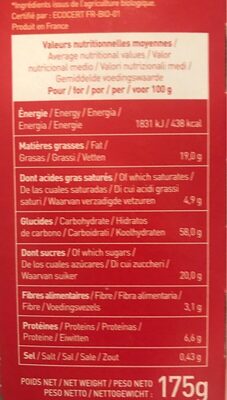
Nutrition facts
| Nutrition facts | As sold for 100 g / 100 ml |
|---|---|
| Energy | 1,831 kJ (438 kcal) |
| FAT | 19 g |
| Saturated fat | 4.9 g |
| Carbohydrates | 58 g |
| Sugars | 20 g |
| Dietary fiber | 3.1 g |
| Proteins | 6.6 g |
| Salt | 0.4 g |
| Sodium | 0.16 g |
| Minerals | |
| Fruits, vegetables and legumes | ~ 0 % |
Nutrition facts (Detailed data)
| Nutrition facts | As sold for 100 g / 100 ml | As sold Per 100 g (packaging) | As sold Per 100 g (estimate) |
|---|---|---|---|
| Energy | 1,831 kJ (438 kcal) | 1,831 kJ (438 kcal) | ? |
| FAT | 19 g | 19 g | ? |
| Saturated fat | 4.9 g | 4.9 g | ? |
| Carbohydrates | 58 g | 58 g | ? |
| Sugars | 20 g | 20 g | ? |
| Added sugars | ~ 25.46 g | ? | ~ 25.46 g |
| Dietary fiber | 3.1 g | 3.1 g | ? |
| Proteins | 6.6 g | 6.6 g | ? |
| Salt | 0.4 g | 0.4 g | ? |
| Sodium | 0.16 g | 0.16 g | ? |
| Minerals | |||
| Fruits, vegetables and legumes | ~ 0 % | ? | ~ 0 % |
Estimated Activity Time
Approximate time needed to burn the energy in 100 g / 100 ml: 1,831 kJ. Reference adult weight: 70 kg. Energy density: Moderate.
Ingredients
Ingredients image
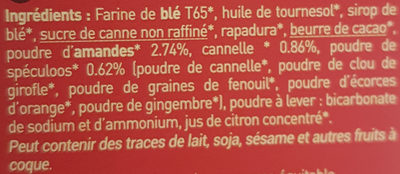
Ingredients list
Ingredient information
Allergens
Traces
Ingredients analysis
No ingredients containing palm oil.
No non-vegan ingredients.
Unrecognized: fr:rapadura
No non-vegetarian ingredients.
Unrecognized: fr:rapadura
Food Processing
NOVA group
Processed foodsElements that indicate the product is in NOVA group 3
How NOVA works
Additives
E500 - Sodium carbonatesStabiliserThickener
Sodium carbonates (E500) are compounds commonly used in food preparation as leavening agents, helping baked goods rise by releasing carbon dioxide when they interact with acids.
Often found in baking soda, they regulate the pH of food, preventing it from becoming too acidic or too alkaline. In the culinary world, sodium carbonates can also enhance the texture and structure of foods, such as noodles, by modifying the gluten network.
Generally recognized as safe, sodium carbonates are non-toxic when consumed in typical amounts found in food.
E500ii - Sodium hydrogen carbonateStabiliserThickener
Sodium hydrogen carbonate, also known as E500ii, is a food additive commonly used as a leavening agent.
When added to recipes, it releases carbon dioxide gas upon exposure to heat or acids, causing dough to rise and resulting in a light, fluffy texture in baked goods.
It is generally recognized as safe (GRAS) by regulatory authorities when used in appropriate quantities and poses no significant health risks when consumed in typical food applications.
E503 - Ammonium carbonates
AMMONIUM BICARBONATE is an inorganic compound with formula (NH4)HCO3, simplified to NH5CO3. Ammonium bicarbonate is used in the food industry as a raising agent for flat baked goods, such as cookies and crackers, and in China in steamed buns and Chinese almond cookies. It was commonly used in the home before modern day baking powder was made available.
E503i - Ammonium carbonate
No additive description is available yet.
Environment
Green-Score, origins bonus, and transportation impact are shown for Worldwide .
Green Score
Overall grade
Low environmental impactAbout Green-Score
Current scope
Life cycle analysis
Average impact of the category
Shortbread pastry biscuit • Score: 70/100Life-cycle reference
Overall environmental impact by stage (PEF)
The overall environmental impact figure (PEF) comes from ADEME's Agribalyse database, for the category: Shortbread pastry biscuit. Source: ADEME Agribalyse Database.
| Stage | Impact |
|---|---|
| Agriculture | 77.7 % |
| Processing | 11.0 % |
| Packaging | 5.3 % |
| Transportation | 4.5 % |
| Distribution | 1.6 % |
| Consumption | 0.0 % |
Bonuses and maluses
Production system
Declared origins
Packaging impact
Green-Score for this product
Green-Score for this product
Final score: 74/100Final score breakdown
Carbon footprint
Carbon footprint
Climate impact by stage (CO2e)
The carbon emission figure comes from ADEME's Agribalyse database, for the category: Shortbread pastry biscuit. Source: ADEME Agribalyse Database.
| Stage | Impact |
|---|---|
| Agriculture | 78.1 % |
| Processing | 5.9 % |
| Packaging | 8.9 % |
| Transportation | 6.3 % |
| Distribution | 0.8 % |
| Consumption | 0.0 % |
Packaging
Packaging impact
Packaging materials
| Material | % | Packaging weight | Packaging weight per 100 g of product |
|---|---|---|---|
| Plastic | |||
| Paper or cardboard | |||
| Total |
Declared packaging
Data precision
Transportation
Manufacturing locations
Declared origins
Data Source
Data presented on this page is sourced from the Open Food Facts database. This platform does not alter the original dataset; its purpose is solely to enhance data visualization and user accessibility.
Product added on February 18, 2017 at 8:17:17 AM UTC by kiliweb .
Last edit on March 17, 2026 at 8:12:48 PM UTC by new-nutrition-bot .
Product page also edited by date-limite-app, drunkenbison, kiliweb, new-nutrition-bot, openfoodfacts-contributors, packbot, quechoisir, quentinbrd, roboto-app, segundo, yuka.ArVGYsfQLcYwJvb4-5s_0SinJcfsP_p-CWYBog, yuka.D4xfOdS3MPN-TdyJ0poP9gGlKeDGJc0AFWYEog, yuka.I4tdGOy2RsF7LMTp4YdtzhadHbvBAfVwAVBcow.