
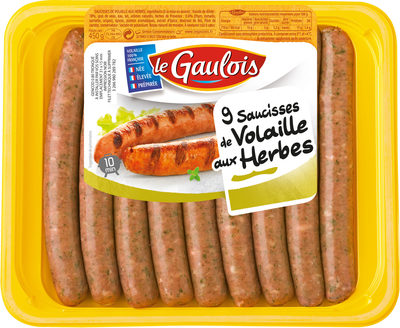
saucisses de volaille aux herbes
Health
Nutrition
Nutri-Score
 Lower nutritional quality
Nutri-Score data warning
Nutrient levels
Fat in moderate quantity (9.9%)
Saturated fat in moderate quantity (3.3%)
Sugars in low quantity (0.7%)
Salt in moderate quantity (1.3%)
Nutrition facts
| Nutrition facts | As sold for 100 g / 100 ml | Compared to: Poultry sausages |
|---|---|---|
| Energy | 677 kJ (162 kcal) | 816.61 kJ (197 kcal) (-17%) |
| Fat | 9.9 g | 13.924 g (-29%) |
| Saturated fat | 3.3 g | 4.315 g (-24%) |
| Carbohydrates | 1.3 g | 2.147 g (-39%) |
| Sugars | 0.7 g | 0.621 g (+13%) |
| Dietary fiber | 0 g | ? |
| Proteins | 17 g | 15.197 g (+12%) |
| Salt | 1.3 g | 1.927 g (-33%) |
| Sodium | 0.52 g | 0.77 g (-32%) |
| Fruits, vegetables and legumes | ~ 1 % | ? |
Nutrition facts (Detailed data)
| Nutrition facts | As sold for 100 g / 100 ml | As sold Per 100 g (packaging) | As sold Per 100 g (estimate) |
|---|---|---|---|
| Energy | 677 kJ (162 kcal) | 677 kJ (162 kcal) | ? |
| Fat | 9.9 g | 9.9 g | ? |
| Saturated fat | 3.3 g | 3.3 g | ? |
| Carbohydrates | 1.3 g | 1.3 g | ? |
| Sugars | 0.7 g | 0.7 g | ? |
| Dietary fiber | 0 g | 0 g | ? |
| Proteins | 17 g | 17 g | ? |
| Salt | 1.3 g | 1.3 g | ? |
| Sodium | 0.52 g | 0.52 g | ? |
| Fruits, vegetables and legumes | ~ 1 % | ? | ~ 1 % |
Ingredients
Ingredients list
Ingredient information
Added sugars
Ingredients analysis
Palm oil content unknown
Contains non-vegan ingredients.
Unrecognized: fr:a-la-mise-en-oeuvre, en:natural-sheep-casing, fr:contient-naturellement-de-l-acide-ascorbique, fr:des-polyphenols
Contains non-vegetarian ingredients.
Unrecognized: fr:a-la-mise-en-oeuvre, en:natural-sheep-casing, fr:contient-naturellement-de-l-acide-ascorbique, fr:des-polyphenols
Food Processing
NOVA group
 Ultra-processed food and drink products
Elements that indicate the product is in NOVA group 4
How NOVA works
Additives
E162 - Beetroot redColour
Betanin, or Beetroot Red, is a red glycosidic food dye obtained from beets; its aglycone, obtained by hydrolyzing away the glucose molecule, is betanidin. As a food additive, its E number is E162. The color of betanin depends on pH; between four and five it is bright bluish-red, becoming blue-violet as the pH increases. Once the pH reaches alkaline levels betanin degrades by hydrolysis, resulting in a yellow-brown color. Betanin is a betalain pigment, together with isobetanin, probetanin, and neobetanin. Other pigments contained in beet are indicaxanthin and vulgaxanthins.
E260 - Acetic acidPreservative
ACETIC ACID, systematically named ethanoic acid, is a colourless liquid organic compound with the chemical formula CH3COOH (also written as CH3CO2H or C2H4O2).
E326 - potassium lactateAntioxidantEmulsifierHumectant
POTASSIUM LACTATE is a compound with formula KC3H5O3. It is produced by neutralizing lactic acid which is fermented from a sugar source. Potassium lactate is commonly used in meat and poultry products to extend shelf life and increase food safety as it has a broad antimicrobial action. lactic acid and lactates can be consumed by all religious groups, vegans and vegetarians. Although the name refers to milk, it is not made from milk and thus suitable for people with milk allergy or lactose intolerance.
Environment
Green-Score, origins bonus, and transportation impact are shown for Worldwide .
Green Score
Overall grade
 Very high environmental impact
About Green-Score
Current scope
Life cycle analysis
Average impact of the category
 Poultry sausage • Score: 20/100
Life-cycle reference
Overall environmental impact by stage (PEF)
The overall environmental impact figure (PEF) comes from ADEME's Agribalyse database, for the category: Poultry sausage. Source: ADEME Agribalyse Database.
| Stage | Impact |
|---|---|
| Agriculture | 92.2 % |
| Processing | 3.0 % |
| Packaging | 0.9 % |
| Transportation | 1.3 % |
| Distribution | 0.6 % |
| Consumption | 2.3 % |
Bonuses and maluses
Declared origins
Packaging impact
Green-Score for this product
Green-Score for this product
Final score: 0/100Final score breakdown
Carbon footprint
Carbon footprint
Climate impact by stage (CO2e)
The carbon emission figure comes from ADEME's Agribalyse database, for the category: Poultry sausage. Source: ADEME Agribalyse Database.
| Stage | Impact |
|---|---|
| Agriculture | 94.7 % |
| Processing | 1.6 % |
| Packaging | 1.2 % |
| Transportation | 1.7 % |
| Distribution | 0.3 % |
| Consumption | 0.6 % |
Packaging
Packaging impact
Declared packaging
Data precision
Transportation
Declared origins
Forest footprint
Forest footprint
Deforestation risk details
Data Source
Product data comes from Open Food Facts. Food Benchmark also adds translations, category comparisons and explanatory calculations.
The database is licensed under ODbL 1.0, individual contents under DbCL 1.0, and product photos under CC BY-SA 3.0.
Product added on February 10, 2019 at 12:21:53 PM UTC by ldc .
Last edit on March 17, 2026 at 10:39:26 PM UTC by new-nutrition-bot .
Product page also edited by fixbot, jecrivaine, kiliweb, ldc, new-nutrition-bot, org-groupe-ldc, packbot, roboto-app.
Source List
- LDC
- groupe-ldc