
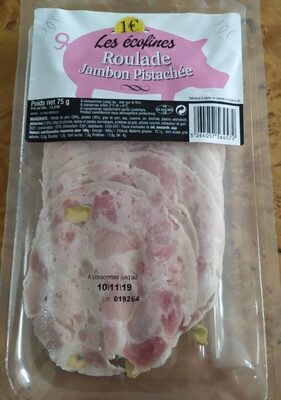
Roulade de Jambon Pistachée
Health
Nutrition
Nutri-Score
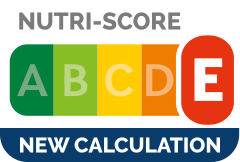 Lower nutritional quality
Nutri-Score data warning
Nutrient levels
Fat in high quantity (20.1%)
Saturated fat in high quantity (8%)
Sugars in low quantity (1%)
Salt in high quantity (4%)
Nutrition label

Nutrition facts
| Nutrition facts | As sold for 100 g / 100 ml | Compared to: fr:Charcuteries cuites |
|---|---|---|
| Energy | ~ 995.3 kJ (240 kcal) | 707.615 kJ (169 kcal) (+41%) |
| Fat | 20.1 g | 9.501 g (+112%) |
| Saturated fat | 8 g | 3.633 g (+120%) |
| Carbohydrates | 1 g | 2.351 g (-57%) |
| Sugars | 1 g | 0.724 g (+38%) |
| Dietary fiber | ? | ? |
| Proteins | 13.8 g | 17.544 g (-21%) |
| Salt | 4 g | 1.914 g (+109%) |
| Sodium | 1.6 g | 0.765 g (+109%) |
| Fruits, vegetables and legumes | ~ 0 % | ? |
Nutrition facts (Detailed data)
| Nutrition facts | As sold for 100 g / 100 ml | As sold Per 100 g (packaging) | As sold Per 100 g (estimate) |
|---|---|---|---|
| Energy | ~ 995.3 kJ (240 kcal) | ? (240 kcal) | ? |
| Fat | 20.1 g | 20.1 g | ? |
| Saturated fat | 8 g | 8 g | ? |
| Carbohydrates | 1 g | 1 g | ? |
| Sugars | 1 g | 1 g | ? |
| Dietary fiber | ? | ? | ? |
| Proteins | 13.8 g | 13.8 g | ? |
| Salt | 4 g | 4 g | ? |
| Sodium | 1.6 g | 1.6 g | ? |
| Fruits, vegetables and legumes | ~ 0 % | ? | ~ 0 % |
Ingredients
Ingredients image

Ingredients list
Ingredient information
Added sugars
Allergens
Traces
Ingredients analysis
Palm oil content unknown
Contains non-vegan ingredients.
Unrecognized: fr:plasma-deshydrate
Contains non-vegetarian ingredients.
Unrecognized: fr:plasma-deshydrate
Food Processing
NOVA group
 Ultra-processed food and drink products
Elements that indicate the product is in NOVA group 4
How NOVA works
Additives
E250 - Sodium nitrite EFSA overexposure risk: highPreservative
Sodium nitrite (E250) is a salt used for curing and preserving meat products.
It plays a critical role in preventing the growth of Clostridium botulinum, the bacterium responsible for botulism, in cured meats like bacon, ham, and sausages. It also provides the characteristic pink color and flavor.
However, nitrites can react with amines in the stomach to form nitrosamines, which are potent carcinogens. High intake of processed meats containing nitrites is associated with an increased risk of colorectal cancer. Regulatory bodies have set strict limits on its use in food.
E301 - Sodium ascorbateAntioxidant
SODIUM ASCORBATE is one of a number of mineral salts of ascorbic acid (vitamin C).
E450 - Diphosphates EFSA overexposure risk: highEmulsifierHumectantSequestrantStabiliserThickener
Diphosphates (E450) are food additives often utilized to modify the texture of products, acting as leavening agents in baking and preventing the coagulation of canned food.
These salts can stabilize whipped cream and are also found in powdered products to maintain their flow properties. They are commonly present in baked goods, processed meats, and soft drinks.
Derived from phosphoric acid, they're part of our daily phosphate intake, which often surpasses recommended levels due to the prevalence of phosphates in processed foods and drinks.
Excessive phosphate consumption is linked to health issues, such as impaired kidney function and weakened bone health. Though diphosphates are generally regarded as safe when consumed within established acceptable daily intakes, it's imperative to monitor overall phosphate consumption to maintain optimal health.
E451 - Triphosphates EFSA overexposure risk: highEmulsifierHumectantSequestrantStabiliserThickener
Sodium triphosphate (STP), also sodium tripolyphosphate (STPP), or tripolyphosphate (TPP),) is an inorganic compound with formula Na5P3O10. It is the sodium salt of the polyphosphate penta-anion, which is the conjugate base of triphosphoric acid. It is produced on a large scale as a component of many domestic and industrial products, especially detergents. Environmental problems associated with eutrophication are attributed to its widespread use.
E621 - Monosodium glutamate EFSA overexposure risk: highFlavour Enhancer
Monosodium glutamate (MSG), or E621, is the sodium salt of glutamic acid, an amino acid found naturally in many foods.
It is widely used as a flavor enhancer to provide an "umami" or savory taste to a variety of processed foods, including soups, snack chips, and frozen meals.
MSG is generally recognized as safe (GRAS) by food authorities. However, some people report sensitivity to MSG, experiencing short-term symptoms like headaches and flushing, though scientific studies have not shown a consistent link.
Environment
Green-Score, origins bonus, and transportation impact are shown for Worldwide .
Green Score
Overall grade
 Unknown environmental impact
About Green-Score
Current scope
Green-Score availability
Bonuses and maluses
Origins of ingredients
Packaging impact
Packaging
Packaging impact
Packaging components
| Shape | Material | Recycling | Impact |
|---|---|---|---|
| Tray | Plastic | Unknown | High |
Declared packaging
Transportation
Manufacturing locations
Origins of ingredients
Origins breakdown
| Origin | Percent of ingredients | Impact |
|---|---|---|
| European Union | 100 % | High |
Forest footprint
Forest footprint
Deforestation risk details
Data Source
Product data comes from Open Food Facts. Food Benchmark also adds translations, category comparisons and explanatory calculations.
The database is licensed under ODbL 1.0, individual contents under DbCL 1.0, and product photos under CC BY-SA 3.0.
Product added on October 24, 2019 at 9:31:45 AM UTC by kiliweb .
Last edit on March 17, 2026 at 11:31:38 PM UTC by new-nutrition-bot .
Product page also edited by anonymous-h4fe4z22fq, kiliweb, new-nutrition-bot, packbot, roboto-app, sebleouf, teolemon, yuka.Ui9rN0xZZzV0OVE0aC9jWTVTSCswNGtvMVlhQVdGT1JGTVlBSWc9PQ.