

Vinaigrette
Health
Nutrition
Nutri-Score
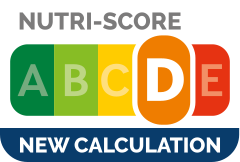 Lower nutritional quality
Nutri-Score data warning
Nutrient levels
Fat in high quantity (25%)
Saturated fat in moderate quantity (1.75%)
Sugars in low quantity (1.7%)
Salt in high quantity (1.85%)
Nutrition label

Nutrition facts
| Nutrition facts | As sold for 100 ml | Compared to: Low-fat vinaigrette dressings |
|---|---|---|
| Energy | ~ 986.20000141859 kJ (240 kcal) | 1,118.845 kJ (271 kcal) (-12%) |
| Fat | 25 g | 27.672 g (-10%) |
| Saturated fat | 1.75 g | 2.445 g (-28%) |
| Carbohydrates | 2.9000000953674 g | 4.257 g (-32%) |
| Sugars | 1.7000000476837 g | 2.666 g (-36%) |
| Dietary fiber | 0 g | ? |
| Proteins | 0.69999998807907 g | 0.522 g (+34%) |
| Salt | 1.85 g | 1.798 g (+3%) |
| Sodium | 0.74 g | 0.718 g (+3%) |
| Fruits, vegetables and legumes | ~ 0.3375 % | ? |
Nutrition facts (Detailed data)
| Nutrition facts | As sold for 100 ml | As sold Per 100 ml (packaging) | As sold Per 100 g (estimate) |
|---|---|---|---|
| Energy | ~ 986.20000141859 kJ (240 kcal) | ? (240 kcal) | ~ 988.276 kJ (239 kcal) |
| Fat | 25 g | 25 g | ~ 25.3714162499529 g |
| Saturated fat | 1.75 g | 1.75 g | ~ 1.838939 g |
| Carbohydrates | 2.9000000953674 g | 2.9000000953674 g | ~ 1.72255001279712 g |
| Sugars | 1.7000000476837 g | 1.7000000476837 g | ~ 0.915775023651115 g |
| Dietary fiber | 0 g | 0 g | ~ 0.0223749998807908 g |
| Proteins | 0.69999998807907 g | 0.69999998807907 g | ~ 0.228002499924898 g |
| Salt | 1.85 g | 1.85 g | ~ 1.11186552499586 g |
| Sodium | 0.74 g | 0.74 g | ~ 0.42375441999805 g |
| Fruits, vegetables and legumes | ~ 0.3375 % | ? | ~ 0.3375 % |
Ingredients
Ingredients image

Ingredients list
Ingredient information
Added sugars
Allergens
Ingredients analysis
No ingredients containing palm oil.
Vegan status unknown
Unrecognized: fr:avant-ouverture, fr:conserver-a-temperature-ambiante-et-a-l-abri-de-la-lumiere
Vegetarian status unknown
Unrecognized: fr:avant-ouverture, fr:conserver-a-temperature-ambiante-et-a-l-abri-de-la-lumiere
Food Processing
NOVA group
 Ultra-processed food and drink products
Elements that indicate the product is in NOVA group 4
How NOVA works
Additives
E14XX - Modified StarchEmulsifierStabiliserThickener
No additive description is available yet.
E160 - Carotenoids
No additive description is available yet.
E224 - Potassium metabisulphite EFSA overexposure risk: highAntioxidantPreservative
POTASSIUM METABISULFITE, K2S2O5, also known as potassium pyrosulfite, is a white crystalline powder with a pungent sulfur odour. The main use for the chemical is as an antioxidant or chemical sterilant.
E330 - Citric acidAntioxidantSequestrant
Citric acid is a natural organic acid found in citrus fruits such as lemons, oranges, and limes.
It is widely used in the food industry as a flavor enhancer, acidulant, and preservative due to its tart and refreshing taste.
Citric acid is safe for consumption when used in moderation and is considered a generally recognized as safe (GRAS) food additive by regulatory agencies worldwide.
E415 - Xanthan gumEmulsifierStabiliserThickener
Xanthan gum (E415) is a natural polysaccharide derived from fermented sugars, often used in the food industry as a thickening and stabilizing agent.
This versatile food additive enhances texture and prevents ingredient separation in a wide range of products, including salad dressings, sauces, and gluten-free baked goods.
It is considered safe for consumption even at high intake amounts.
Environment
Green-Score, origins bonus, and transportation impact are shown for Worldwide .
Green Score
Overall grade
 High environmental impact
About Green-Score
Current scope
Life cycle analysis
Average impact of the category
 Salad dressing, prepacked • Score: 58/100
Life-cycle reference
Overall environmental impact by stage (PEF)
The overall environmental impact figure (PEF) comes from ADEME's Agribalyse database, for the category: Salad dressing, prepacked. Source: ADEME Agribalyse Database.
| Stage | Impact |
|---|---|
| Agriculture | 68.6 % |
| Processing | 11.3 % |
| Packaging | 11.6 % |
| Transportation | 5.8 % |
| Distribution | 2.3 % |
| Consumption | 0.6 % |
Bonuses and maluses
Declared origins
Packaging impact
Green-Score for this product
Green-Score for this product
Final score: 43/100Final score breakdown
Carbon footprint
Carbon footprint
Climate impact by stage (CO2e)
The carbon emission figure comes from ADEME's Agribalyse database, for the category: Salad dressing, prepacked. Source: ADEME Agribalyse Database.
| Stage | Impact |
|---|---|
| Agriculture | 59.7 % |
| Processing | 12.1 % |
| Packaging | 13.7 % |
| Transportation | 12.4 % |
| Distribution | 1.8 % |
| Consumption | 0.3 % |
Packaging
Packaging impact
Packaging components
| Shape | Material | Recycling | Impact |
|---|---|---|---|
| 1 Bottle | Plastic | Recycle | High |
Declared packaging
Transportation
Declared origins
Forest footprint
Forest footprint
Deforestation risk details
Data Source
Product data comes from Open Food Facts. Food Benchmark also adds translations, category comparisons and explanatory calculations.
The database is licensed under ODbL 1.0, individual contents under DbCL 1.0, and product photos under CC BY-SA 3.0.
Product added on March 1, 2017 at 9:23:08 PM UTC by kiliweb .
Last edit on March 17, 2026 at 11:11:29 PM UTC by new-nutrition-bot .
Product page also edited by inf, jeriicko, kiliweb, kyofu88, new-nutrition-bot, openfoodfacts-contributors, roboto-app, yuka.DeteO9qbOt4gGsHW1dgEjTefJc7yGKNVKCcdog, yuka.UmJGUVNva0F0Nmd4cGZBeStpSHR4WWhJeDdxckFtSHNldHNKSVE9PQ, yuka.sY2b0xO6T85zoF3NwEKvlkobctqAnCjhZyH5lROi5fW1EKXqOc1LxdfGKKg.