
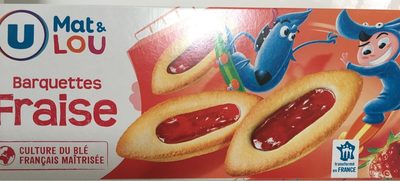
Mat & Lou - Barquettes fraise
Health
Nutrition
Nutri-Score
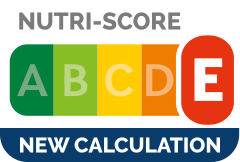 Lower nutritional quality
Nutri-Score data warning
Nutrient levels
Fat in moderate quantity (3.9%)
Saturated fat in low quantity (0.7%)
Sugars in high quantity (52.7%)
Salt in moderate quantity (0.4%)
Nutrition label
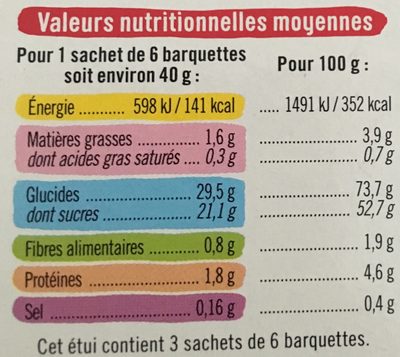
Nutrition facts
| Nutrition facts | As sold for 100 g / 100 ml | Compared to: fr:Barquettes à la fraise |
|---|---|---|
| Energy | ~ 1490.6 kJ (352 kcal) | 1,503.469 kJ (355 kcal) (-1%) |
| Fat | 3.9 g | 3.743 g (+4%) |
| Saturated fat | 0.7 g | 0.748 g (-6%) |
| Carbohydrates | 73.7 g | 74.695 g (-1%) |
| Sugars | 52.7 g | 53.119 g (-1%) |
| Dietary fiber | 1.9 g | ? |
| Proteins | 4.6 g | 4.696 g (-2%) |
| Salt | 0.4 g | 0.304 g (+32%) |
| Sodium | 0.16 g | 0.12 g (+33%) |
| Fruits, vegetables and legumes | ~ 11 % | ? |
Nutrition facts (Detailed data)
| Nutrition facts | As sold for 100 g / 100 ml | As sold Per 100 g (packaging) | As sold Per 100 g (estimate) |
|---|---|---|---|
| Energy | ~ 1490.6 kJ (352 kcal) | ? (352 kcal) | ? |
| Fat | 3.9 g | 3.9 g | ? |
| Saturated fat | 0.7 g | 0.7 g | ? |
| Carbohydrates | 73.7 g | 73.7 g | ? |
| Sugars | 52.7 g | 52.7 g | ? |
| Dietary fiber | 1.9 g | 1.9 g | ? |
| Proteins | 4.6 g | 4.6 g | ? |
| Salt | 0.4 g | 0.4 g | ? |
| Sodium | 0.16 g | 0.16 g | ? |
| Fruits, vegetables and legumes | ~ 11 % | ? | ~ 11 % |
Serving size
Ingredients
Ingredients image
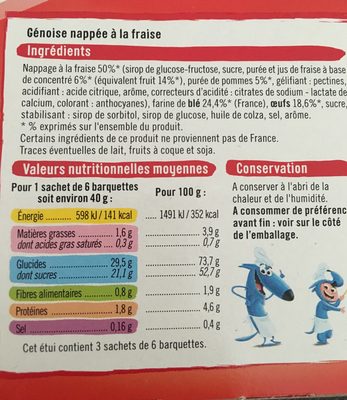
Ingredients list
Ingredient information
Added sugars
Allergens
Traces
Ingredients analysis
No ingredients containing palm oil.
Contains non-vegan ingredients.
Vegetarian status unknown
Food Processing
NOVA group
 Ultra-processed food and drink products
Elements that indicate the product is in NOVA group 4
How NOVA works
Additives
E163 - AnthocyaninsColour
Anthocyanins (also anthocyans; from Greek: ἄνθος (anthos) "flower" and κυάνεος/κυανοῦς kyaneos/kyanous "dark blue") are water-soluble vacuolar pigments that, depending on their pH, may appear red, purple, or blue. Food plants rich in anthocyanins include the blueberry, raspberry, black rice, and black soybean, among many others that are red, blue, purple, or black. Some of the colors of autumn leaves are derived from anthocyanins.Anthocyanins belong to a parent class of molecules called flavonoids synthesized via the phenylpropanoid pathway. They occur in all tissues of higher plants, including leaves, stems, roots, flowers, and fruits. Anthocyanins are derived from anthocyanidins by adding sugars. They are odorless and moderately astringent. Although approved to color foods and beverages in the European Union, anthocyanins are not approved for use as a food additive because they have not been verified as safe when used as food or supplement ingredients. There is no conclusive evidence anthocyanins have any effect on human biology or diseases.
E327 - calcium lactateThickener
Calcium lactate is a white crystalline salt with formula C6H10CaO6, consisting of two lactate anions H3C(CHOH)CO−2 for each calcium cation Ca2+. It forms several hydrates, the most common being the pentahydrate C6H10CaO6·5H2O. Calcium lactate is used in medicine, mainly to treat calcium deficiencies; and as a food additive with E number of E327. Some cheese crystals consist of calcium lactate.
E330 - Citric acidAntioxidantSequestrant
Citric acid is a natural organic acid found in citrus fruits such as lemons, oranges, and limes.
It is widely used in the food industry as a flavor enhancer, acidulant, and preservative due to its tart and refreshing taste.
Citric acid is safe for consumption when used in moderation and is considered a generally recognized as safe (GRAS) food additive by regulatory agencies worldwide.
E331 - Sodium citratesEmulsifierSequestrantStabiliser
DISODIUM CITRATE, more properly, disodium hydrogen citrate, is an acid salt of citric acid with the chemical formula Na2C6H6O7. It is used as an antioxidant in food and to improve the effects of other antioxidants. It is also used as an acidity regulator and sequestrant. Typical products include gelatin, jam, sweets, ice cream, carbonated beverages, milk powder, wine, and processed cheeses.
E420 - SorbitolHumectantSequestrantStabiliserSweetenerThickener
Sorbitol (), less commonly known as glucitol (), is a sugar alcohol with a sweet taste which the human body metabolizes slowly. It can be obtained by reduction of glucose, which changes the aldehyde group to a hydroxyl group. Most sorbitol is made from corn syrup, but it is also found in nature, for example in apples, pears, peaches, and prunes. It is converted to fructose by sorbitol-6-phosphate 2-dehydrogenase. Sorbitol is an isomer of mannitol, another sugar alcohol; the two differ only in the orientation of the hydroxyl group on carbon 2. While similar, the two sugar alcohols have very different sources in nature, melting points, and uses.
E420ii - Sorbitol syrupHumectantSequestrantStabiliserSweetenerThickener
No additive description is available yet.
E440 - PectinsEmulsifierStabiliserThickener
Pectins (E440) are natural carbohydrates, predominantly found in fruits, that act as gelling agents in the food industry, creating the desirable jelly-like texture in jams, jellies, and marmalades.
Pectins stabilize and thicken various food products, such as desserts, confectioneries, and beverages, ensuring a uniform consistency and quality.
Recognized as safe by various health authorities, pectins have been widely used without notable adverse effects when consumed in typical dietary amounts.
Environment
Green-Score, origins bonus, and transportation impact are shown for Worldwide .
Green Score
Overall grade
 Low environmental impact
About Green-Score
Current scope
Life cycle analysis
Average impact of the category
Biscuit sponge cake with fruits covering, pre-packed • Score: 71/100Life-cycle reference
Overall environmental impact by stage (PEF)
The overall environmental impact figure (PEF) comes from ADEME's Agribalyse database, for the category: Biscuit sponge cake with fruits covering, pre-packed. Source: ADEME Agribalyse Database.
| Stage | Impact |
|---|---|
| Agriculture | 68.1 % |
| Processing | 10.6 % |
| Packaging | 14.4 % |
| Transportation | 5.3 % |
| Distribution | 1.6 % |
| Consumption | 0.0 % |
Bonuses and maluses
Origins of ingredients
Packaging impact
Green-Score for this product
Green-Score for this product
Final score: 64/100Final score breakdown
Carbon footprint
Carbon footprint
Climate impact by stage (CO2e)
The carbon emission figure comes from ADEME's Agribalyse database, for the category: Biscuit sponge cake with fruits covering, pre-packed. Source: ADEME Agribalyse Database.
| Stage | Impact |
|---|---|
| Agriculture | 59.2 % |
| Processing | 6.1 % |
| Packaging | 25.7 % |
| Transportation | 7.7 % |
| Distribution | 0.9 % |
| Consumption | 0.0 % |
Packaging
Packaging impact
Packaging components
| Shape | Material | Recycling | Impact |
|---|---|---|---|
| BOX | Plastic | Unknown | High |
| Unknown | Cardboard | Unknown | Low |
Declared packaging
Data precision
Transportation
Manufacturing locations
Origins of ingredients
Origins breakdown
| Origin | Percent of ingredients | Impact |
|---|---|---|
| France | 94 % | Medium |
Forest footprint
Forest footprint
Ingredients linked to forest pressure
| Ingredient | Type | Percent in product | Forest footprint |
|---|---|---|---|
| EGG | Oeufs standards | 18.60 % | 0.02 |
Data Source
Product data comes from Open Food Facts. Food Benchmark also adds translations, category comparisons and explanatory calculations.
The database is licensed under ODbL 1.0, individual contents under DbCL 1.0, and product photos under CC BY-SA 3.0.
Product added on April 17, 2016 at 2:34:50 PM UTC by openfoodfacts-contributors .
Last edit on March 17, 2026 at 11:29:02 AM UTC by new-nutrition-bot .
Product page also edited by beniben, desan, kiliweb, new-nutrition-bot, openfoodfacts-contributors, packbot, quechoisir, teolemon, yuka.UqxkOvCyB-45FfHw2poF7BTkFMbvEtREN1ofoQ.