

Gros sel équilibré
Health
Nutrition
Nutri-Score data warning
Nutrient levels
Fat in low quantity (0%)
Saturated fat in low quantity (0%)
Sugars in low quantity (0%)
Salt in high quantity (65.6%)
Nutrition label
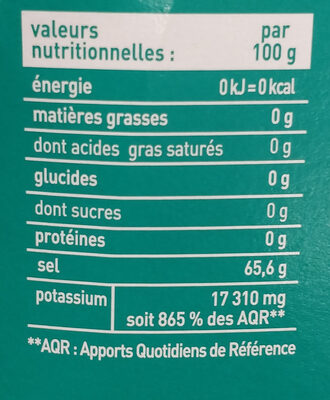
Nutrition facts
| Nutrition facts | As sold for 100 g / 100 ml |
|---|---|
| Energy | ~ 0 kJ (0 kcal) |
| Fat | 0 g |
| Saturated fat | 0 g |
| Polyunsaturated fat | 17.31 g |
| Carbohydrates | 0 g |
| Sugars | 0 g |
| Dietary fiber | 0 g |
| Proteins | 0 g |
| Salt | 65.6 g |
| Sodium | 26.24 g |
| Fruits, vegetables and legumes | ~ 0 % |
Nutrition facts (Detailed data)
| Nutrition facts | As sold for 100 g / 100 ml | As sold Per 100 g (packaging) | As sold Per 100 g (estimate) |
|---|---|---|---|
| Energy | ~ 0 kJ (0 kcal) | ? (0 kcal) | ? |
| Fat | 0 g | 0 g | ? |
| Saturated fat | 0 g | 0 g | ? |
| Polyunsaturated fat | 17.31 g | 17.31 g | ? |
| Carbohydrates | 0 g | 0 g | ? |
| Sugars | 0 g | 0 g | ? |
| Dietary fiber | 0 g | 0 g | ? |
| Proteins | 0 g | 0 g | ? |
| Salt | 65.6 g | 65.6 g | ? |
| Sodium | 26.24 g | 26.24 g | ? |
| Fruits, vegetables and legumes | ~ 0 % | ? | ~ 0 % |
Ingredients
Ingredients image

Ingredients list
Ingredient information
Ingredients analysis
No ingredients containing palm oil.
No non-vegan ingredients.
No non-vegetarian ingredients.
Food Processing
NOVA group
 Processed culinary ingredients
Elements that indicate the product is in NOVA group 2
How NOVA works
Additives
E504 - Magnesium carbonatesCarrier
MAGNESIUM CARBONATE, MgCO3 (archaic name magnesia alba), is an inorganic salt that is a white solid.
E535 - Sodium ferrocyanide
Sodium ferrocyanide is the sodium salt of the coordination compound of formula [Fe(CN)6]4−. In its hydrous form, Na4Fe(CN)6 · 10 H2O (sodium ferrocyanide decahydrate), it is sometimes known as yellow prussiate of soda. It is a yellow crystalline solid that is soluble in water and insoluble in alcohol. The yellow color is the color of ferrocyanide anion. Despite the presence of the cyanide ligands, sodium ferrocyanide has low toxicity (acceptable daily intake 0–0.025 mg/kg body weight). The ferrocyanides are less toxic than many salts of cyanide, because they tend not to release free cyanide. However, like all ferrocyanide salt solutions, addition of an acid can result in the production of hydrogen cyanide gas, which is toxic.
Environment
Green-Score, origins bonus, and transportation impact are shown for Worldwide .
Green Score
Overall grade
 Very low environmental impact
About Green-Score
Current scope
Life cycle analysis
Average impact of the category
Salt, white, for human consumption (sea, igneous or rock), no enrichment • Score: 98/100Life-cycle reference
Overall environmental impact by stage (PEF)
The overall environmental impact figure (PEF) comes from ADEME's Agribalyse database, for the category: Salt, white, for human consumption (sea, igneous or rock), no enrichment. Source: ADEME Agribalyse Database.
| Stage | Impact |
|---|---|
| Agriculture | 54.9 % |
| Processing | 0.1 % |
| Packaging | 22.6 % |
| Transportation | 14.9 % |
| Distribution | 7.6 % |
| Consumption | 0.0 % |
Bonuses and maluses
Declared origins
Packaging impact
Green-Score for this product
Green-Score for this product
Final score: 92/100Final score breakdown
Carbon footprint
Carbon footprint
Climate impact by stage (CO2e)
The carbon emission figure comes from ADEME's Agribalyse database, for the category: Salt, white, for human consumption (sea, igneous or rock), no enrichment. Source: ADEME Agribalyse Database.
| Stage | Impact |
|---|---|
| Agriculture | 47.8 % |
| Processing | 0.0 % |
| Packaging | 26.4 % |
| Transportation | 21.5 % |
| Distribution | 4.3 % |
| Consumption | 0.0 % |
Packaging

Packaging impact
Packaging components
| Shape | Material | Recycling | Impact |
|---|---|---|---|
| Sleeve | Cardboard | Unknown | Low |
Declared packaging
Transportation
Declared origins
Data Source
Product data comes from Open Food Facts. Food Benchmark also adds translations, category comparisons and explanatory calculations.
The database is licensed under ODbL 1.0, individual contents under DbCL 1.0, and product photos under CC BY-SA 3.0.
Product added on September 15, 2019 at 10:54:15 AM UTC by kiliweb .
Last edit on March 17, 2026 at 11:50:07 PM UTC by new-nutrition-bot .
Product page also edited by ecoscore-impact-estimator, kiliweb, new-nutrition-bot, openfoodfacts-contributors, quechoisir, raphael, roboto-app, teolemon, yuka.SFljQVMvb0NtK3M2dWN3QS9pek8vZlZxNjVDdmVFSzhGK3NMSVE9PQ.