

Madeleines longues MGV
Labels
 Poor nutritional quality
 Ultra-processed food and drink products
 Moderate environmental impact
Health
Nutrition
Label
Poor nutritional qualityNutrient levels
Fat in moderate quantity (19%)
Saturated fat in moderate quantity (2.5%)
Sugars in high quantity (25%)
Salt in moderate quantity (0.84%)
Nutrition label
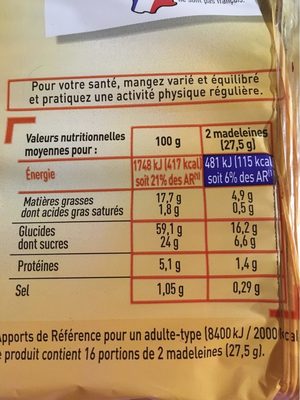
Nutrition facts
| Nutrition facts | As sold for 100 g / 100 ml |
|---|---|
| Energy | 1,766 kJ (417 kcal) |
| FAT | 19 g |
| Saturated fat | 2.5 g |
| Carbohydrates | 57 g |
| Sugars | 25 g |
| Dietary fiber | 0 g |
| Proteins | 5.5 g |
| Salt | 0.84 g |
| Sodium | 0.34 g |
| Minerals | |
| Fruits, vegetables and legumes | ~ 0 % |
Nutrition facts (Detailed data)
| Nutrition facts | As sold for 100 g / 100 ml | As sold Per 100 g (packaging) | As sold Per 100 g (estimate) |
|---|---|---|---|
| Energy | 1,766 kJ (417 kcal) | 1,766 kJ (417 kcal) | ? |
| FAT | 19 g | 19 g | ? |
| Saturated fat | 2.5 g | 2.5 g | ? |
| Carbohydrates | 57 g | 57 g | ? |
| Sugars | 25 g | 25 g | ? |
| Added sugars | ~ 28.75 g | ? | ~ 28.75 g |
| Dietary fiber | 0 g | 0 g | ? |
| Proteins | 5.5 g | 5.5 g | ? |
| Salt | 0.84 g | 0.84 g | ? |
| Sodium | 0.34 g | 0.34 g | ? |
| Minerals | |||
| Fruits, vegetables and legumes | ~ 0 % | ? | ~ 0 % |
Serving size
Estimated Activity Time
Approximate time needed to burn the energy in 100 g / 100 ml: 1,766 kJ. Reference adult weight: 70 kg. Energy density: Moderate.
Ingredients
Ingredients image

Ingredients list
Ingredient information
Allergens
Traces
Ingredients analysis
Palm oil content unknown
Contains non-vegan ingredients.
Vegetarian status unknown
Food Processing
NOVA group
Ultra-processed food and drink productsElements that indicate the product is in NOVA group 4
How NOVA works
Additives
E422 - GlycerolHumectantThickener
Glycerol (; also called glycerine or glycerin; see spelling differences) is a simple polyol compound. It is a colorless, odorless, viscous liquid that is sweet-tasting and non-toxic. The glycerol backbone is found in all lipids known as triglycerides. It is widely used in the food industry as a sweetener and humectant and in pharmaceutical formulations. Glycerol has three hydroxyl groups that are responsible for its solubility in water and its hygroscopic nature.
E471 - Mono- and diglycerides of fatty acidsEmulsifierStabiliser
Mono- and diglycerides of fatty acids (E471), are food additives commonly used as emulsifiers in various processed foods.
These compounds consist of glycerol molecules linked to one or two fatty acid chains, which help stabilize and blend water and oil-based ingredients. E471 enhances the texture and shelf life of products like margarine, baked goods, and ice cream, ensuring a smooth and consistent texture.
It is generally considered safe for consumption within established regulatory limits.
E503 - Ammonium carbonates
AMMONIUM BICARBONATE is an inorganic compound with formula (NH4)HCO3, simplified to NH5CO3. Ammonium bicarbonate is used in the food industry as a raising agent for flat baked goods, such as cookies and crackers, and in China in steamed buns and Chinese almond cookies. It was commonly used in the home before modern day baking powder was made available.
Environment
Green-Score, origins bonus, and transportation impact are shown for Worldwide .
Green Score
Overall grade
Moderate environmental impactAbout Green-Score
Current scope
Life cycle analysis
Average impact of the category
 Madeleine cake, pure butter • Score: 66/100
Life-cycle reference
Overall environmental impact by stage (PEF)
The overall environmental impact figure (PEF) comes from ADEME's Agribalyse database, for the category: Madeleine cake, pure butter. Source: ADEME Agribalyse Database.
| Stage | Impact |
|---|---|
| Agriculture | 82.1 % |
| Processing | 10.2 % |
| Packaging | 2.0 % |
| Transportation | 4.2 % |
| Distribution | 1.4 % |
| Consumption | 0.0 % |
Bonuses and maluses
Origins of ingredients
Packaging impact
Green-Score for this product
Green-Score for this product
Final score: 48/100Final score breakdown
Carbon footprint
Carbon footprint
Climate impact by stage (CO2e)
The carbon emission figure comes from ADEME's Agribalyse database, for the category: Madeleine cake, pure butter. Source: ADEME Agribalyse Database.
| Stage | Impact |
|---|---|
| Agriculture | 81.6 % |
| Processing | 6.8 % |
| Packaging | 3.8 % |
| Transportation | 6.8 % |
| Distribution | 0.9 % |
| Consumption | 0.0 % |
Packaging
Packaging impact
Data precision
Transportation
Origins of ingredients
Origins breakdown
| Origin | Percent of ingredients | Impact |
|---|---|---|
| Unknown | 83 % | High |
| France | 17 % | High |
Forest footprint
Forest footprint
Ingredients linked to forest pressure
| Ingredient | Type | Percent in product | Forest footprint |
|---|---|---|---|
| Free Range Chicken Eggs | Oeufs standards | 17.00 % | 0.01 |
Data Source
Data presented on this page is sourced from the Open Food Facts database. This platform does not alter the original dataset; its purpose is solely to enhance data visualization and user accessibility.
Product added on January 6, 2018 at 4:35:07 PM UTC by kiliweb .
Last edit on March 17, 2026 at 11:33:03 AM UTC by new-nutrition-bot .
Product page also edited by bazcalou, foodvisor, jbieber, kiliweb, new-nutrition-bot, openfoodfacts-contributors, org-les-mousquetaires, roboto-app, teolemon, yuka.E4gcBPqlLssbEMjZgZpp5mmXSOKxDPtdJkMiog, yuka.UnFZTkhwWXQvK0FBeDhBNjN3N24rdFI1dzRPWkJ6aTBHOUlYSVE9PQ, yuka.WjR3Y0ZMazZtZHNyZ01OZ3dEL3lwY3BFeUk2VmYxdUpkT29BSVE9PQ.
Source List
- les-mousquetaires