
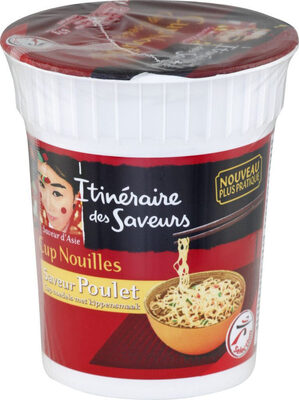
Saveur d'Asie - Cup Nouilles saveur poulet
Health
Nutrition
Nutrition label

Nutrition facts
| Nutrition facts | As sold for 100 g / 100 ml | Compared to: Chinese noodles |
|---|---|---|
| Energy | ~ 379.0597 kJ (91 kcal) | 965.067 kJ (234 kcal) (-61%) |
| Fat | 3.1429 g | 4.446 g (-29%) |
| Saturated fat | 1.5143 g | 1.41 g (+7%) |
| Carbohydrates | 13.1429 g | 38.721 g (-66%) |
| Sugars | 0.7429 g | 2.272 g (-67%) |
| Dietary fiber | ? | ? |
| Proteins | 2.3143 g | 6.784 g (-66%) |
| Salt | 5.8 g | 1.163 g (+399%) |
| Sodium | 2.32 g | 0.466 g (+398%) |
| Fruits, vegetables and legumes | ~ 1.30522824923196 % | ? |
Nutrition facts (Detailed data)
| Nutrition facts | As sold for 100 g / 100 ml | As sold Per 100 g (packaging) | As sold Per 100 g (estimate) |
|---|---|---|---|
| Energy | ~ 379.0597 kJ (91 kcal) | ? (91 kcal) | ? |
| Fat | 3.1429 g | 3.1429 g | ? |
| Saturated fat | 1.5143 g | 1.5143 g | ? |
| Carbohydrates | 13.1429 g | 13.1429 g | ? |
| Sugars | 0.7429 g | 0.7429 g | ? |
| Dietary fiber | ? | ? | ? |
| Proteins | 2.3143 g | 2.3143 g | ? |
| Salt | 5.8 g | 5.8 g | ? |
| Sodium | 2.32 g | 2.32 g | ? |
| Fruits, vegetables and legumes | ~ 1.30522824923196 % | ? | ~ 1.30522824923196 % |
Serving size
Ingredients
Ingredients image

Ingredients list
Ingredient information
Added sugars
Allergens
Traces
Ingredients analysis
Contains ingredients containing palm oil.
Vegan status unknown
Unrecognized: fr:arome-teriyaki, fr:extrait-de-levure-ignon-en-poudre, fr:proteines-hydrolysees-soja, fr:sp, fr:information
Vegetarian status unknown
Unrecognized: fr:arome-teriyaki, fr:extrait-de-levure-ignon-en-poudre, fr:proteines-hydrolysees-soja, fr:sp, fr:information
Food Processing
NOVA group
 Ultra-processed food and drink products
Elements that indicate the product is in NOVA group 4
How NOVA works
Additives
E150a - Plain caramel EFSA overexposure risk: noColour
Caramel color or caramel coloring is a water-soluble food coloring.
E160c - Paprika extractColour
No additive description is available yet.
E306 - Tocopherol-rich extract
No additive description is available yet.
E627 - Disodium guanylate
Disodium guanylate, also known as sodium 5'-guanylate and disodium 5'-guanylate, is a natural sodium salt of the flavor enhancing nucleotide guanosine monophosphate (GMP). Disodium guanylate is a food additive with the E number E627. It is commonly used in conjunction with glutamic acid. As it is a fairly expensive additive, it is not used independently of glutamic acid; if disodium guanylate is present in a list of ingredients but MSG does not appear to be, it is likely that glutamic acid is provided as part of another ingredient such as a processed soy protein complex. It is often added to foods in conjunction with disodium inosinate; the combination is known as disodium 5'-ribonucleotides. Disodium guanylate is produced from dried seaweed and is often added to instant noodles, potato chips and other snacks, savory rice, tinned vegetables, cured meats, and packaged soup.
Environment
Green-Score, origins bonus, and transportation impact are shown for Worldwide .
Green Score
Overall grade
 Moderate environmental impact
About Green-Score
Current scope
Life cycle analysis
Average impact of the category
 Asian noodles, flavoured, dehydrated • Score: 88/100
Life-cycle reference
Overall environmental impact by stage (PEF)
The overall environmental impact figure (PEF) comes from ADEME's Agribalyse database, for the category: Asian noodles, flavoured, dehydrated. Source: ADEME Agribalyse Database.
| Stage | Impact |
|---|---|
| Agriculture | 47.9 % |
| Processing | 24.5 % |
| Packaging | 19.1 % |
| Transportation | 6.5 % |
| Distribution | 2.3 % |
| Consumption | 0.0 % |
Bonuses and maluses
Declared origins
Threatened species risk
Packaging impact
Green-Score for this product
Green-Score for this product
Final score: 59/100Final score breakdown
Carbon footprint
Carbon footprint
Climate impact by stage (CO2e)
The carbon emission figure comes from ADEME's Agribalyse database, for the category: Asian noodles, flavoured, dehydrated. Source: ADEME Agribalyse Database.
| Stage | Impact |
|---|---|
| Agriculture | 42.6 % |
| Processing | 14.8 % |
| Packaging | 30.5 % |
| Transportation | 10.8 % |
| Distribution | 1.2 % |
| Consumption | 0.0 % |
Packaging

Packaging impact
Packaging materials
| Material | % | Packaging weight | Packaging weight per 100 g of product |
|---|---|---|---|
| Paper or cardboard | 95.19 % | 19.2 g | 29.54 g |
| Metal | 2.73 % | 0.55 g | 0.85 g |
| Plastic | 2.08 % | 0.42 g | 0.65 g |
| Total | 100 % | 20.17 g | 31.03 g |
Packaging components
| Shape | Material | Recycling | Impact |
|---|---|---|---|
| 1 Tumbler | Other Paper | Unknown | Low |
| 1 Seal | Other Paper | Unknown | Low |
| 1 BAG | PE 7 Polyethylene | Unknown | High |
| 1 BAG | Heavy Aluminium | Unknown | Medium |
| 1 Label | Paper | Unknown | Low |
Declared packaging
Transportation
Declared origins
Forest footprint
Forest footprint
Deforestation risk details
Data Source
Product data comes from Open Food Facts. Food Benchmark also adds translations, category comparisons and explanatory calculations.
The database is licensed under ODbL 1.0, individual contents under DbCL 1.0, and product photos under CC BY-SA 3.0.
Product added on December 29, 2017 at 1:31:50 PM UTC by openfoodfacts-contributors .
Last edit on March 17, 2026 at 9:32:21 AM UTC by new-nutrition-bot .
Product page also edited by bubucho, emmaly, foodvisor, kiliweb, navig491, new-nutrition-bot, openfoodfacts-contributors, org-les-mousquetaires, packbot, raphael0202, roboto-app, spotter, teolemon, yuka.ZFAwRkhJa3o5NlVvdGRzVm9rTFoydGRQM3JLMERYR3BjdWN4SVE9PQ, yuka.sY2b0xO6T85zoF3NwEKvllBrDf_vkB2bFwHuwk2139SXB5POO_tN3bLWbqo.
Source List
- les-mousquetaires