

2 Cheese burgers
Health
Nutrition
Nutri-Score
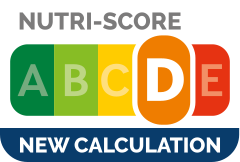 Lower nutritional quality
Nutri-Score data warning
Nutrient levels
Fat in moderate quantity (10%)
Saturated fat in moderate quantity (4.7%)
Sugars in low quantity (4.1%)
Salt in moderate quantity (1.4%)
Nutrition label
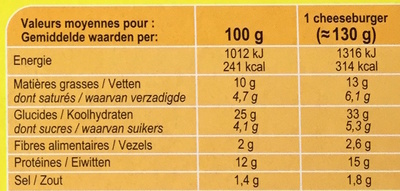
Nutrition facts
| Nutrition facts | As sold for 100 g / 100 ml | Compared to: Frozen snacks and starters |
|---|---|---|
| Energy | 1012 kJ (241 kcal) | 913.529 kJ (217 kcal) (+11%) |
| Fat | 10 g | 11.714 g (-15%) |
| Saturated fat | 4.7 g | 5.29 g (-11%) |
| Carbohydrates | 25 g | 17.848 g (+40%) |
| Sugars | 4.1 g | 3.041 g (+35%) |
| Dietary fiber | 2 g | ? |
| Proteins | 12 g | 8.183 g (+47%) |
| Salt | 1.4 g | 1.015 g (+38%) |
| Sodium | 0.56 g | 0.407 g (+38%) |
| Fruits, vegetables and legumes | ~ 3.125 % | ? |
Nutrition facts (Detailed data)
| Nutrition facts | As sold for 100 g / 100 ml | As sold Per 100 g (packaging) | As sold Per 100 g (estimate) |
|---|---|---|---|
| Energy | 1012 kJ (241 kcal) | 1012 kJ (241 kcal) | ? |
| Fat | 10 g | 10 g | ? |
| Saturated fat | 4.7 g | 4.7 g | ? |
| Carbohydrates | 25 g | 25 g | ? |
| Sugars | 4.1 g | 4.1 g | ? |
| Dietary fiber | 2 g | 2 g | ? |
| Proteins | 12 g | 12 g | ? |
| Salt | 1.4 g | 1.4 g | ? |
| Sodium | 0.56 g | 0.56 g | ? |
| Fruits, vegetables and legumes | ~ 3.125 % | ? | ~ 3.125 % |
Serving size
Ingredients
Ingredients image
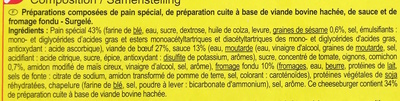
Ingredients list
Ingredient information
Added sugars
Allergens
Ingredients analysis
No ingredients containing palm oil.
Contains non-vegan ingredients.
Unrecognized: fr:mono-et-diglycerides-d-acides-gras-et-esters-monoacetyltartriques-et-diacetyltartriques-des-mono-et-diglycerides-d-acides-gras, fr:ce-cheeseburger-contient-34-de-preparation-cuite-a-base-de-viande-bovine-hachee
Contains non-vegetarian ingredients.
Unrecognized: fr:mono-et-diglycerides-d-acides-gras-et-esters-monoacetyltartriques-et-diacetyltartriques-des-mono-et-diglycerides-d-acides-gras, fr:ce-cheeseburger-contient-34-de-preparation-cuite-a-base-de-viande-bovine-hachee
Food Processing
NOVA group
 Ultra-processed food and drink products
Elements that indicate the product is in NOVA group 4
How NOVA works
Additives
E14XX - Modified StarchEmulsifierStabiliserThickener
No additive description is available yet.
E160 - Carotenoids
No additive description is available yet.
E224 - Potassium metabisulphite EFSA overexposure risk: highAntioxidantPreservative
POTASSIUM METABISULFITE, K2S2O5, also known as potassium pyrosulfite, is a white crystalline powder with a pungent sulfur odour. The main use for the chemical is as an antioxidant or chemical sterilant.
E300 - Ascorbic acidAntioxidantSequestrant
No additive description is available yet.
E330 - Citric acidAntioxidantSequestrant
Citric acid is a natural organic acid found in citrus fruits such as lemons, oranges, and limes.
It is widely used in the food industry as a flavor enhancer, acidulant, and preservative due to its tart and refreshing taste.
Citric acid is safe for consumption when used in moderation and is considered a generally recognized as safe (GRAS) food additive by regulatory agencies worldwide.
E331 - Sodium citratesEmulsifierSequestrantStabiliser
DISODIUM CITRATE, more properly, disodium hydrogen citrate, is an acid salt of citric acid with the chemical formula Na2C6H6O7. It is used as an antioxidant in food and to improve the effects of other antioxidants. It is also used as an acidity regulator and sequestrant. Typical products include gelatin, jam, sweets, ice cream, carbonated beverages, milk powder, wine, and processed cheeses.
E471 - Mono- and diglycerides of fatty acidsEmulsifierStabiliser
Mono- and diglycerides of fatty acids (E471), are food additives commonly used as emulsifiers in various processed foods.
These compounds consist of glycerol molecules linked to one or two fatty acid chains, which help stabilize and blend water and oil-based ingredients. E471 enhances the texture and shelf life of products like margarine, baked goods, and ice cream, ensuring a smooth and consistent texture.
It is generally considered safe for consumption within established regulatory limits.
E503 - Ammonium carbonates
AMMONIUM BICARBONATE is an inorganic compound with formula (NH4)HCO3, simplified to NH5CO3. Ammonium bicarbonate is used in the food industry as a raising agent for flat baked goods, such as cookies and crackers, and in China in steamed buns and Chinese almond cookies. It was commonly used in the home before modern day baking powder was made available.
E503ii - Ammonium hydrogen carbonate
No additive description is available yet.
Environment
Green-Score, origins bonus, and transportation impact are shown for Worldwide .
Green Score
Overall grade
 Very high environmental impact
About Green-Score
Current scope
Life cycle analysis
Average impact of the category
Cheeseburger, from fast foods restaurant • Score: 15/100Life-cycle reference
Overall environmental impact by stage (PEF)
The overall environmental impact figure (PEF) comes from ADEME's Agribalyse database, for the category: Cheeseburger, from fast foods restaurant. Source: ADEME Agribalyse Database.
| Stage | Impact |
|---|---|
| Agriculture | 90.6 % |
| Processing | 3.1 % |
| Packaging | 2.4 % |
| Transportation | 1.3 % |
| Distribution | 0.5 % |
| Consumption | 2.0 % |
Bonuses and maluses
Origins of ingredients
Packaging impact
Green-Score for this product
Green-Score for this product
Final score: 18/100Final score breakdown
Carbon footprint
Carbon footprint
Climate impact by stage (CO2e)
The carbon emission figure comes from ADEME's Agribalyse database, for the category: Cheeseburger, from fast foods restaurant. Source: ADEME Agribalyse Database.
| Stage | Impact |
|---|---|
| Agriculture | 92.6 % |
| Processing | 1.7 % |
| Packaging | 3.6 % |
| Transportation | 1.6 % |
| Distribution | 0.2 % |
| Consumption | 0.5 % |
Packaging
Packaging impact
Packaging components
| Shape | Material | Recycling | Impact |
|---|---|---|---|
| Unknown | Cardboard | Unknown | Low |
Declared packaging
Data precision
Transportation
Manufacturing locations
Origins of ingredients
Origins breakdown
| Origin | Percent of ingredients | Impact |
|---|---|---|
| France | 100 % | Medium |
Forest footprint
Forest footprint
Deforestation risk details
Additional information
- Preparation
- Au four à micro-ondes : Sans décongélation préalable, sortez le cheeseburger de sa boîte et retirez son sachet. Placez le cheeseburger au centre du micro-ondes dans une assiette adaptée. Faites réchauffer le produit selon la puissance de votre four : 1min30 pour 650 W, 1min20 pour 850 W, 1min10 pour 1000 W. Le cheeseburger peut être très chaud à la sortie du four à micro-ondes, laissez-le reposer 1 min avant de le consommer pour éviter de vous brûler. Ces temps restent indicatifs, ils peuvent varier en fonction des caractéristiques de votre micro-ondes et sont à ajuster selon votre propre expérience. Au four traditionnel : Sans décongélation préalable et sans préchauffage du four, sortez le cheeseburger de son film et enlevez le demi pain du dessus. Faites réchauffer 25 min environ à 150°C (Th. 5/6). Ajoutez le demi pain du dessus 3 minutes avant la fin de la cuisson.
- Warnings
- ATTENTION, NE PAS RECONGELER APRÈS DÉCONGÉLATION.
- Conservation conditions
- À conserver dans un congélateur*** à -18°C et à consommer de préférence avant la date indiquée sur le côté de l'étui.
- Customer service
- Interdis - TSA 91431 - 91343 MASSY Cedex - France
Data Source
Product data comes from Open Food Facts. Food Benchmark also adds translations, category comparisons and explanatory calculations.
The database is licensed under ODbL 1.0, individual contents under DbCL 1.0, and product photos under CC BY-SA 3.0.
Product added on May 29, 2015 at 12:03:27 PM UTC by tacite .
Last edit on March 17, 2026 at 9:17:11 AM UTC by new-nutrition-bot .
Product page also edited by cupcakes, ecoscore-impact-estimator, new-nutrition-bot, org-carrefour, packbot, ramyprime, roboto-app, shiroken54, tacite, teolemon, yuka.FqthPN25AdUnQcP9z48dwB2xLd7lCth0CGcToQ.
Source List
- carrefour