

Rollmops
Health
Nutrition
Nutri-Score
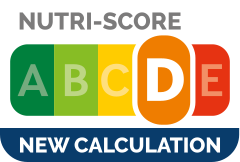 Lower nutritional quality
Nutri-Score data warning
Nutrient levels
Fat in moderate quantity (10%)
Saturated fat in moderate quantity (2.5%)
Sugars in low quantity (2.2%)
Salt in high quantity (2.3%)
Nutrition label

Nutrition facts
| Nutrition facts | As sold for 100 g / 100 ml | Compared to: Rollmops |
|---|---|---|
| Energy | 577 kJ (139 kcal) | 587.432 kJ (142 kcal) (-2%) |
| Fat | 10 g | 9.247 g (+8%) |
| Saturated fat | 2.5 g | 2.292 g (+9%) |
| Carbohydrates | 2.8 g | 2.362 g (+19%) |
| Sugars | 2.2 g | 1.295 g (+70%) |
| Added sugars | 0 g | 0.913 g (-100%) |
| Starch | 0 g | 0.051 g (-100%) |
| Dietary fiber | 0 g | ? |
| Proteins | 9 g | 11.518 g (-22%) |
| Salt | 2.3 g | 2.495 g (-8%) |
| Sodium | 0.92 g | 0.999 g (-8%) |
| Vitamin A | 0 g | 17.24 µg (-100%) |
| Vitamin E | 0 g | 0.565 mg (-100%) |
| Vitamin K | 0 g | ? |
| Vitamin C | 0 g | ? |
| Phosphorus | 0 g | 111.246 mg (-100%) |
| Iron | 0 g | 0.612 mg (-100%) |
| Magnesium | 0 g | 14.341 mg (-100%) |
| Zinc | 0 g | 0.39 mg (-100%) |
| Copper | 0 g | 0.077 mg (-100%) |
| Manganese | 0 g | 0.039 mg (-100%) |
| Selenium | 0 g | 14.775 µg (-100%) |
| Caffeine | 0 g | ? |
| Fruits, vegetables and legumes | ~ 14.1833333333333 % | ? |
| Choline | 0 g | ? |
Nutrition facts (Detailed data)
| Nutrition facts | As sold for 100 g / 100 ml | As sold Per 100 g (packaging) | As sold Per 100 g (estimate) |
|---|---|---|---|
| Energy | 577 kJ (139 kcal) | 577 kJ (139 kcal) | ? |
| Fat | 10 g | 10 g | ? |
| Saturated fat | 2.5 g | 2.5 g | ? |
| Carbohydrates | 2.8 g | 2.8 g | ? |
| Sugars | 2.2 g | 2.2 g | ? |
| Added sugars | 0 g | 0 g | ~ 1.1 g |
| Starch | 0 g | 0 g | ? |
| Dietary fiber | 0 g | 0 g | ? |
| Proteins | 9 g | 9 g | ? |
| Salt | 2.3 g | 2.3 g | ? |
| Sodium | 0.92 g | 0.92 g | ? |
| Vitamin A | 0 g | 0 g | ? |
| Vitamin E | 0 g | 0 g | ? |
| Vitamin K | 0 g | 0 g | ? |
| Vitamin C | 0 g | 0 g | ? |
| Phosphorus | 0 g | 0 g | ? |
| Iron | 0 g | 0 g | ? |
| Magnesium | 0 g | 0 g | ? |
| Zinc | 0 g | 0 g | ? |
| Copper | 0 g | 0 g | ? |
| Manganese | 0 g | 0 g | ? |
| Selenium | 0 g | 0 g | ? |
| Caffeine | 0 g | 0 g | ? |
| Fruits, vegetables and legumes | ~ 14.1833333333333 % | ? | ~ 14.1833333333333 % |
| Choline | 0 g | 0 g | ? |
Ingredients
Ingredients image
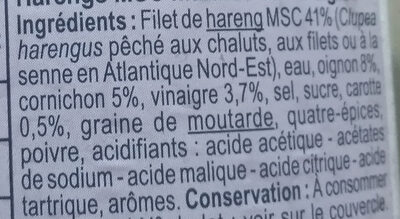
Ingredients list
Ingredient information
Added sugars
Allergens
Traces
Ingredients analysis
No ingredients containing palm oil.
Unrecognized: fr:clupea-harengus-peche-aux-chaluts-et-filets-tournants-et-filets-souleves-en-atlantique-nord-est, fr:quatre-epices
Contains non-vegan ingredients.
Unrecognized: fr:clupea-harengus-peche-aux-chaluts-et-filets-tournants-et-filets-souleves-en-atlantique-nord-est, fr:quatre-epices
Contains non-vegetarian ingredients.
Unrecognized: fr:clupea-harengus-peche-aux-chaluts-et-filets-tournants-et-filets-souleves-en-atlantique-nord-est, fr:quatre-epices
Food Processing
NOVA group
 Ultra-processed food and drink products
Elements that indicate the product is in NOVA group 4
How NOVA works
Additives
E260 - Acetic acidPreservative
ACETIC ACID, systematically named ethanoic acid, is a colourless liquid organic compound with the chemical formula CH3COOH (also written as CH3CO2H or C2H4O2).
E262 - Sodium acetatesPreservativeSequestrant
SODIUM ACETATE, also abbreviated NaOAc,[8] is the sodium salt of acetic acid.
E296 - Malic acid
MALIC ACID is an organic compound with the molecular formula C4H6O5. Malic acid has two stereoisomeric forms (L- and D-enantiomers), though only the L-isomer exists naturally.
E330 - Citric acidAntioxidantSequestrant
Citric acid is a natural organic acid found in citrus fruits such as lemons, oranges, and limes.
It is widely used in the food industry as a flavor enhancer, acidulant, and preservative due to its tart and refreshing taste.
Citric acid is safe for consumption when used in moderation and is considered a generally recognized as safe (GRAS) food additive by regulatory agencies worldwide.
E334 - L(+)-tartaric acidAntioxidantSequestrant
TARTARIC ACID is a white, crystalline organic acid that occurs naturally in many fruits, most notably in grapes, but also in bananas, tamarinds, and citrus
Environment
Green-Score, origins bonus, and transportation impact are shown for Worldwide .
Green Score
Overall grade
 Low environmental impact
About Green-Score
Current scope
Life cycle analysis
Average impact of the category
Atlantic herring, marinated, or rollmops • Score: 65/100Life-cycle reference
Overall environmental impact by stage (PEF)
The overall environmental impact figure (PEF) comes from ADEME's Agribalyse database, for the category: Atlantic herring, marinated, or rollmops. Source: ADEME Agribalyse Database.
| Stage | Impact |
|---|---|
| Agriculture | 52.1 % |
| Processing | 0.0 % |
| Packaging | 23.6 % |
| Transportation | 21.1 % |
| Distribution | 2.5 % |
| Consumption | 0.7 % |
Bonuses and maluses
Production system
Declared origins
Packaging impact
Green-Score for this product
Green-Score for this product
Final score: 71/100Final score breakdown
Carbon footprint
Carbon footprint
Climate impact by stage (CO2e)
The carbon emission figure comes from ADEME's Agribalyse database, for the category: Atlantic herring, marinated, or rollmops. Source: ADEME Agribalyse Database.
| Stage | Impact |
|---|---|
| Agriculture | 42.4 % |
| Processing | 0.0 % |
| Packaging | 20.1 % |
| Transportation | 35.5 % |
| Distribution | 1.5 % |
| Consumption | 0.2 % |
Packaging
Packaging impact
Packaging components
| Shape | Material | Recycling | Impact |
|---|---|---|---|
| JAR | Glass | Recycle IN Glass BIN | Low |
| LID | Metal | Recycle IN Sorting BIN | High |
Declared packaging
Data precision
Transportation
Manufacturing locations
Declared origins
Forest footprint
Forest footprint
Deforestation risk details
Additional information
- Other information
- Poids net égoutté 200g logo MSC logo pêche durable MSC + www.msc.org/fr + MSC-C-51134. Ce produit est conforme au référentiel mondial du MSC pour la pêche durable. www.msc.org/fr Marinade Vinaigrée
- Preparation
- Déroulez les rollmops avec le cornichon en ajoutant de la salade ou des pommes de terres.
- Warnings
- Enlever le clip rouge avant consommation.
- Conservation conditions
- À consommer jusqu'au / N° de lot : voir sur le couvercle. À CONSERVER AVANT ET APRES OUVERTURE ENTRE 0°C ET +4°C. À consommer rapidement après ouverture.
- Customer service
- Interdis - TSA 91431 - 91343 MASSY Cedex - France
Data Source
Product data comes from Open Food Facts. Food Benchmark also adds translations, category comparisons and explanatory calculations.
The database is licensed under ODbL 1.0, individual contents under DbCL 1.0, and product photos under CC BY-SA 3.0.
Product added on November 11, 2013 at 9:25:36 PM UTC by hommedanslalune .
Last edit on March 17, 2026 at 11:49:48 PM UTC by new-nutrition-bot .
Product page also edited by carrefour, driveoff, foodless, hommedanslalune, kgrap, kiliweb, morganesh, municorn-calorie-counter-app, new-nutrition-bot, org-carrefour, packbot, quechoisir, roboto-app, sebleouf, segundo, thar75, theo18, yuka.Wm9FaE80NDh1c1VKa01BaTl4RHRxdnhRNTdiNGIwMnJMZkV2SVE9PQ.
Source List
- Carrefour
- carrefour