ProductsTanoshiRamen saveur poulet teriyaki
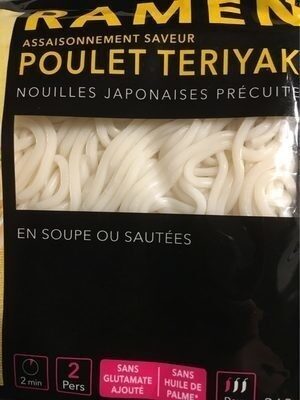
Ramen saveur poulet teriyaki
Barcode 3229820794723
Tanoshi

Ramen saveur poulet teriyaki

360g
BARCODE:3229820794723
CATEGORIES:Plant Based Foods And Beverages, Plant Based Foods, Cereals And Potatoes, Cereals And Their Products, Pastas, Noodles
LABELS:No Added Msg, Triman, Tanoshi
PACKAGING:Bag
ORIGIN:Farine De Ble Origine Non Ue, Nouilles Japonaises Precuites Fabriquees En Chine
MANUFACTURING:Corée du Sud
COUNTRIES:France
STORES:carrefour.fr

Health

Nutrition

Nutri-Score

CAverage nutritional quality

Nutri-Score data warning

Warning: the amount of fruits, vegetables and nuts is not specified on the label, it was estimated from the list of ingredients: 0

Nutrient levels

Fat in low quantity (0.5%)
What you need to know • A high consumption of fat, especially saturated fats, can raise cholesterol, which increases the risk of heart diseases. Recommendation: Limit the consumption of fat and saturated fat • Choose products with lower fat and saturated fat content. Source: National Health Service UK (NHS) - Fat: the facts
Saturated fat in low quantity (0.1%)
What you need to know • A high consumption of fat, especially saturated fats, can raise cholesterol, which increases the risk of heart diseases. Recommendation: Limit the consumption of fat and saturated fat • Choose products with lower fat and saturated fat content. Source: National Health Service UK (NHS) - Fat: the facts
Sugars in low quantity (0.5%)
What you need to know • A high consumption of sugar can cause weight gain and tooth decay. It also augments the risk of type 2 diabetes and cardio-vascular diseases. Recommendation: Limit the consumption of sugar and sugary drinks • Sugary drinks (such as sodas, fruit beverages, and fruit juices and nectars) should be limited as much as possible (no more than 1 glass a day). • Choose products with lower sugar content and reduce the consumption of products with added sugars. Source: National Health Service UK (NHS) - Sugar: the facts
Salt in moderate quantity (0.75%)
What you need to know • A high consumption of salt (or sodium) can cause raised blood pressure, which can increase the risk of heart disease and stroke. • Many people who have high blood pressure do not know it, as there are often no symptoms. • Most people consume too much salt (on average 9 to 12 grams per day), around twice the recommended maximum level of intake. Recommendation: Limit the consumption of salt and salted food • Reduce the quantity of salt used when cooking, and don't salt again at the table. • Limit the consumption of salty snacks and choose products with lower salt content. Source: World Health Organization (WHO) - Fact sheet - Salt reduction Source: National Health Service UK (NHS) - Salt: the facts

Nutrition label

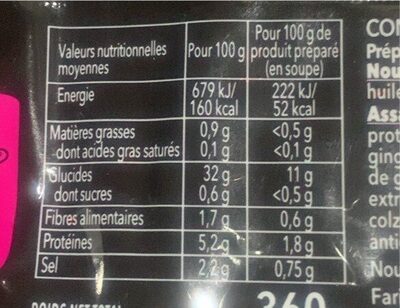
Ramen saveur poulet teriyaki nutrition label

Nutrition facts

Nutrition factsAs sold for 100 g / 100 mlCompared to: Noodles
Energy~ 240.9 kJ (52 kcal)1,223.644 kJ (292 kcal) (-80%)
Fat0.5 g5.878 g (-91%)
Saturated fat0.1 g2.251 g (-96%)
Carbohydrates11 g49.016 g (-78%)
Sugars0.5 g2.242 g (-78%)
Dietary fiber0.6 g?
Proteins1.8 g7.852 g (-77%)
Salt0.75 g1.325 g (-43%)
Sodium0.3 g0.532 g (-44%)
Fruits, vegetables and legumes~ 0.046875 %?

Nutrition facts (Detailed data)

Nutrition factsAs sold for 100 g / 100 mlAs sold Per 100 g (packaging)As sold Per 100 g (estimate)
Energy~ 240.9 kJ (52 kcal)? (52 kcal)?
Fat0.5 g0.5 g?
Saturated fat0.1 g0.1 g?
Carbohydrates11 g11 g?
Sugars0.5 g0.5 g?
Dietary fiber0.6 g0.6 g?
Proteins1.8 g1.8 g?
Salt0.75 g0.75 g?
Sodium0.3 g0.3 g?
Fruits, vegetables and legumes~ 0.046875 %?~ 0.046875 %

Serving size

170g

Ingredients

Ingredients image

Ramen saveur poulet teriyaki ingredients image

Ingredients list

precooked japanese noodles: wheat flour 63%, water, tapioca starch, wheat gluten, salt, rapeseed oil, emulsifiers: sorbitol syrup, lecithins (soy), mono - and diglycerides of fatty acids, acidity regulators: acetic acid, gluconodelta-lactone, malic acid, sodium malates, lactic acid, sodium lactate, noodle origin china, wheat flour non-eu origin

Ingredient information

Nouilles Japonaises Precuites
95.75% (estimate)
Wheat Flour
61.0%
Water
19.92% (estimate)
E1420
7.42% (estimate)
Wheat Gluten
3.71% (estimate)
Salt
0.38% (estimate)
Soya Oil
0.38% (estimate)
Acidity Regulator
2.96% (estimate)
E270
0.38% (estimate)
E500
2.58% (estimate)
Assaisonnement Saveur Poulet Teryaki
4.25% (estimate)
Sugar
0.25% (estimate)
Salt
0.25% (estimate)
Corn Maltodextrin
0.25% (estimate)
Corn Starch
0.25% (estimate)
Hydrolysed Soy Protein
0.25% (estimate)
Yeast Extract
0.25% (estimate)
Spice
0.25% (estimate)
Black Pepper
0.13% (estimate)
White Pepper
0.06% (estimate)
Garlic
0.03% (estimate)
Ginger
0.03% (estimate)
Soy Sauce
0.25% (estimate)
Salt
0.13% (estimate)
Sugar
0.06% (estimate)
Corn Maltodextrin
0.03% (estimate)
Soya Bean
0.02% (estimate)
Flavour Enhancer
0.02% (estimate)
E635
0.02% (estimate)
Flavour Enhancer
0.25% (estimate)
E635
0.25% (estimate)
Wheat Malt
0.25% (estimate)
Colour
0.25% (estimate)
E160c
0.25% (estimate)
Arome Saveur Poulet
0.25% (estimate)
Colza Oil
0.25% (estimate)
Anti Caking Agent
0.25% (estimate)
E500
0.25% (estimate)
Acidity Regulator
0.25% (estimate)
E330
0.25% (estimate)
Antioxidant
0.25% (estimate)
E325
0.25% (estimate)
White Sesame Seeds
0.25% (estimate)

Added sugars

Contains added sugars (12%) Added sugars: sugar Quantity of added sugars: 12%

Allergens

GlutenSesame SeedsSoybeans

Ingredients analysis

Palm oil free
Yes

No ingredients containing palm oil.

Vegan
Unknown

Vegan status unknown

Unrecognized: fr:arome-saveur-poulet

Vegetarian
Unknown

Vegetarian status unknown

Unrecognized: fr:arome-saveur-poulet


Food Processing

NOVA group

4Ultra-processed food and drink products

Elements that indicate the product is in NOVA group 4

Additives
E160c - Paprika extract
Additives
E325 - sodium lactate
Additives
E635 - Disodium 5'-ribonucleotide
Ingredients
Colour
Ingredients
Flavour Enhancer
Ingredients
Gluten
Ingredients
Maltodextrin

How NOVA works

The NOVA classification assigns food products into 4 groups based on their degree of processing: 1. Unprocessed or minimally processed foods 2. Processed culinary ingredients 3. Processed foods 4. Ultra-processed food and drink products

Additives

E1421 - Acetylated starchEmulsifierStabiliserThickener

No additive description is available yet.

E160c - Paprika extractColour

No additive description is available yet.

E270 - Lactic acid

LACTIC ACID is an organic compound with the formula CH3CH(OH)CO2H. In the form of its conjugate base called lactate (this is thus different and kept as a separate ingredient). Lactic acid is chiral, consisting of two optical isomers. One is known as L-(+)-lactic acid or (S)-lactic acid and the other, its mirror image, is D-(−)-lactic acid or (R)-lactic acid in food the L-variant is used

E325 - sodium lactateAntioxidantEmulsifierHumectantThickener

SODIUM LACTATE is the sodium salt of lactic acid, and has a mild saline taste. It is produced by fermentation of a sugar source, such as corn or beets. It acts as a preservative, acidity regulator, and bulking agent.

E330 - Citric acidAntioxidantSequestrant

Citric acid is a natural organic acid found in citrus fruits such as lemons, oranges, and limes.

It is widely used in the food industry as a flavor enhancer, acidulant, and preservative due to its tart and refreshing taste.

Citric acid is safe for consumption when used in moderation and is considered a generally recognized as safe (GRAS) food additive by regulatory agencies worldwide.

E500 - Sodium carbonatesStabiliserThickener

Sodium carbonates (E500) are compounds commonly used in food preparation as leavening agents, helping baked goods rise by releasing carbon dioxide when they interact with acids.

Often found in baking soda, they regulate the pH of food, preventing it from becoming too acidic or too alkaline. In the culinary world, sodium carbonates can also enhance the texture and structure of foods, such as noodles, by modifying the gluten network.

Generally recognized as safe, sodium carbonates are non-toxic when consumed in typical amounts found in food.

E635 - Disodium 5'-ribonucleotide

No additive description is available yet.

Environment

Green-Score, origins bonus, and transportation impact are shown for Worldwide .

Green Score

Overall grade

UnknownUnknown environmental impact

About Green-Score

The Green-Score is an experimental score that summarizes the environmental impacts of food products.

Current scope

The Green-Score was initially developed for France and it is being extended to other European countries. The Green-Score formula is subject to change as it is regularly improved to make it more precise and better suited to each country. Select a country to include the full impact of transportation in the final score.

Green-Score availability

We could not compute the Green-Score of this product because some data is missing. A more precise category, ingredients list, origins or packaging data can unlock the computation.

Bonuses and maluses

Declared origins

Origins of ingredients are missing for this product. Ingredients need to be completed before the transportation bonus can be computed precisely.

Packaging impact

Packaging with a high impact Malus: -15 Packaging score: -200

Packaging

Ramen saveur poulet teriyaki packaging image

Packaging impact

Packaging with a high impact Malus: -15 Packaging score: -200

Packaging materials

Material%Packaging weightPackaging weight per 100 g of product
Plastic100 %13.27 g3.69 g
Total100 %13.27 g3.69 g

Packaging components

ShapeMaterialRecyclingImpact
1 BAG (360g)PlasticRecycle IN Sorting BINHigh
2 Individual BAG (180g)PlasticRecycle IN Sorting BINHigh

Declared packaging

Bag

Transportation

Manufacturing locations

Corée du Sud

Declared origins

Origins of ingredients are missing for this product. Ingredients need to be completed before the transportation bonus can be computed precisely.

Forest footprint

Forest footprint

Forest Footprint not computed Potential deforestation risk but not yet computed. Forest Footprint The Forest Footprint is a methodology developed by the association Envol Vert to estimate the risk of deforestation related to our consumption. → More information on the methodology Forest Footprint not computed Potential deforestation risk but not yet computed.

Deforestation risk details

Other risky ingredients These ingredients are not yet assessed for deforestation risk: soya bean

Data Source

Product data comes from Open Food Facts. Food Benchmark also adds translations, category comparisons and explanatory calculations.

The database is licensed under ODbL 1.0, individual contents under DbCL 1.0, and product photos under CC BY-SA 3.0.

Product added on October 2, 2017 at 6:20:43 PM UTC by kiliweb .

Last edit on March 17, 2026 at 11:29:09 PM UTC by new-nutrition-bot .

Product page also edited by anmoron, baboubis, driveoff, ferodoh, fgo, foodless, foodvisor, gwen0, hikitsune, inf, jusdekiwi, kiliweb, liloumangedesdorayaki, new-nutrition-bot, nicklatric, openfoodfacts-contributors, packbot, quechoisir, rapa93, roboto-app, tom60chat, wrjf, yuka.WGF4YkRMMGloZEJXdmMxdTRUM3V4NHQ1MjZHU2ZWNk5EZE1OSWc9PQ, yuka.sY2b0xO6T85zoF3NwEKvlh1kSf7zjSPFKjXRmHSFyoihdJW3SIF16aijCKs, yuka.sY2b0xO6T85zoF3NwEKvlhUbWYXa8yz0Hg7UlWeE6sjRIbzDbNpj2aHYKKs, yuka.sY2b0xO6T85zoF3NwEKvlmUYdNWB_jLJPRjRx3Cn7463BZHKSs1N0qLebqo, yuka.sY2b0xO6T85zoF3NwEKvlndNcIHM_mL8Dyf4pxeG4Y2rMq60S9JI0KvTY6o.