
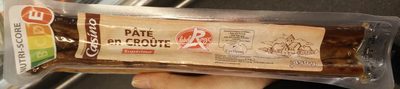
Pâté en croûte supérieur Label Rouge
Health
Nutrition
Nutri-Score
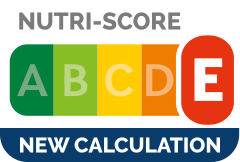 Lower nutritional quality
Nutri-Score data warning
Nutrient levels
Fat in moderate quantity (17%)
Saturated fat in high quantity (9.1%)
Sugars in low quantity (0.7%)
Salt in high quantity (1.7%)
Nutrition label
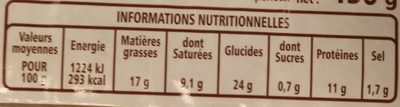
Nutrition facts
| Nutrition facts | As sold for 100 g / 100 ml | Compared to: Pâté in crust |
|---|---|---|
| Energy | 1224 kJ (293 kcal) | 1,174.771 kJ (282 kcal) (+4%) |
| Fat | 17 g | 17.971 g (-5%) |
| Saturated fat | 9.1 g | 7.587 g (+20%) |
| Carbohydrates | 24 g | 18.288 g (+31%) |
| Sugars | 0.7 g | 1.174 g (-40%) |
| Dietary fiber | ? | ? |
| Proteins | 11 g | 11.372 g (-3%) |
| Salt | 1.7 g | 1.756 g (-3%) |
| Sodium | 0.68 g | 0.703 g (-3%) |
| Fruits, vegetables and legumes | ~ 0.85 % | ? |
Nutrition facts (Detailed data)
| Nutrition facts | As sold for 100 g / 100 ml | As sold Per 100 g (packaging) | As sold Per 100 g (estimate) |
|---|---|---|---|
| Energy | 1224 kJ (293 kcal) | 1224 kJ (293 kcal) | ? |
| Fat | 17 g | 17 g | ? |
| Saturated fat | 9.1 g | 9.1 g | ? |
| Carbohydrates | 24 g | 24 g | ? |
| Sugars | 0.7 g | 0.7 g | ? |
| Dietary fiber | ? | ? | ? |
| Proteins | 11 g | 11 g | ? |
| Salt | 1.7 g | 1.7 g | ? |
| Sodium | 0.68 g | 0.68 g | ? |
| Fruits, vegetables and legumes | ~ 0.85 % | ? | ~ 0.85 % |
Ingredients
Ingredients image

Ingredients list
Ingredient information
Added sugars
Allergens
Traces
Ingredients analysis
No ingredients containing palm oil.
Contains non-vegan ingredients.
Contains non-vegetarian ingredients.
Food Processing
NOVA group
 Ultra-processed food and drink products
Elements that indicate the product is in NOVA group 4
How NOVA works
Additives
E150a - Plain caramel EFSA overexposure risk: noColour
Caramel color or caramel coloring is a water-soluble food coloring.
E250 - Sodium nitrite EFSA overexposure risk: highPreservative
Sodium nitrite (E250) is a salt used for curing and preserving meat products.
It plays a critical role in preventing the growth of Clostridium botulinum, the bacterium responsible for botulism, in cured meats like bacon, ham, and sausages. It also provides the characteristic pink color and flavor.
However, nitrites can react with amines in the stomach to form nitrosamines, which are potent carcinogens. High intake of processed meats containing nitrites is associated with an increased risk of colorectal cancer. Regulatory bodies have set strict limits on its use in food.
E301 - Sodium ascorbateAntioxidant
SODIUM ASCORBATE is one of a number of mineral salts of ascorbic acid (vitamin C).
E330 - Citric acidAntioxidantSequestrant
Citric acid is a natural organic acid found in citrus fruits such as lemons, oranges, and limes.
It is widely used in the food industry as a flavor enhancer, acidulant, and preservative due to its tart and refreshing taste.
Citric acid is safe for consumption when used in moderation and is considered a generally recognized as safe (GRAS) food additive by regulatory agencies worldwide.
E407 - Carrageenan EFSA overexposure risk: highCarrierEmulsifierHumectantStabiliserThickener
Carrageenan (E407), derived from red seaweed, is widely employed in the food industry as a gelling, thickening, and stabilizing agent, notably in dairy and meat products.
It can exist in various forms, each imparting distinct textural properties to food.
However, its degraded form, often referred to as poligeenan, has raised health concerns due to its potential inflammatory effects and its classification as a possible human carcinogen (Group 2B) by the International Agency for Research on Cancer (IARC).
Nevertheless, food-grade carrageenan has been deemed safe by various regulatory bodies when consumed in amounts typically found in food.
E428 - Gelatine
No additive description is available yet.
Environment
Green-Score, origins bonus, and transportation impact are shown for Worldwide .
Green Score
Overall grade
 Very high environmental impact
About Green-Score
Current scope
Life cycle analysis
Average impact of the category
Pâté in crust • Score: 23/100Life-cycle reference
Overall environmental impact by stage (PEF)
The overall environmental impact figure (PEF) comes from ADEME's Agribalyse database, for the category: Pâté in crust. Source: ADEME Agribalyse Database.
| Stage | Impact |
|---|---|
| Agriculture | 89.6 % |
| Processing | 2.5 % |
| Packaging | 5.9 % |
| Transportation | 1.6 % |
| Distribution | 0.4 % |
| Consumption | 0.2 % |
Bonuses and maluses
Declared origins
Packaging impact
Green-Score for this product
Green-Score for this product
Final score: 17/100Final score breakdown
Carbon footprint
Carbon footprint
Climate impact by stage (CO2e)
The carbon emission figure comes from ADEME's Agribalyse database, for the category: Pâté in crust. Source: ADEME Agribalyse Database.
| Stage | Impact |
|---|---|
| Agriculture | 87.2 % |
| Processing | 1.6 % |
| Packaging | 8.6 % |
| Transportation | 2.4 % |
| Distribution | 0.2 % |
| Consumption | 0.1 % |
Packaging
Packaging impact
Packaging components
| Shape | Material | Recycling | Impact |
|---|---|---|---|
| Film | Plastic | Unknown | High |
Declared packaging
Transportation
Manufacturing locations
Declared origins
Forest footprint
Forest footprint
Ingredients linked to forest pressure
| Ingredient | Type | Percent in product | Forest footprint |
|---|---|---|---|
| EGG White | Oeufs Label Rouge issus de poules nourries sans OGM | 0.85 % | 0.00 |
Additional information
- Other information
- Label Rouge.
- Conservation conditions
- A conserver entre 0 et +4°C - A conserver entre 0 et +4°C et à consommer rapidement
- Disposal instructions
- Film plastique
Data Source
Product data comes from Open Food Facts. Food Benchmark also adds translations, category comparisons and explanatory calculations.
The database is licensed under ODbL 1.0, individual contents under DbCL 1.0, and product photos under CC BY-SA 3.0.
Product added on September 29, 2016 at 2:58:39 PM UTC by tacinte .
Last edit on March 17, 2026 at 10:37:57 PM UTC by new-nutrition-bot .
Product page also edited by bcatelin, casino, casino-off, new-nutrition-bot, packbot, roboto-app, segundo, tacinte, tacite, teolemon.
Source List
- Casino
- casino