
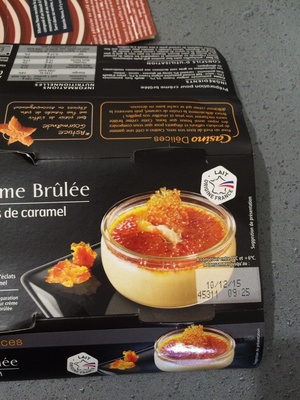
Crème brûlée
Health
Nutrition
Nutri-Score
 Lower nutritional quality
Nutrient levels
Fat in high quantity (22%)
Saturated fat in high quantity (14%)
Sugars in high quantity (16%)
Salt in low quantity (0.12%)
Nutrition label
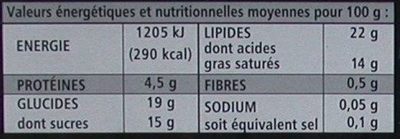
Nutrition facts
| Nutrition facts | As sold for 100 g / 100 ml | Compared to: Crème brûlée |
|---|---|---|
| Energy | 1190 kJ (286 kcal) | 1,027.283 kJ (246 kcal) (+16%) |
| Fat | 22 g | 16.428 g (+34%) |
| Saturated fat | 14 g | 10.256 g (+37%) |
| Carbohydrates | 18 g | 18.778 g (-4%) |
| Sugars | 16 g | 17.079 g (-6%) |
| Dietary fiber | 0 g | ? |
| Proteins | 4.1 g | 4.137 g (-1%) |
| Salt | 0.12 g | 0.114 g (+5%) |
| Sodium | 0.048 g | 0.045 g (+7%) |
| Fruits, vegetables and legumes | ~ 0 % | ? |
Nutrition facts (Detailed data)
| Nutrition facts | As sold for 100 g / 100 ml | As sold Per 100 g (packaging) | As sold Per 100 g (estimate) |
|---|---|---|---|
| Energy | 1190 kJ (286 kcal) | 1190 kJ (286 kcal) | ~ 964.252 kJ (231 kcal) |
| Fat | 22 g | 22 g | ~ 17.03292 g |
| Saturated fat | 14 g | 14 g | ~ 10.62055 g |
| Carbohydrates | 18 g | 18 g | ~ 13.53182 g |
| Sugars | 16 g | 16 g | ~ 13.44691 g |
| Dietary fiber | 0 g | 0 g | ~ 0.76867 g |
| Proteins | 4.1 g | 4.1 g | ~ 4.45922 g |
| Salt | 0.12 g | 0.12 g | ~ 0.1028356 g |
| Sodium | 0.048 g | 0.048 g | ~ 0.04099878 g |
| Fruits, vegetables and legumes | ~ 0 % | ? | ~ 0 % |
Serving size
Ingredients
Ingredients image

Ingredients list
Ingredient information
Added sugars
Allergens
Ingredients analysis
No ingredients containing palm oil.
Contains non-vegan ingredients.
No non-vegetarian ingredients.
Food Processing
NOVA group
 Ultra-processed food and drink products
Elements that indicate the product is in NOVA group 4
How NOVA works
Additives
Environment
Green-Score, origins bonus, and transportation impact are shown for Worldwide .
Green Score
Overall grade
 Very low environmental impact
About Green-Score
Current scope
Life cycle analysis
Average impact of the category
Caramelized custard cream (crème brûlée), refrigerated • Score: 83/100Life-cycle reference
Overall environmental impact by stage (PEF)
The overall environmental impact figure (PEF) comes from ADEME's Agribalyse database, for the category: Caramelized custard cream (crème brûlée), refrigerated. Source: ADEME Agribalyse Database.
| Stage | Impact |
|---|---|
| Agriculture | 56.9 % |
| Processing | 17.3 % |
| Packaging | 13.5 % |
| Transportation | 7.6 % |
| Distribution | 3.8 % |
| Consumption | 1.0 % |
Bonuses and maluses
Origins of ingredients
Packaging impact
Green-Score for this product
Green-Score for this product
Final score: 84/100Final score breakdown
Carbon footprint
Carbon footprint
Climate impact by stage (CO2e)
The carbon emission figure comes from ADEME's Agribalyse database, for the category: Caramelized custard cream (crème brûlée), refrigerated. Source: ADEME Agribalyse Database.
| Stage | Impact |
|---|---|
| Agriculture | 55.5 % |
| Processing | 10.3 % |
| Packaging | 20.3 % |
| Transportation | 11.9 % |
| Distribution | 1.9 % |
| Consumption | 0.3 % |
Packaging
Packaging impact
Packaging components
| Shape | Material | Recycling | Impact |
|---|---|---|---|
| POT | Cardboard | Unknown | Low |
| Unknown | Glass | Unknown | Low |
Declared packaging
Data precision
Transportation
Manufacturing locations
Origins of ingredients
Origins breakdown
| Origin | Percent of ingredients | Impact |
|---|---|---|
| France | 100 % | Medium |
Forest footprint
Forest footprint
Ingredients linked to forest pressure
| Ingredient | Type | Percent in product | Forest footprint |
|---|---|---|---|
| EGG | Oeufs standards | 14.60 % | 0.01 |
| EGG Yolk | Oeufs standards | 4.50 % | 0.00 |
Additional information
- Other information
- Lait origine France
- Preparation
- Au four : préchauffer votre four position grill porte entrouverte. Retirez l'opercule en aluminium et saupoudrez les éclats de caramel sur le dessus de votre dessert. Disposez les pots sous le grill le plus près possible de la source de chaleur. Laissez dorer 1 minute 30. Avant de déguster, laisser refroidir 2 minutes pour obtenir une fine couche craquante de caramel prête à être cassée à la cuillère.
- Conservation conditions
- A conserver entre 0°C et +6°C.
- Recycling instructions
- Pot verre, opercule métal et étui carton
- Disposal instructions
- sachet plastique
Data Source
Product data comes from Open Food Facts. Food Benchmark also adds translations, category comparisons and explanatory calculations.
The database is licensed under ODbL 1.0, individual contents under DbCL 1.0, and product photos under CC BY-SA 3.0.
Product added on November 28, 2015 at 4:05:41 PM UTC by openfoodfacts-contributors .
Last edit on March 17, 2026 at 10:46:22 PM UTC by new-nutrition-bot .
Product page also edited by casino, casino-off, date-limite-app, kiliweb, navig491, new-nutrition-bot, openfoodfacts-contributors, org-casino, packbot, quechoisir, roboto-app, sto, tacite-mass-editor, yuka.WG9rdE1ZUWh1Zm9XbDh3LzVCVHhvOEJ0bmFDdldFeWRKZW9VSWc9PQ, yuka.ZVlBY0hKZzl1ZWNyaC9RNHdETEkvdDVMbHI2cmUzeTRNK0JJSVE9PQ.
Source List
- Casino
- casino