
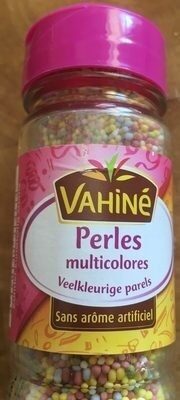
Perles multicolores
Health
Nutrition
Nutri-Score
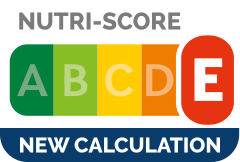 Lower nutritional quality
Nutri-Score data warning
Nutrient levels
Fat in low quantity (0%)
Saturated fat in low quantity (0%)
Sugars in high quantity (69.1%)
Salt in low quantity (0%)
Nutrition label
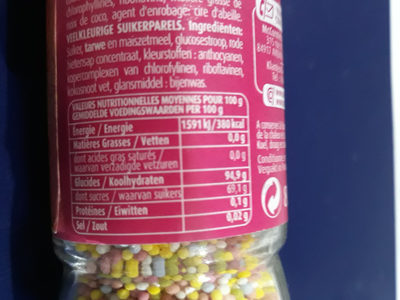
Nutrition facts
| Nutrition facts | As sold for 100 g / 100 ml | Compared to: Cooking helpers |
|---|---|---|
| Energy | ~ 1615 kJ (380 kcal) | 1,359.312 kJ (323 kcal) (+19%) |
| Fat | 0 g | 7.619 g (-100%) |
| Saturated fat | 0 g | 3.142 g (-100%) |
| Carbohydrates | 94.9 g | 52.798 g (+80%) |
| Sugars | 69.1 g | 28.548 g (+142%) |
| Dietary fiber | 0 g | ? |
| Proteins | 0.1 g | 4.986 g (-98%) |
| Salt | 0 g | 0.554 g (-100%) |
| Sodium | 0 g | 0.221 g (-100%) |
| Fruits, vegetables and legumes | ~ 2.8125 % | ? |
Nutrition facts (Detailed data)
| Nutrition facts | As sold for 100 g / 100 ml | As sold Per 100 g (packaging) | As sold Per 100 g (estimate) |
|---|---|---|---|
| Energy | ~ 1615 kJ (380 kcal) | ? (380 kcal) | ~ 1553.84140625 kJ (365 kcal) |
| Fat | 0 g | 0 g | ~ 0.65503125 g |
| Saturated fat | 0 g | 0 g | ~ 0.08560546875 g |
| Carbohydrates | 94.9 g | 94.9 g | ~ 88.3896875 g |
| Sugars | 69.1 g | 69.1 g | ~ 60.873875 g |
| Dietary fiber | 0 g | 0 g | ~ 0.89296875 g |
| Proteins | 0.1 g | 0.1 g | ~ 1.0569375 g |
| Salt | 0 g | 0 g | ~ 0.0128925 g |
| Sodium | 0 g | 0 g | ~ 0.005763109375 g |
| Fruits, vegetables and legumes | ~ 2.8125 % | ? | ~ 2.8125 % |
Ingredients
Ingredients image

Ingredients list
Ingredient information
Added sugars
Allergens
Ingredients analysis
No ingredients containing palm oil.
Contains non-vegan ingredients.
Unrecognized: fr:anthocyanes-complexes-cuivriques-de-chlorophyllines
Vegetarian status unknown
Unrecognized: fr:anthocyanes-complexes-cuivriques-de-chlorophyllines
Food Processing
NOVA group
 Ultra-processed food and drink products
Elements that indicate the product is in NOVA group 4
How NOVA works
Additives
E101 - RiboflavinColour
Riboflavin, also known as vitamin B2, is a vitamin found in food and used as a dietary supplement. Food sources include eggs, green vegetables, milk and other dairy product, meat, mushrooms, and almonds. Some countries require its addition to grains. As a supplement it is used to prevent and treat riboflavin deficiency and prevent migraines. It may be given by mouth or injection.It is nearly always well tolerated. Normal doses are safe during pregnancy. Riboflavin is in the vitamin B group. It is required by the body for cellular respiration.Riboflavin was discovered in 1920, isolated in 1933, and first made in 1935. It is on the World Health Organization's List of Essential Medicines, the most effective and safe medicines needed in a health system. Riboflavin is available as a generic medication and over the counter. In the United States a month of supplements costs less than 25 USD.
E101i - RiboflavinColour
No additive description is available yet.
E163 - AnthocyaninsColour
Anthocyanins (also anthocyans; from Greek: ἄνθος (anthos) "flower" and κυάνεος/κυανοῦς kyaneos/kyanous "dark blue") are water-soluble vacuolar pigments that, depending on their pH, may appear red, purple, or blue. Food plants rich in anthocyanins include the blueberry, raspberry, black rice, and black soybean, among many others that are red, blue, purple, or black. Some of the colors of autumn leaves are derived from anthocyanins.Anthocyanins belong to a parent class of molecules called flavonoids synthesized via the phenylpropanoid pathway. They occur in all tissues of higher plants, including leaves, stems, roots, flowers, and fruits. Anthocyanins are derived from anthocyanidins by adding sugars. They are odorless and moderately astringent. Although approved to color foods and beverages in the European Union, anthocyanins are not approved for use as a food additive because they have not been verified as safe when used as food or supplement ingredients. There is no conclusive evidence anthocyanins have any effect on human biology or diseases.
E901 - white and yellow beeswaxCarrierEmulsifierStabiliserThickener
Beeswax (cera alba) is a natural wax produced by honey bees of the genus Apis. The wax is formed into "scales" by eight wax-producing glands in the abdominal segments of worker bees, which discard it in or at the hive. The hive workers collect and use it to form cells for honey storage and larval and pupal protection within the beehive. Chemically, beeswax consists mainly of esters of fatty acids and various long-chain alcohols. Beeswax has long-standing applications in human food and flavoring. For example, it is used as a glazing agent or as a light/heat source. It is edible, in the sense of having similar negligible toxicity to plant waxes, and is approved for food use in most countries and the European Union under the E number E901. However, the wax monoesters in beeswax are poorly hydrolysed in the guts of humans and other mammals, so they have insignificant nutritional value. Some birds, such as honeyguides, can digest beeswax. Beeswax is the main diet of wax moth larvae.
Environment
Green-Score, origins bonus, and transportation impact are shown for Worldwide .
Green Score
Overall grade
 Unknown environmental impact
About Green-Score
Current scope
Green-Score availability
Bonuses and maluses
Declared origins
Packaging impact
Packaging
Packaging impact
Packaging components
| Shape | Material | Recycling | Impact |
|---|---|---|---|
| POT | Glass | Unknown | Low |
Declared packaging
Transportation
Declared origins
Forest footprint
Forest footprint
Deforestation risk details
Data Source
Product data comes from Open Food Facts. Food Benchmark also adds translations, category comparisons and explanatory calculations.
The database is licensed under ODbL 1.0, individual contents under DbCL 1.0, and product photos under CC BY-SA 3.0.
Product added on July 1, 2012 at 2:01:48 PM UTC by manu1400 .
Last edit on March 17, 2026 at 11:29:51 PM UTC by new-nutrition-bot .
Product page also edited by date-limite-app, deltonio2, driveoff, el-ka-91, foodless, kiliweb, magasins-u, manu1400, morganesh, new-nutrition-bot, openfoodfacts-contributors, packbot, quechoisir, roboto-app, segundo, stephane, yuka.SG8wd0Z2UXIrNlJWcXZFUjd5L0szUEF0N0lPVEJXN3NOYnRQSVE9PQ, yuka.UkpnalFiODRscUV5d3M4NHJ6N2JwNE5lN2JtV2NuaTZFK1krSVE9PQ, yuka.WjZvR0l2c29nTlVuaHMwaTJ4N3A4ZTlTOWJ5WGYzaUtFK1VJSVE9PQ, yuka.ZnY0aE5mZ1BwNmcydC9NZHhpejM1TWtsNU1lSWMyaTlKdXRMSUE9PQ, yuka.sY2b0xO6T85zoF3NwEKvlksdV_bxoymcaEXutEuz2fKBCobJRM9e2Imhb6s.