
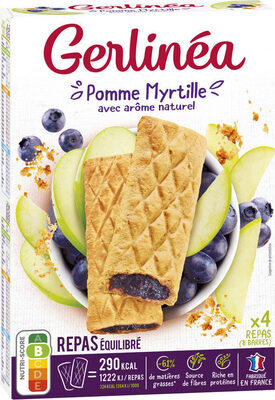
Barre Pomme Myrtille avec arôme naturel
Health
Nutrition
Nutri-Score data warning
Nutrient levels
Fat in moderate quantity (6.4%)
Saturated fat in low quantity (0.6%)
Sugars in high quantity (21%)
Salt in moderate quantity (0.65%)
Nutrition label

Nutrition facts
| Nutrition facts | As sold for 100 g / 100 ml | Compared to: Meal replacements |
|---|---|---|
| Energy | 1364 kJ (324 kcal) | 1,187.371 kJ (283 kcal) (+15%) |
| Fat | 6.4 g | 8.508 g (-25%) |
| Saturated fat | 0.6 g | 1.894 g (-68%) |
| Carbohydrates | 42 g | 25.663 g (+64%) |
| Sugars | 21 g | 7.764 g (+170%) |
| Dietary fiber | 4.1 g | ? |
| Proteins | 25 g | 20.385 g (+23%) |
| Salt | 0.65 g | 0.654 g (-1%) |
| Sodium | 0.26 g | 0.259 g (~0%) |
| Vitamin A | 0.000405 g | 207.238 µg (+95%) |
| Vitamin D | 0.0000022 g | 2.341 µg (-6%) |
| Vitamin E | 0.011 g | 4.023 mg (+173%) |
| Vitamin K | 0.000035 g | 18.704 µg (+87%) |
| Vitamin C | 0.042 g | ? |
| Vitamin PP | 0.0082 g | ? |
| Biotin | 0.000023 g | 13.174 µg (+75%) |
| Pantothenic acid | 0.0033 g | ? |
| Potassium | 0.83 g | 430.825 mg (+93%) |
| Calcium | 0.378 g | 195.966 mg (+93%) |
| Phosphorus | 0.488 g | 255 mg (+91%) |
| Iron | 0.0089 g | 4.676 mg (+90%) |
| Magnesium | 0.18 g | 73.237 mg (+146%) |
| Zinc | 0.0061 g | 3.013 mg (+102%) |
| Copper | 0.00072 g | 0.338 mg (+113%) |
| Manganese | 0.0015 g | 0.823 mg (+82%) |
| Selenium | 0.000026 g | 17.1 µg (+52%) |
| Iodine | 0.000124 g | 42.106 µg (+194%) |
| Fruits, vegetables and legumes | ~ 51.6 % | ? |
Nutrition facts (Detailed data)
| Nutrition facts | As sold for 100 g / 100 ml | As sold Per 100 g (packaging) | As sold Per 100 g (estimate) |
|---|---|---|---|
| Energy | 1364 kJ (324 kcal) | 1364 kJ (324 kcal) | ? |
| Fat | 6.4 g | 6.4 g | ? |
| Saturated fat | 0.6 g | 0.6 g | ? |
| Carbohydrates | 42 g | 42 g | ? |
| Sugars | 21 g | 21 g | ? |
| Dietary fiber | 4.1 g | 4.1 g | ? |
| Proteins | 25 g | 25 g | ? |
| Salt | 0.65 g | 0.65 g | ? |
| Sodium | 0.26 g | 0.26 g | ? |
| Vitamin A | 0.000405 g | 0.000405 g | ? |
| Vitamin D | 0.0000022 g | 0.0000022 g | ? |
| Vitamin E | 0.011 g | 0.011 g | ? |
| Vitamin K | 0.000035 g | 0.000035 g | ? |
| Vitamin C | 0.042 g | 0.042 g | ? |
| Vitamin PP | 0.0082 g | 0.0082 g | ? |
| Biotin | 0.000023 g | 0.000023 g | ? |
| Pantothenic acid | 0.0033 g | 0.0033 g | ? |
| Potassium | 0.83 g | 0.83 g | ? |
| Calcium | 0.378 g | 0.378 g | ? |
| Phosphorus | 0.488 g | 0.488 g | ? |
| Iron | 0.0089 g | 0.0089 g | ? |
| Magnesium | 0.18 g | 0.18 g | ? |
| Zinc | 0.0061 g | 0.0061 g | ? |
| Copper | 0.00072 g | 0.00072 g | ? |
| Manganese | 0.0015 g | 0.0015 g | ? |
| Selenium | 0.000026 g | 0.000026 g | ? |
| Iodine | 0.000124 g | 0.000124 g | ? |
| Fruits, vegetables and legumes | ~ 51.6 % | ? | ~ 51.6 % |
Serving size
Ingredients
Ingredients image

Ingredients list
Ingredient information
Added sugars
Allergens
Traces
Ingredients analysis
No ingredients containing palm oil.
Vegan status unknown
Vegetarian status unknown
Food Processing
NOVA group
 Ultra-processed food and drink products
Elements that indicate the product is in NOVA group 4
How NOVA works
Additives
E330 - Citric acidAntioxidantSequestrant
Citric acid is a natural organic acid found in citrus fruits such as lemons, oranges, and limes.
It is widely used in the food industry as a flavor enhancer, acidulant, and preservative due to its tart and refreshing taste.
Citric acid is safe for consumption when used in moderation and is considered a generally recognized as safe (GRAS) food additive by regulatory agencies worldwide.
E333 - Calcium citratesSequestrantStabiliser
Calcium citrate is the calcium salt of citric acid. It is commonly used as a food additive (E333), usually as a preservative, but sometimes for flavor. In this sense, it is similar to sodium citrate. Calcium citrate is also found in some dietary calcium supplements (e.g. Citracal). Calcium makes up 24.1% of calcium citrate (anhydrous) and 21.1% of calcium citrate (tetrahydrate) by mass. The tetrahydrate occurs in nature as the mineral Earlandite.
E422 - GlycerolHumectantThickener
Glycerol (; also called glycerine or glycerin; see spelling differences) is a simple polyol compound. It is a colorless, odorless, viscous liquid that is sweet-tasting and non-toxic. The glycerol backbone is found in all lipids known as triglycerides. It is widely used in the food industry as a sweetener and humectant and in pharmaceutical formulations. Glycerol has three hydroxyl groups that are responsible for its solubility in water and its hygroscopic nature.
E500 - Sodium carbonatesStabiliserThickener
Sodium carbonates (E500) are compounds commonly used in food preparation as leavening agents, helping baked goods rise by releasing carbon dioxide when they interact with acids.
Often found in baking soda, they regulate the pH of food, preventing it from becoming too acidic or too alkaline. In the culinary world, sodium carbonates can also enhance the texture and structure of foods, such as noodles, by modifying the gluten network.
Generally recognized as safe, sodium carbonates are non-toxic when consumed in typical amounts found in food.
Environment
Green-Score, origins bonus, and transportation impact are shown for Worldwide .
Green Score
Overall grade
 Low environmental impact
About Green-Score
Current scope
Life cycle analysis
Average impact of the category
 Meal replacement low calorie, ready-to-drink • Score: 85/100
Life-cycle reference
Overall environmental impact by stage (PEF)
The overall environmental impact figure (PEF) comes from ADEME's Agribalyse database, for the category: Meal replacement low calorie, ready-to-drink. Source: ADEME Agribalyse Database.
| Stage | Impact |
|---|---|
| Agriculture | 38.8 % |
| Processing | 15.5 % |
| Packaging | 32.3 % |
| Transportation | 8.0 % |
| Distribution | 4.3 % |
| Consumption | 1.1 % |
Bonuses and maluses
Declared origins
Packaging impact
Green-Score for this product
Green-Score for this product
Final score: 69/100Final score breakdown
Carbon footprint
Carbon footprint
Climate impact by stage (CO2e)
The carbon emission figure comes from ADEME's Agribalyse database, for the category: Meal replacement low calorie, ready-to-drink. Source: ADEME Agribalyse Database.
| Stage | Impact |
|---|---|
| Agriculture | 36.1 % |
| Processing | 8.5 % |
| Packaging | 43.6 % |
| Transportation | 9.6 % |
| Distribution | 1.8 % |
| Consumption | 0.3 % |
Packaging

Packaging impact
Packaging materials
| Material | % | Packaging weight | Packaging weight per 100 g of product |
|---|---|---|---|
| Paper or cardboard | 81.29 % | 45.18 g | 12.55 g |
| Plastic | 18.71 % | 10.4 g | 2.89 g |
| Total | 100 % | 55.58 g | 15.44 g |
Packaging components
| Shape | Material | Recycling | Impact |
|---|---|---|---|
| 1 BOX (360 g) | Paperboard | Recycle IN Sorting BIN | Low |
| 8 Individual BAG (45 g) | Plastic | Recycle IN Sorting BIN | High |
Declared packaging
Transportation
Manufacturing locations
Declared origins
Forest footprint
Forest footprint
Deforestation risk details
Data Source
Product data comes from Open Food Facts. Food Benchmark also adds translations, category comparisons and explanatory calculations.
The database is licensed under ODbL 1.0, individual contents under DbCL 1.0, and product photos under CC BY-SA 3.0.
Product added on November 8, 2014 at 2:33:15 PM UTC by mawn .
Last edit on March 17, 2026 at 10:05:52 PM UTC by new-nutrition-bot .
Product page also edited by agamitsudo, cloclorama, desan, ecoscore-impact-estimator, emmanuel11100, fgouget, kiliweb, laurent-66, macrofactor, magasins-u, mawn, moncoachigbas, new-nutrition-bot, openfoodfacts-contributors, packbot, quechoisir, roboto-app, stephane, yuka.US9FU0RxVUtxcWRYbThabi9TL3Q0Y3h5N0sreFVFNjRLUGNMSWc9PQ, yuka.VGFFSkQ1d3dxNklnc3ZjZS9RSFAzZlZ0dzQrN1VqaWRBY1E4SVE9PQ, yuka.sY2b0xO6T85zoF3NwEKvlh1fY9jCjmj2NBDSvRO6you3MpLHTNFywYTnH6s.