
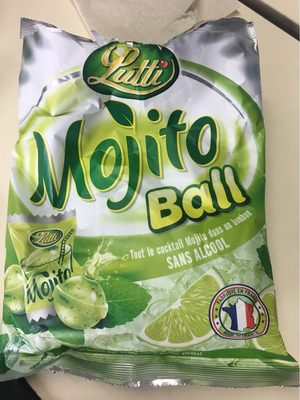
Mojito ball
Health
Nutrition
Nutri-Score
 Lower nutritional quality
Nutri-Score data warning
Nutrient levels
Fat in low quantity (0.1%)
Saturated fat in low quantity (0%)
Sugars in high quantity (59%)
Salt in low quantity (0%)
Nutrition label
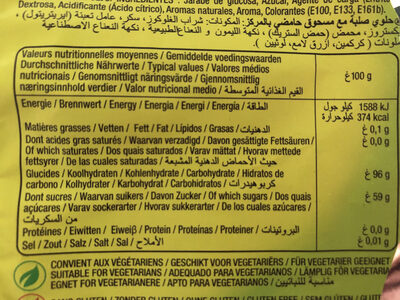
Nutrition facts
| Nutrition facts | As sold for 100 g / 100 ml | Compared to: Candies |
|---|---|---|
| Energy | ~ 1635.7 kJ (374 kcal) | 1,499.627 kJ (349 kcal) (+9%) |
| Fat | 0.1 g | 1.537 g (-93%) |
| Saturated fat | 0 g | 0.857 g (-100%) |
| Carbohydrates | 96 g | 82.947 g (+16%) |
| Sugars | 59 g | 54.872 g (+8%) |
| Dietary fiber | ? | ? |
| Proteins | 0 g | 2.153 g (-100%) |
| Salt | 0 g | 0.127 g (-100%) |
| Sodium | 0 g | 0.051 g (-100%) |
| Fruits, vegetables and legumes | ~ 0 % | ? |
Nutrition facts (Detailed data)
| Nutrition facts | As sold for 100 g / 100 ml | As sold Per 100 g (packaging) | As sold Per 100 g (estimate) |
|---|---|---|---|
| Energy | ~ 1635.7 kJ (374 kcal) | ? (374 kcal) | ? |
| Fat | 0.1 g | 0.1 g | ? |
| Saturated fat | 0 g | 0 g | ? |
| Carbohydrates | 96 g | 96 g | ? |
| Sugars | 59 g | 59 g | ? |
| Dietary fiber | ? | ? | ? |
| Proteins | 0 g | 0 g | ? |
| Salt | 0 g | 0 g | ? |
| Sodium | 0 g | 0 g | ? |
| Fruits, vegetables and legumes | ~ 0 % | ? | ~ 0 % |
Ingredients
Ingredients image

Ingredients list
Ingredient information
Added sugars
Ingredients analysis
No ingredients containing palm oil.
Vegan status unknown
Vegetarian status unknown
Food Processing
NOVA group
 Ultra-processed food and drink products
Elements that indicate the product is in NOVA group 4
How NOVA works
Additives
E100 - CurcuminColour
No additive description is available yet.
E133 - Brilliant blue FCF EFSA overexposure risk: moderateColour
BRILLIANT BLUE FCF (Blue 1) is an organic compound classified as a blue triarylmethane dye, reflecting its chemical structure. Known under various commercial names, it is a colorant for foods and other substances.
E161b - LuteinColour
LUTEIN is a xanthophyll and one of 600 known naturally occurring carotenoids. Lutein is extracted from the petals of African marigold (Tagetes erecta). It is approved for use in the EU and Australia and New Zealand. In the United States lutein may not be used as a food coloring for foods intended for human consumption, but can be added to animal feed.
E330 - Citric acidAntioxidantSequestrant
Citric acid is a natural organic acid found in citrus fruits such as lemons, oranges, and limes.
It is widely used in the food industry as a flavor enhancer, acidulant, and preservative due to its tart and refreshing taste.
Citric acid is safe for consumption when used in moderation and is considered a generally recognized as safe (GRAS) food additive by regulatory agencies worldwide.
E968 - ErythritolHumectantSweetener
Erythritol ((2R,3S)-butane-1,2,3,4-tetrol) is a sugar alcohol (or polyol) that has been approved for use as a food additive in the United States and throughout much of the world. It was discovered in 1848 by Scottish chemist John Stenhouse. It occurs naturally in some fruit and fermented foods. At the industrial level, it is produced from glucose by fermentation with a yeast, Moniliella pollinis. Erythritol is 60–70% as sweet as sucrose (table sugar) yet it is almost noncaloric, does not affect blood sugar, does not cause tooth decay, and is partially absorbed by the body, excreted in urine and feces. Under U.S. Food and Drug Administration (FDA) labeling requirements, it has a caloric value of 0.2 kilocalories per gram (95% less than sugar and other carbohydrates), though nutritional labeling varies from country to country. Some countries, such as Japan and the United States, label it as zero-calorie; the European Union labels it 0 kcal/g.
Environment
Green-Score, origins bonus, and transportation impact are shown for Worldwide .
Green Score
Overall grade
 Low environmental impact
About Green-Score
Current scope
Life cycle analysis
Average impact of the category
 Candies, all types • Score: 88/100
Life-cycle reference
Overall environmental impact by stage (PEF)
The overall environmental impact figure (PEF) comes from ADEME's Agribalyse database, for the category: Candies, all types. Source: ADEME Agribalyse Database.
| Stage | Impact |
|---|---|
| Agriculture | 47.6 % |
| Processing | 28.1 % |
| Packaging | 17.3 % |
| Transportation | 4.5 % |
| Distribution | 2.3 % |
| Consumption | 0.0 % |
Bonuses and maluses
Declared origins
Packaging impact
Green-Score for this product
Green-Score for this product
Final score: 68/100Final score breakdown
Carbon footprint
Carbon footprint
Climate impact by stage (CO2e)
The carbon emission figure comes from ADEME's Agribalyse database, for the category: Candies, all types. Source: ADEME Agribalyse Database.
| Stage | Impact |
|---|---|
| Agriculture | 46.7 % |
| Processing | 27.1 % |
| Packaging | 16.4 % |
| Transportation | 8.7 % |
| Distribution | 1.5 % |
| Consumption | 0.0 % |
Packaging
Packaging impact
Data precision
Transportation
Declared origins
Forest footprint
Forest footprint
Deforestation risk details
Data Source
Product data comes from Open Food Facts. Food Benchmark also adds translations, category comparisons and explanatory calculations.
The database is licensed under ODbL 1.0, individual contents under DbCL 1.0, and product photos under CC BY-SA 3.0.
Product added on September 8, 2017 at 12:29:55 PM UTC by kiliweb .
Last edit on March 17, 2026 at 11:24:30 PM UTC by new-nutrition-bot .
Product page also edited by autorotate-bot, kiliweb, magasins-u, new-nutrition-bot, openfoodfacts-contributors, roboto-app, sebleouf, teolemon, yuka.UqkYA8awHOh8Ad3yjroYzjKpS77HJP1hGUMOog, yuka.V0tZYkFiNHZpLzQ3bGNGbDJETFM0WU5yMTQyemZsNk5CZVFMSVE9PQ, yuka.WG9reUVvc2V1c2NhaXNJL3h6L2Z3T3d1N2FPTWNtR2ROdXhMSUE9PQ, yuka.WWI4OUlmOVpscWNydS9FdjhnN3FwSXRYNjZENVFUdm5jdkFNSVE9PQ, yuka.ZlpzQktJUlpvZkFTeXNjUi9DL2F4c3RPeUkrdmUweStFcnNUSWc9PQ.