
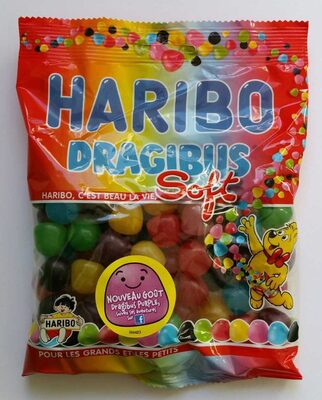
Dragibus soft
Health
Nutrition
Nutri-Score
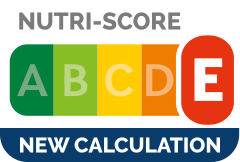 Lower nutritional quality
Nutri-Score data warning
Nutrient levels
Fat in low quantity (0.5%)
Saturated fat in low quantity (0.1%)
Sugars in high quantity (58%)
Salt in low quantity (0.05%)
Nutrition label
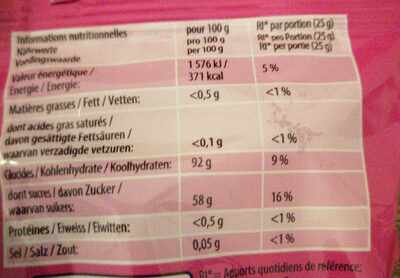
Nutrition facts
| Nutrition facts | As sold for 100 g / 100 ml | Compared to: Candies |
|---|---|---|
| Energy | ~ 1591 kJ (371 kcal) | 1,499.599 kJ (349 kcal) (+6%) |
| Fat | 0.5 g | 1.539 g (-68%) |
| Saturated fat | 0.1 g | 0.858 g (-88%) |
| Carbohydrates | 92 g | 82.946 g (+11%) |
| Sugars | 58 g | 54.872 g (+6%) |
| Dietary fiber | ? | ? |
| Proteins | 0.5 g | 2.152 g (-77%) |
| Salt | 0.05 g | 0.127 g (-61%) |
| Sodium | 0.02 g | 0.051 g (-61%) |
| Fruits, vegetables and legumes | ~ 0 % | ? |
Nutrition facts (Detailed data)
| Nutrition facts | As sold for 100 g / 100 ml | As sold Per 100 g (packaging) | As sold Per 100 g (estimate) |
|---|---|---|---|
| Energy | ~ 1591 kJ (371 kcal) | ? (371 kcal) | ? |
| Fat | 0.5 g | 0.5 g | ? |
| Saturated fat | 0.1 g | 0.1 g | ? |
| Carbohydrates | 92 g | 92 g | ? |
| Sugars | 58 g | 58 g | ? |
| Dietary fiber | ? | ? | ? |
| Proteins | 0.5 g | 0.5 g | ? |
| Salt | 0.05 g | 0.05 g | ? |
| Sodium | 0.02 g | 0.02 g | ? |
| Fruits, vegetables and legumes | ~ 0 % | ? | ~ 0 % |
Serving size
Ingredients
Ingredients image
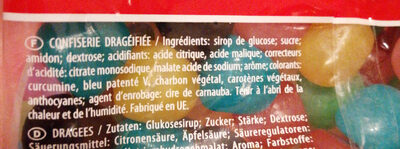
Ingredients list
Ingredient information
Added sugars
Ingredients analysis
Palm oil content unknown
Vegan status unknown
Unrecognized: en:citrate-monosodium, en:malate
Vegetarian status unknown
Unrecognized: en:citrate-monosodium, en:malate
Food Processing
NOVA group
 Ultra-processed food and drink products
Elements that indicate the product is in NOVA group 4
How NOVA works
Additives
E100 - CurcuminColour
No additive description is available yet.
E131 - Patent blue v EFSA overexposure risk: moderate
PATENT BLUE V is a dark bluish synthetic triphenylmethane dye used as a food coloring. It is not widely used, but in Europe it can be found in Scotch eggs, certain jelly sweets, blue Curaçao, certain jello varieties (though not in actual Jell-O brand products), among others.
E153 - Vegetable carbon
No additive description is available yet.
E160a - caroteneColour
β-Carotene is an organic, strongly colored red-orange pigment abundant in plants and fruits. It is a member of the carotenes, which are terpenoids (isoprenoids), synthesized biochemically from eight isoprene units and thus having 40 carbons. Among the carotenes, β-carotene is distinguished by having beta-rings at both ends of the molecule. β-Carotene is biosynthesized from geranylgeranyl pyrophosphate.β-Carotene is the most common form of carotene in plants. When used as a food coloring, it has the E number E160a. The structure was deduced by Karrer et al. in 1930. In nature, β-carotene is a precursor (inactive form) to vitamin A via the action of beta-carotene 15,15'-monooxygenase.Isolation of β-carotene from fruits abundant in carotenoids is commonly done using column chromatography. It can also be extracted from the beta-carotene rich algae, Dunaliella salina. The separation of β-carotene from the mixture of other carotenoids is based on the polarity of a compound. β-Carotene is a non-polar compound, so it is separated with a non-polar solvent such as hexane. Being highly conjugated, it is deeply colored, and as a hydrocarbon lacking functional groups, it is very lipophilic.
E163 - AnthocyaninsColour
Anthocyanins (also anthocyans; from Greek: ἄνθος (anthos) "flower" and κυάνεος/κυανοῦς kyaneos/kyanous "dark blue") are water-soluble vacuolar pigments that, depending on their pH, may appear red, purple, or blue. Food plants rich in anthocyanins include the blueberry, raspberry, black rice, and black soybean, among many others that are red, blue, purple, or black. Some of the colors of autumn leaves are derived from anthocyanins.Anthocyanins belong to a parent class of molecules called flavonoids synthesized via the phenylpropanoid pathway. They occur in all tissues of higher plants, including leaves, stems, roots, flowers, and fruits. Anthocyanins are derived from anthocyanidins by adding sugars. They are odorless and moderately astringent. Although approved to color foods and beverages in the European Union, anthocyanins are not approved for use as a food additive because they have not been verified as safe when used as food or supplement ingredients. There is no conclusive evidence anthocyanins have any effect on human biology or diseases.
E296 - Malic acid
MALIC ACID is an organic compound with the molecular formula C4H6O5. Malic acid has two stereoisomeric forms (L- and D-enantiomers), though only the L-isomer exists naturally.
E330 - Citric acidAntioxidantSequestrant
Citric acid is a natural organic acid found in citrus fruits such as lemons, oranges, and limes.
It is widely used in the food industry as a flavor enhancer, acidulant, and preservative due to its tart and refreshing taste.
Citric acid is safe for consumption when used in moderation and is considered a generally recognized as safe (GRAS) food additive by regulatory agencies worldwide.
E450 - Diphosphates EFSA overexposure risk: highEmulsifierHumectantSequestrantStabiliserThickener
Diphosphates (E450) are food additives often utilized to modify the texture of products, acting as leavening agents in baking and preventing the coagulation of canned food.
These salts can stabilize whipped cream and are also found in powdered products to maintain their flow properties. They are commonly present in baked goods, processed meats, and soft drinks.
Derived from phosphoric acid, they're part of our daily phosphate intake, which often surpasses recommended levels due to the prevalence of phosphates in processed foods and drinks.
Excessive phosphate consumption is linked to health issues, such as impaired kidney function and weakened bone health. Though diphosphates are generally regarded as safe when consumed within established acceptable daily intakes, it's imperative to monitor overall phosphate consumption to maintain optimal health.
E450i - Disodium diphosphateEmulsifierHumectantSequestrantStabiliserThickener
No additive description is available yet.
E903 - Carnauba waxCarrier
Carnauba (; Portuguese: carnaúba [kaʁnɐˈubɐ]), also called Brazil wax and palm wax, is a wax of the leaves of the palm Copernicia prunifera (Synonym: Copernicia cerifera), a plant native to and grown only in the northeastern Brazilian states of Piauí, Ceará, Maranhão, Bahia, and Rio Grande do Norte. It is known as "queen of waxes" and in its pure state, usually comes in the form of hard yellow-brown flakes. It is obtained from the leaves of the carnauba palm by collecting and drying them, beating them to loosen the wax, then refining and bleaching the wax.
Environment
Green-Score, origins bonus, and transportation impact are shown for Worldwide .
Green Score
Overall grade
 Low environmental impact
About Green-Score
Current scope
Life cycle analysis
Average impact of the category
 Candies, all types • Score: 88/100
Life-cycle reference
Overall environmental impact by stage (PEF)
The overall environmental impact figure (PEF) comes from ADEME's Agribalyse database, for the category: Candies, all types. Source: ADEME Agribalyse Database.
| Stage | Impact |
|---|---|
| Agriculture | 47.6 % |
| Processing | 28.1 % |
| Packaging | 17.3 % |
| Transportation | 4.5 % |
| Distribution | 2.3 % |
| Consumption | 0.0 % |
Bonuses and maluses
Declared origins
Packaging impact
Green-Score for this product
Green-Score for this product
Final score: 72/100Final score breakdown
Carbon footprint
Carbon footprint
Climate impact by stage (CO2e)
The carbon emission figure comes from ADEME's Agribalyse database, for the category: Candies, all types. Source: ADEME Agribalyse Database.
| Stage | Impact |
|---|---|
| Agriculture | 46.7 % |
| Processing | 27.1 % |
| Packaging | 16.4 % |
| Transportation | 8.7 % |
| Distribution | 1.5 % |
| Consumption | 0.0 % |
Packaging
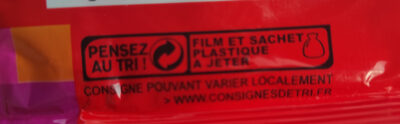
Packaging impact
Packaging components
| Shape | Material | Recycling | Impact |
|---|---|---|---|
| BAG | Plastic | Unknown | High |
| Film | Plastic | Unknown | High |
Declared packaging
Transportation
Declared origins
Forest footprint
Forest footprint
Deforestation risk details
Data Source
Product data comes from Open Food Facts. Food Benchmark also adds translations, category comparisons and explanatory calculations.
The database is licensed under ODbL 1.0, individual contents under DbCL 1.0, and product photos under CC BY-SA 3.0.
Product added on May 16, 2012 at 6:20:42 PM UTC by stephane .
Last edit on March 17, 2026 at 9:54:58 AM UTC by new-nutrition-bot .
Product page also edited by date-limite-app, ecoscore-impact-estimator, hugopeuze, inf, kiliweb, lolotte048, louis-rousselet, magasins-u, mrhalal, new-nutrition-bot, off.bfc5723f-73d5-4e4b-8d91-87338b015eb4, openfoodfacts-contributors, packbot, quechoisir, raphael0202, roboto-app, scanbot, sebleouf, stephane, svanacco, tacite, telperion87, yuka.R0lReFA1azhoZEl0di9NbDJFeUUySTF3MTgrRmZIKzlkTFkwSVE9PQ, yuka.R0t3K0ZQd2l0T01BbmNJdzV3M3N5K2xrNGNHNVZHRHNGck1PSWc9PQ, yuka.R3FSZFR2NEtoOXRYeHNRUjhUei8vOXhhMzRQMFJqK25JT2tBSVE9PQ, yuka.UW8wdlNvTThvc1lxc1BFczNVM2U0dk5QbXI2S1pteThDN3NZSVE9PQ, yuka.UWJnSEtJWWEvOHN2bXNJWjBqcnN3czl6NklQelFYK1lLL0lvSVE9PQ, yuka.UXB3OEhvNHN0OHNUby9BZy9rand3ZEYreVlleERFK2RGN3BNSUE9PQ, yuka.V0tZaEhxQlEvdHc2Z013Z29RalM1KzVPK0tTd2RGcXdLKzBBSVE9PQ, yuka.V284cUNLY3VodlVUc3NVeCtrcUZ5K2xsbTZLSGNtVG5OcnNTSVE9PQ, yuka.V293NU9ZQURoK2NreGNFaDBRalk2dEpzelpLRVUzK0xKT1JLSVE9PQ, yuka.VGY0blBaMEZ2L29QaS9RRThnem41ZmQvNjZTNVh6eWJkOFVJSVE9PQ, yuka.WEtBQ001OWR2TU1EdWNBTTRnUFI1ZkJweDVENFFtMlRMK1pNSUE9PQ, yuka.WG9VSE83UVJ1TUEydGZZQ296Nk9xOWgrbDhDeUJFeVFEK3NlSWc9PQ, yuka.WGZFckNwOG9vcWdUdzlnN29Bbno4L3RQL01La1kzeWFPZVV0SVE9PQ, yuka.WjZFQklJc0txZjlWa3NVM3BRN1oxWTRxbUllR1VqbVFPdWd1SVE9PQ, yuka.WnYwWkc1VXdqS01EaS9RRTh4bUsxL3RWbHJXYllYdUdkOWNqSVE9PQ, yuka.YUp3UE02TVJoLzFVbk1NWTd6TFcrc3dseUpXcUEwQ1lkZUZPSVE9PQ, yuka.YkxrZE5vTVppTll2b1BZN3dqVEx4dFpWM3NEeloycXNOTEk4SUE9PQ, yuka.ZEswTkQvc3RvdndZZ2RvUXhrMlArUGR6bXJ5dFgxeVFHdUVESVE9PQ, yuka.ZkpGYU9hWWZuOGtSdzlzejJTdlMzOXhGd002allFRG1POVVnSVE9PQ, yuka.Zll0ZkFLOG9yT0VGeFAwdjBTdm8rTUo3eDhHQ1RXZUdCOEF4SUE9PQ, yuka.Zlo0eUZwa2h2T3N2cXMwZnhDNlA1dDB2bDYySFlEcVVOZU1NSVE9PQ, yukafix.