ProductsSocopaBrochettes Tex Mex
Brochettes Tex Mex
Barcode 3039050048103
Socopa

Brochettes Tex Mex

400 g (x 4)
BARCODE:3039050048103
COMMON NAME:Préparation à 74% de viande bovine hachée, avec protéines végétales, assaisonnée
PACKAGER CODE:FR 72.080.002 EC
CATEGORIES:Meats And Their Products, Beef And Its Products, Meat Preparations, Meats, Skewers, Beef, Meat Skewers, Ground Meat Preparations, Beef Skewers
LABELS:French Meat, French Beef
PACKAGING:Plastic, Protective Gas, Tray
ORIGIN:France
MANUFACTURING:France
COUNTRIES:France
STORES:Carrefour

Health

Nutrition

Nutri-Score

DLower nutritional quality

Nutri-Score data warning

Warning: the amount of fruits, vegetables and nuts is not specified on the label, it was estimated from the list of ingredients: 0

Nutrient levels

Fat in moderate quantity (20%)
What you need to know • A high consumption of fat, especially saturated fats, can raise cholesterol, which increases the risk of heart diseases. Recommendation: Limit the consumption of fat and saturated fat • Choose products with lower fat and saturated fat content. Source: National Health Service UK (NHS) - Fat: the facts
Saturated fat in high quantity (8.6%)
What you need to know • A high consumption of fat, especially saturated fats, can raise cholesterol, which increases the risk of heart diseases. Recommendation: Limit the consumption of fat and saturated fat • Choose products with lower fat and saturated fat content. Source: National Health Service UK (NHS) - Fat: the facts
Sugars in low quantity (1.1%)
What you need to know • A high consumption of sugar can cause weight gain and tooth decay. It also augments the risk of type 2 diabetes and cardio-vascular diseases. Recommendation: Limit the consumption of sugar and sugary drinks • Sugary drinks (such as sodas, fruit beverages, and fruit juices and nectars) should be limited as much as possible (no more than 1 glass a day). • Choose products with lower sugar content and reduce the consumption of products with added sugars. Source: National Health Service UK (NHS) - Sugar: the facts
Salt in moderate quantity (0.9%)
What you need to know • A high consumption of salt (or sodium) can cause raised blood pressure, which can increase the risk of heart disease and stroke. • Many people who have high blood pressure do not know it, as there are often no symptoms. • Most people consume too much salt (on average 9 to 12 grams per day), around twice the recommended maximum level of intake. Recommendation: Limit the consumption of salt and salted food • Reduce the quantity of salt used when cooking, and don't salt again at the table. • Limit the consumption of salty snacks and choose products with lower salt content. Source: World Health Organization (WHO) - Fact sheet - Salt reduction Source: National Health Service UK (NHS) - Salt: the facts

Nutrition facts

Nutrition factsAs sold for 100 g / 100 mlCompared to: Beef skewers
Energy~ 1040.9 kJ (256 kcal)679.703 kJ (172 kcal) (+53%)
Fat20 g9.846 g (+103%)
Saturated fat8.6 g3.613 g (+138%)
Carbohydrates4.7 g1.619 g (+190%)
Sugars1.1 g0.654 g (+68%)
Dietary fiber??
Proteins13 g16.305 g (-20%)
Salt0.9 g0.601 g (+50%)
Sodium0.36 g0.24 g (+50%)
Fruits, vegetables and legumes~ 0.2484375 %?

Nutrition facts (Detailed data)

Nutrition factsAs sold for 100 g / 100 mlAs sold Per 100 g (packaging)As sold Per 100 g (estimate)
Energy~ 1040.9 kJ (256 kcal)? (256 kcal)?
Fat20 g20 g?
Saturated fat8.6 g8.6 g?
Carbohydrates4.7 g4.7 g?
Sugars1.1 g1.1 g?
Dietary fiber???
Proteins13 g13 g?
Salt0.9 g0.9 g?
Sodium0.36 g0.36 g?
Fruits, vegetables and legumes~ 0.2484375 %?~ 0.2484375 %

Ingredients

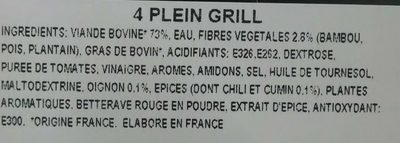
Ingredients image

Brochettes Tex Mex ingredients image

Ingredients list

Viande bovine 73%, eau, protéines de pois réhydratées 4%, gras de bovin, fibres végétales, acidifiants : E326, E262, dextrose, concentré de tomates, vinaigre, arômes, fécule, sel, huile de tournesol, maltodextrine, purée d'oignon 0.1%, épices (dont chili et cumin 0.1%), plantes aromatiques, poudre de betterave rouge, amidon, épaississant : E415, antioxydant : E300

Ingredient information

Beef Meat
73.0%
Water
13.5% (estimate)
Pea Protein
4.0%
Beef Fat
4.75% (estimate)
Vegetable Fiber
2.38% (estimate)
Acid
1.19% (estimate)
E326
1.19% (estimate)
E262
0.59% (estimate)
Dextrose
0.3% (estimate)
Tomato Concentrate
0.15% (estimate)
Vinegar
0.07% (estimate)
Flavouring
0.04% (estimate)
Starch
0.02% (estimate)
Salt
0.01% (estimate)
Sunflower Oil
0% (estimate)
Maltodextrin
0% (estimate)
Onion
0.1%
Cumin
0.1%

Added sugars

Contains added sugars (0%) Added sugars: dextrose Quantity of added sugars: 0%

Ingredients analysis

Palm oil free
Unknown

Palm oil content unknown

Vegan
No

Contains non-vegan ingredients.

Vegetarian
No

Contains non-vegetarian ingredients.


Food Processing

NOVA group

4Ultra-processed food and drink products

Elements that indicate the product is in NOVA group 4

Additives
E326 - potassium lactate
Additives
E415 - Xanthan gum
Ingredients
Dextrose
Ingredients
Flavouring
Ingredients
Glucose
Ingredients
Maltodextrin
Ingredients
Thickener
Ingredients
Vegetable Fiber

How NOVA works

The NOVA classification assigns food products into 4 groups based on their degree of processing: 1. Unprocessed or minimally processed foods 2. Processed culinary ingredients 3. Processed foods 4. Ultra-processed food and drink products

Additives

E262 - Sodium acetatesPreservativeSequestrant

SODIUM ACETATE, also abbreviated NaOAc,[8] is the sodium salt of acetic acid.

E300 - Ascorbic acidAntioxidantSequestrant

No additive description is available yet.

E326 - potassium lactateAntioxidantEmulsifierHumectant

POTASSIUM LACTATE is a compound with formula KC3H5O3. It is produced by neutralizing lactic acid which is fermented from a sugar source. Potassium lactate is commonly used in meat and poultry products to extend shelf life and increase food safety as it has a broad antimicrobial action. lactic acid and lactates can be consumed by all religious groups, vegans and vegetarians. Although the name refers to milk, it is not made from milk and thus suitable for people with milk allergy or lactose intolerance.

E415 - Xanthan gumEmulsifierStabiliserThickener

Xanthan gum (E415) is a natural polysaccharide derived from fermented sugars, often used in the food industry as a thickening and stabilizing agent.

This versatile food additive enhances texture and prevents ingredient separation in a wide range of products, including salad dressings, sauces, and gluten-free baked goods.

It is considered safe for consumption even at high intake amounts.

Environment

Green-Score, origins bonus, and transportation impact are shown for Worldwide .

Green Score

Overall grade

FVery high environmental impact

About Green-Score

The Green-Score is an experimental score that summarizes the environmental impacts of food products.

Current scope

The Green-Score was initially developed for France and it is being extended to other European countries. The Green-Score formula is subject to change as it is regularly improved to make it more precise and better suited to each country. Select a country to include the full impact of transportation in the final score.

Life cycle analysis

Average impact of the category

FBeef on skewer • Score: 0/100

Life-cycle reference

Category: Beef on skewer PEF environmental score: 3.48 Climate change impact: 37.00 kg CO2 eq / kg product The overall environmental impact figure (PEF) comes from ADEME's Agribalyse database, for the category: Beef on skewer. Source: ADEME Agribalyse Database.

Overall environmental impact by stage (PEF)

The overall environmental impact figure (PEF) comes from ADEME's Agribalyse database, for the category: Beef on skewer. Source: ADEME Agribalyse Database.

StageImpact
Agriculture96.0 %
Processing0.4 %
Packaging1.3 %
Transportation0.8 %
Distribution0.4 %
Consumption1.1 %

Bonuses and maluses

Origins of ingredients

Declared origins: France Origins bonus: +4 Transportation (Worldwide): 0 Environmental policy adjustment: +4 Select a country to include the full impact of transportation.

Packaging impact

Packaging with a medium impact Malus: -10 Packaging score: 0

Green-Score for this product

Green-Score for this product

FFinal score: 0/100

Final score breakdown

Life cycle analysis score: 0 Sum of bonuses and maluses: -6 Final score: 0/100

Carbon footprint

Carbon footprint

Equivalent to driving 19.2 km in a petrol car. 3700 g CO2e per 100g of product. Reference category: Beef on skewer. The carbon emission figure comes from ADEME's Agribalyse database, for the category: Beef on skewer. Source: ADEME Agribalyse Database.

Climate impact by stage (CO2e)

The carbon emission figure comes from ADEME's Agribalyse database, for the category: Beef on skewer. Source: ADEME Agribalyse Database.

StageImpact
Agriculture96.5 %
Processing0.4 %
Packaging1.7 %
Transportation1.0 %
Distribution0.1 %
Consumption0.3 %

Packaging

Packaging impact

Packaging with a medium impact Malus: -10 Packaging score: 0

Packaging components

ShapeMaterialRecyclingImpact
TrayPlasticUnknownHigh

Declared packaging

Plastic, Protective Gas, Tray

Transportation

Manufacturing locations

France

Origins of ingredients

Declared origins: France Origins bonus: +4 Transportation (Worldwide): 0 Environmental policy adjustment: +4 Select a country to include the full impact of transportation.

Origins breakdown

OriginPercent of ingredientsImpact
France100 %Medium

Forest footprint

Forest footprint

Forest Footprint not computed Potential deforestation risk but not yet computed. Forest Footprint The Forest Footprint is a methodology developed by the association Envol Vert to estimate the risk of deforestation related to our consumption. → More information on the methodology Forest Footprint not computed Potential deforestation risk but not yet computed.

Deforestation risk details

Other risky ingredients These ingredients are not yet assessed for deforestation risk: beef meat

Data Source

Product data comes from Open Food Facts. Food Benchmark also adds translations, category comparisons and explanatory calculations.

The database is licensed under ODbL 1.0, individual contents under DbCL 1.0, and product photos under CC BY-SA 3.0.

Product added on June 3, 2015 at 6:38:46 PM UTC by openfoodfacts-contributors .

Last edit on March 17, 2026 at 11:32:24 PM UTC by new-nutrition-bot .

Product page also edited by aleene, date-limite-app, foodvisor, kiliweb, marketinggms, moon-rabbit, new-nutrition-bot, openfoodfacts-contributors, packbot, phoenix, roboto-app, tacite-mass-editor, yuka.ZlpzQktJUlpvZkFTeXNjUi9DL2F4c3RPeUkrdmUweStFcnNUSWc9PQ.