

Yaourt ferme & fondant caramel Sveltesse
Labels
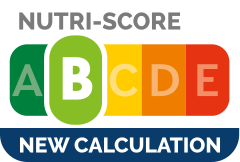 Good nutritional quality
 Ultra-processed food and drink products
 Green-Score not computed
Health
Nutrition
Label
Good nutritional qualityNutrient levels
Fat in low quantity (0.9%)
Saturated fat in low quantity (0.6%)
Sugars in moderate quantity (10.6%)
Salt in low quantity (0.2%)
Nutrition label
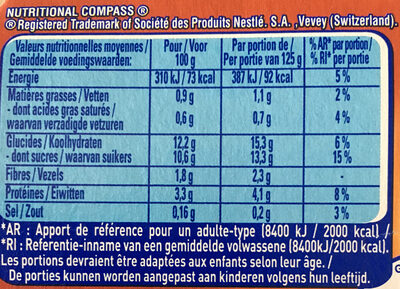
Nutrition facts
| Nutrition facts | As sold for 100 g / 100 ml |
|---|---|
| Energy | ~ 315.2 kJ (73 kcal) |
| FAT | 0.9 g |
| Saturated fat | 0.6 g |
| Carbohydrates | 12.2 g |
| Sugars | 10.6 g |
| Dietary fiber | 2.3 g |
| Proteins | 3.3 g |
| Salt | 0.2 g |
| Sodium | 0.08 g |
| Minerals | |
| Fruits, vegetables and legumes | ~ 0 % |
Nutrition facts (Detailed data)
| Nutrition facts | As sold for 100 g / 100 ml | As sold Per 100 g (packaging) | As sold Per 100 g (estimate) |
|---|---|---|---|
| Energy | ~ 315.2 kJ (73 kcal) | ? (73 kcal) | ? |
| FAT | 0.9 g | 0.9 g | ? |
| Saturated fat | 0.6 g | 0.6 g | ? |
| Carbohydrates | 12.2 g | 12.2 g | ? |
| Sugars | 10.6 g | 10.6 g | ? |
| Added sugars | ~ 9.02 g | ? | ~ 9.02 g |
| Dietary fiber | 2.3 g | 2.3 g | ? |
| Proteins | 3.3 g | 3.3 g | ? |
| Salt | 0.2 g | 0.2 g | ? |
| Sodium | 0.08 g | 0.08 g | ? |
| Minerals | |||
| Fruits, vegetables and legumes | ~ 0 % | ? | ~ 0 % |
Serving size
Estimated Activity Time
Approximate time needed to burn the energy in 100 g / 100 ml: 315 kJ. Reference adult weight: 70 kg. Energy density: Low.
Ingredients
Ingredients image

Ingredients list
Ingredient information
Allergens
Ingredients analysis
No ingredients containing palm oil.
Contains non-vegan ingredients.
Unrecognized: fr:lait-a-1-1-de-matiere-grasse
Vegetarian status unknown
Unrecognized: fr:lait-a-1-1-de-matiere-grasse
Food Processing
NOVA group
Ultra-processed food and drink productsElements that indicate the product is in NOVA group 4
How NOVA works
Additives
E14XX - Modified StarchEmulsifierStabiliserThickener
No additive description is available yet.
E160b - AnnattoColour
No additive description is available yet.
E407 - CarrageenanCarrierEmulsifierHumectantStabiliserThickener
Carrageenan (E407), derived from red seaweed, is widely employed in the food industry as a gelling, thickening, and stabilizing agent, notably in dairy and meat products.
It can exist in various forms, each imparting distinct textural properties to food.
However, its degraded form, often referred to as poligeenan, has raised health concerns due to its potential inflammatory effects and its classification as a possible human carcinogen (Group 2B) by the International Agency for Research on Cancer (IARC).
Nevertheless, food-grade carrageenan has been deemed safe by various regulatory bodies when consumed in amounts typically found in food.
E524 - Sodium hydroxide
Sodium hydroxide, also known as lye and caustic soda, is an inorganic compound with the formula NaOH. It is a white solid ionic compound consisting of sodium cations Na+ and hydroxide anions OH−. Sodium hydroxide is a highly caustic base and alkali that decomposes proteins at ordinary ambient temperatures and may cause severe chemical burns. It is highly soluble in water, and readily absorbs moisture and carbon dioxide from the air. It forms a series of hydrates NaOH·nH2O. The monohydrate NaOH·H2O crystallizes from water solutions between 12.3 and 61.8 °C. The commercially available "sodium hydroxide" is often this monohydrate, and published data may refer to it instead of the anhydrous compound. As one of the simplest hydroxides, it is frequently utilized alongside neutral water and acidic hydrochloric acid to demonstrate the pH scale to chemistry students.Sodium hydroxide is used in many industries: in the manufacture of pulp and paper, textiles, drinking water, soaps and detergents, and as a drain cleaner. Worldwide production in 2004 was approximately 60 million tonnes, while demand was 51 million tonnes.
E950 - Acesulfame kSweetener
Acesulfame potassium ( AY-see-SUL-faym), also known as acesulfame K (K is the symbol for potassium) or Ace K, is a calorie-free sugar substitute (artificial sweetener) often marketed under the trade names Sunett and Sweet One. In the European Union, it is known under the E number (additive code) E950. It was discovered accidentally in 1967 by German chemist Karl Clauss at Hoechst AG (now Nutrinova). In chemical structure, acesulfame potassium is the potassium salt of 6-methyl-1,2,3-oxathiazine-4(3H)-one 2,2-dioxide. It is a white crystalline powder with molecular formula C4H4KNO4S and a molecular weight of 201.24 g/mol.
E952 - Cyclamic acid and its Na and Ca saltsSweetener
Cyclamic acid is a compound with formula C6H13NO3S. It is included in E number "E952". Cyclamic acid is mainly used as catalyst in the production of paints and plastics, and furthermore as a reagent for laboratory usage.The sodium and calcium salts of cyclamic acid are used as artificial sweeteners under the name cyclamate.
E959 - Neohesperidine dihydrochalconeSweetener
Neohesperidin dihydrochalcone, sometimes abbreviated to neohesperidin DC or simply NHDC, is an artificial sweetener derived from citrus. It is particularly effective in masking the bitter tastes of other compounds found in citrus, including limonin and naringin. Industrially, it is produced by extracting neohesperidin from the bitter orange, and then hydrogenating this to make NHDC.
Environment
Green-Score, origins bonus, and transportation impact are shown for Worldwide .
Green Score
Overall grade
Unknown environmental impactAbout Green-Score
Current scope
Green-Score availability
Bonuses and maluses
Origins of ingredients
Packaging impact
Packaging
Packaging impact
Packaging materials
| Material | % | Packaging weight | Packaging weight per 100 g of product |
|---|---|---|---|
| Plastic | |||
| Total |
Declared packaging
Transportation
Origins of ingredients
Origins breakdown
| Origin | Percent of ingredients | Impact |
|---|---|---|
| France | 100 % | Medium |
Data Source
Data presented on this page is sourced from the Open Food Facts database. This platform does not alter the original dataset; its purpose is solely to enhance data visualization and user accessibility.
Product added on July 20, 2017 at 5:59:32 PM UTC by kiliweb .
Last edit on March 17, 2026 at 8:56:42 PM UTC by freshtrack .
Product page also edited by autorotate-bot, beniben, charlesnepote, date-limite-app, foodless, foodvisor, freshtrack, isaure2205, kiliweb, magasins-u, new-nutrition-bot, openfoodfacts-contributors, packbot, roboto-app, tacite, thaialagata, yuka.LJZSIdCzFO4NG_Pj1qUY7Wm8Bv7PEtBeBy8Oog, yuka.R0trTFAva2hvL3NoeXZNejkwM2IwYzFzeGJhd1JWbVpKc285SUE9PQ.