ProductsToques & TartesPâte Brisée
Pâte Brisée
Barcode 26066868
Toques & Tartes

Pâte Brisée

230 g
BARCODE:26066868
COMMON NAME:Pâte à tarte
CATEGORIES:Plant Based Foods And Beverages, Plant Based Foods, Cereals And Potatoes, Cereals And Their Products, Fresh Foods, Pie Dough, Shortcrust Pastry, Baked Shortcrust Pastry With Vegetable Oil
LABELS:Vegetarian, Vegan, Green Dot, Eco Emballages
PACKAGING:Fresh, Film Plastique, Papier Cuisson
MANUFACTURING:Cérélia - 1494 Rue François Jacob - ZI des Alouettes - 62800 Liévin,Pas-de-Calais,Nord-Pas-de-Calais,France
COUNTRIES:France
STORES:Aldi

Health

Nutrition

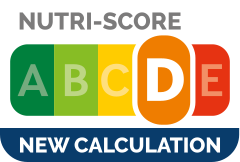
Nutri-Score

DLower nutritional quality

Nutri-Score data warning

Warning: the amount of fruits, vegetables and nuts is not specified on the label, it was estimated from the list of ingredients: 1

Nutrient levels

Fat in moderate quantity (15%)
What you need to know • A high consumption of fat, especially saturated fats, can raise cholesterol, which increases the risk of heart diseases. Recommendation: Limit the consumption of fat and saturated fat • Choose products with lower fat and saturated fat content. Source: National Health Service UK (NHS) - Fat: the facts
Saturated fat in high quantity (6.5%)
What you need to know • A high consumption of fat, especially saturated fats, can raise cholesterol, which increases the risk of heart diseases. Recommendation: Limit the consumption of fat and saturated fat • Choose products with lower fat and saturated fat content. Source: National Health Service UK (NHS) - Fat: the facts
Sugars in low quantity (2.3%)
What you need to know • A high consumption of sugar can cause weight gain and tooth decay. It also augments the risk of type 2 diabetes and cardio-vascular diseases. Recommendation: Limit the consumption of sugar and sugary drinks • Sugary drinks (such as sodas, fruit beverages, and fruit juices and nectars) should be limited as much as possible (no more than 1 glass a day). • Choose products with lower sugar content and reduce the consumption of products with added sugars. Source: National Health Service UK (NHS) - Sugar: the facts
Salt in moderate quantity (1%)
What you need to know • A high consumption of salt (or sodium) can cause raised blood pressure, which can increase the risk of heart disease and stroke. • Many people who have high blood pressure do not know it, as there are often no symptoms. • Most people consume too much salt (on average 9 to 12 grams per day), around twice the recommended maximum level of intake. Recommendation: Limit the consumption of salt and salted food • Reduce the quantity of salt used when cooking, and don't salt again at the table. • Limit the consumption of salty snacks and choose products with lower salt content. Source: World Health Organization (WHO) - Fact sheet - Salt reduction Source: National Health Service UK (NHS) - Salt: the facts

Nutrition label

Pâte Brisée nutrition label

Nutrition facts

Nutrition factsAs sold for 100 g / 100 mlCompared to: Baked shortcrust pastry with vegetable oil
Energy~ 1439 kJ (356 kcal)1,554.399 kJ (373 kcal) (-7%)
Fat15 g19.309 g (-22%)
Saturated fat6.5 g8.815 g (-26%)
Carbohydrates45 g41.985 g (+7%)
Sugars2.3 g2.153 g (+7%)
Dietary fiber??
Proteins7 g5.585 g (+25%)
Salt1 g1.042 g (-4%)
Sodium0.4 g0.417 g (-4%)
Fruits, vegetables and legumes~ 0.5 %?

Nutrition facts (Detailed data)

Nutrition factsAs sold for 100 g / 100 mlAs sold Per 100 g (packaging)As sold Per 100 g (estimate)
Energy~ 1439 kJ (356 kcal)? (356 kcal)?
Fat15 g15 g?
Saturated fat6.5 g6.5 g?
Carbohydrates45 g45 g?
Sugars2.3 g2.3 g?
Dietary fiber???
Proteins7 g7 g?
Salt1 g1 g?
Sodium0.4 g0.4 g?
Fruits, vegetables and legumes~ 0.5 %?~ 0.5 %

Serving size

38 g (Ce produit contient 6 portions)

Ingredients

Ingredients image

Pâte Brisée ingredients image

Ingredients list

Farine de blé (contient du gluten), eau, huiles et graisses végétales non hydrogénées (palme, tournesol), alcool éthylique, sucre, sel, jus de citron concentré, agent de traitement de la farine : L-cystéine.

Ingredient information

Wheat Flour
56.25% (estimate)
Water
21.88% (estimate)
Non Hydrogenated Vegetable Oil And Fat
10.94% (estimate)
Palm Oil
5.47% (estimate)
Sunflower Oil
5.47% (estimate)
E1510
5.47% (estimate)
Sugar
1.15% (estimate)
Salt
0.5% (estimate)
Concentrated Lemon Juice
0.5% (estimate)
Flour Treatment Agent
3.32% (estimate)
E920
3.32% (estimate)

Added sugars

Contains added sugars (1%) Added sugars: sugar Quantity of added sugars: 1%

Allergens

Gluten

Traces

EggsMilk

Ingredients analysis

Palm oil free
No

Contains ingredients containing palm oil.

Vegan
Yes

No non-vegan ingredients.

Vegetarian
Yes

No non-vegetarian ingredients.


Food Processing

NOVA group

3Processed foods

Elements that indicate the product is in NOVA group 3

Ingredients
Salt
Ingredients
Sugar
Ingredients
Vegetable Oil

How NOVA works

The NOVA classification assigns food products into 4 groups based on their degree of processing: 1. Unprocessed or minimally processed foods 2. Processed culinary ingredients 3. Processed foods 4. Ultra-processed food and drink products

Additives

E1510 - Ethanol

Ethanol, also called alcohol, ethyl alcohol, grain alcohol, and drinking alcohol, is a chemical compound, a simple alcohol with the chemical formula C2H5OH. Its formula can be also written as CH3−CH2−OH or C2H5−OH (an ethyl group linked to a hydroxyl group), and is often abbreviated as EtOH. Ethanol is a volatile, flammable, colorless liquid with a slight characteristic odor. It is a psychoactive substance and is the principal type of alcohol found in alcoholic drinks. Ethanol is naturally produced by the fermentation of sugars by yeasts or via petrochemical processes, and is most commonly consumed as a popular recreational drug. It also has medical applications as an antiseptic and disinfectant. The compound is widely used as a chemical solvent, either for scientific chemical testing or in synthesis of other organic compounds, and is a vital substance used across many different kinds of manufacturing industries. Ethanol is also used as a clean-burning fuel source.

E920 - l-cysteine

Cysteine (symbol Cys or C; ) is a semi-essential proteinogenic amino acid with the formula HO2CCH(NH2)CH2SH. The thiol side chain in cysteine often participates in enzymatic reactions, as a nucleophile. The thiol is susceptible to oxidation to give the disulfide derivative cystine, which serves an important structural role in many proteins. When used as a food additive, it has the E number E920. It is encoded by the codons UGU and UGC. Cysteine has the same structure as serine, but with one of its oxygen atoms replaced by sulfur; replacing it with selenium gives selenocysteine. (Like other natural proteinogenic amino acids cysteine has (L) chirality in the older D/L notation based on homology to D and L glyceraldehyde. In the newer R/S system of designating chirality, based on the atomic numbers of atoms near the asymmetric carbon, cysteine (and selenocysteine) have R chirality, because of the presence of sulfur (resp. selenium) as a second neighbor to the asymmetric carbon. The remaining chiral amino acids, having lighter atoms in that position, have S chirality.)

Environment

Green-Score, origins bonus, and transportation impact are shown for Worldwide .

Green Score

Overall grade

CModerate environmental impact

About Green-Score

The Green-Score is an experimental score that summarizes the environmental impacts of food products.

Current scope

The Green-Score was initially developed for France and it is being extended to other European countries. The Green-Score formula is subject to change as it is regularly improved to make it more precise and better suited to each country. Select a country to include the full impact of transportation in the final score.

Life cycle analysis

Average impact of the category

BPastry, short crust, baked • Score: 64/100

Life-cycle reference

Category: Pastry, short crust, baked PEF environmental score: 0.39 Climate change impact: 3.59 kg CO2 eq / kg product The overall environmental impact figure (PEF) comes from ADEME's Agribalyse database, for the category: Pastry, short crust, baked. Source: ADEME Agribalyse Database.

Overall environmental impact by stage (PEF)

The overall environmental impact figure (PEF) comes from ADEME's Agribalyse database, for the category: Pastry, short crust, baked. Source: ADEME Agribalyse Database.

StageImpact
Agriculture64.9 %
Processing9.6 %
Packaging8.0 %
Transportation5.7 %
Distribution2.5 %
Consumption9.3 %

Bonuses and maluses

Declared origins

Origins of ingredients are missing for this product. Ingredients need to be completed before the transportation bonus can be computed precisely.

Threatened species risk

Contains ingredients that may threaten species or ecosystems, such as palm oil.

Packaging impact

Packaging with a low impact Malus: -2 Packaging score: +82

Green-Score for this product

Green-Score for this product

CFinal score: 47/100

Final score breakdown

Life cycle analysis score: 64 Sum of bonuses and maluses: -17 Final score: 47/100

Carbon footprint

Carbon footprint

Equivalent to driving 1.9 km in a petrol car. 359 g CO2e per 100g of product. Reference category: Pastry, short crust, baked. The carbon emission figure comes from ADEME's Agribalyse database, for the category: Pastry, short crust, baked. Source: ADEME Agribalyse Database.

Climate impact by stage (CO2e)

The carbon emission figure comes from ADEME's Agribalyse database, for the category: Pastry, short crust, baked. Source: ADEME Agribalyse Database.

StageImpact
Agriculture69.6 %
Processing5.1 %
Packaging13.3 %
Transportation8.2 %
Distribution1.2 %
Consumption2.6 %

Packaging

Pâte Brisée packaging image

Packaging impact

Packaging with a low impact Malus: -2 Packaging score: +82

Packaging components

ShapeMaterialRecyclingImpact
FilmPlasticUnknownHigh
UnknownPaperUnknownLow

Declared packaging

Fresh, Film Plastique, Papier Cuisson

Data precision

The packaging information is not sufficiently precise to compute the most accurate packaging impact. Exact shapes and materials of all packaging components help improve the Green-Score.

Transportation

Manufacturing locations

Cérélia - 1494 Rue François Jacob - ZI des Alouettes - 62800 Liévin,Pas-de-Calais,Nord-Pas-de-Calais,France

Declared origins

Origins of ingredients are missing for this product. Ingredients need to be completed before the transportation bonus can be computed precisely.

Forest footprint

Forest footprint

Medium risk of deforestation Presence of one or more ingredients at risk of deforestation, with moderate risk given their quantity, origin and/or labels. Forest Footprint The Forest Footprint is a methodology developed by the association Envol Vert to estimate the risk of deforestation related to our consumption. → More information on the methodology Forest Footprint grade: C Presence of one or more ingredients at risk of deforestation, with moderate risk given their quantity, origin and/or labels. Total Forest Footprint: 0.007 m² per kg of food

Deforestation risk details

Palm oil Primary ingredient grade: C Primary ingredient: 0.007 m² per kg of food Palm oil production, concentrated mainly in Indonesia and Malaysia, contributes significantly to deforestation. Borneo has lost more than half of its forests since the 1970s. Labels The presence of certain labels can greatly help reduce the risk of deforestation, through the presence of environmental criteria and/or through better remuneration of producers.

Data Source

Product data comes from Open Food Facts. Food Benchmark also adds translations, category comparisons and explanatory calculations.

The database is licensed under ODbL 1.0, individual contents under DbCL 1.0, and product photos under CC BY-SA 3.0.

Product added on February 8, 2015 at 7:38:21 PM UTC by jacob80 .

Last edit on March 17, 2026 at 10:46:46 AM UTC by new-nutrition-bot .

Product page also edited by desaalex8, desan, jacob80, jusdekiwi, new-nutrition-bot, packbot, yuka.Er5EBuC2BuULGtzP6Ztt-hajP9m9UqMFIkImog, yuka.SG9jaVAvVWloTnNzdDhJUjdCRGs2b2w0K0xTdVcyeXNOY3NkSVE9PQ, yuka.ZTRNcExyWmE5L1lwaGRnajVRSFYrSXAreTV1N1ExeWVDN0VTSWc9PQ.