

Crème fouettée à l’aneth
Health
Nutrition
Nutri-Score
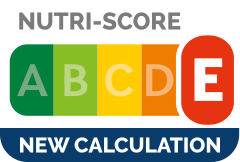 Lower nutritional quality
Nutri-Score data warning
Nutrient levels
Fat in high quantity (30%)
Saturated fat in high quantity (21%)
Sugars in low quantity (3.3%)
Salt in moderate quantity (0.71%)
Nutrition label

Nutrition facts
| Nutrition facts | As sold for 100 g / 100 ml | Compared to: Whipped creams |
|---|---|---|
| Energy | ~ 1205.2 kJ (292 kcal) | 1,229.898 kJ (297 kcal) (-2%) |
| Fat | 30 g | 28.953 g (+4%) |
| Saturated fat | 21 g | 19.86 g (+6%) |
| Carbohydrates | 3.3 g | 6.474 g (-49%) |
| Sugars | 3.3 g | 6.136 g (-46%) |
| Dietary fiber | ? | ? |
| Proteins | 2.3 g | 2.285 g (+1%) |
| Salt | 0.71 g | 0.092 g (+672%) |
| Sodium | 0.284 g | 0.037 g (+668%) |
| Fruits, vegetables and legumes | ~ 0 % | ? |
Nutrition facts (Detailed data)
| Nutrition facts | As sold for 100 g / 100 ml | As sold Per 100 g (packaging) | As sold Per 100 g (estimate) |
|---|---|---|---|
| Energy | ~ 1205.2 kJ (292 kcal) | ? (292 kcal) | ? |
| Fat | 30 g | 30 g | ? |
| Saturated fat | 21 g | 21 g | ? |
| Carbohydrates | 3.3 g | 3.3 g | ? |
| Sugars | 3.3 g | 3.3 g | ? |
| Dietary fiber | ? | ? | ? |
| Proteins | 2.3 g | 2.3 g | ? |
| Salt | 0.71 g | 0.71 g | ? |
| Sodium | 0.284 g | 0.284 g | ? |
| Fruits, vegetables and legumes | ~ 0 % | ? | ~ 0 % |
Ingredients
Ingredients image

Ingredients list
Ingredient information
Allergens
Ingredients analysis
Palm oil content unknown
Contains non-vegan ingredients.
Unrecognized: fr:creme-a-40-de-matiere-se, fr:or-sine, fr:huile-essentielle-d-aneth
Vegetarian status unknown
Unrecognized: fr:creme-a-40-de-matiere-se, fr:or-sine, fr:huile-essentielle-d-aneth
Food Processing
NOVA group
 Ultra-processed food and drink products
Elements that indicate the product is in NOVA group 4
How NOVA works
Additives
E175 - Gold
Gold is a chemical element with symbol Au (from Latin: aurum) and atomic number 79, making it one of the higher atomic number elements that occur naturally. In its purest form, it is a bright, slightly reddish yellow, dense, soft, malleable, and ductile metal. Chemically, gold is a transition metal and a group 11 element. It is one of the least reactive chemical elements and is solid under standard conditions. Gold often occurs in free elemental (native) form, as nuggets or grains, in rocks, in veins, and in alluvial deposits. It occurs in a solid solution series with the native element silver (as electrum) and also naturally alloyed with copper and palladium. Less commonly, it occurs in minerals as gold compounds, often with tellurium (gold tellurides). Gold is resistant to most acids, though it does dissolve in aqua regia, a mixture of nitric acid and hydrochloric acid, which forms a soluble tetrachloroaurate anion. Gold is insoluble in nitric acid, which dissolves silver and base metals, a property that has long been used to refine gold and to confirm the presence of gold in metallic objects, giving rise to the term acid test. Gold also dissolves in alkaline solutions of cyanide, which are used in mining and electroplating. Gold dissolves in mercury, forming amalgam alloys, but this is not a chemical reaction. A relatively rare element, gold is a precious metal that has been used for coinage, jewelry, and other arts throughout recorded history. In the past, a gold standard was often implemented as a monetary policy, but gold coins ceased to be minted as a circulating currency in the 1930s, and the world gold standard was abandoned for a fiat currency system after 1971. A total of 186,700 tonnes of gold exists above ground, as of 2015. The world consumption of new gold produced is about 50% in jewelry, 40% in investments, and 10% in industry. Gold's high malleability, ductility, resistance to corrosion and most other chemical reactions, and conductivity of electricity have led to its continued use in corrosion resistant electrical connectors in all types of computerized devices (its chief industrial use). Gold is also used in infrared shielding, colored-glass production, gold leafing, and tooth restoration. Certain gold salts are still used as anti-inflammatories in medicine. As of 2016, the world's largest gold producer by far was China with 450 tonnes per year.
E407 - Carrageenan EFSA overexposure risk: highCarrierEmulsifierHumectantStabiliserThickener
Carrageenan (E407), derived from red seaweed, is widely employed in the food industry as a gelling, thickening, and stabilizing agent, notably in dairy and meat products.
It can exist in various forms, each imparting distinct textural properties to food.
However, its degraded form, often referred to as poligeenan, has raised health concerns due to its potential inflammatory effects and its classification as a possible human carcinogen (Group 2B) by the International Agency for Research on Cancer (IARC).
Nevertheless, food-grade carrageenan has been deemed safe by various regulatory bodies when consumed in amounts typically found in food.
E471 - Mono- and diglycerides of fatty acidsEmulsifierStabiliser
Mono- and diglycerides of fatty acids (E471), are food additives commonly used as emulsifiers in various processed foods.
These compounds consist of glycerol molecules linked to one or two fatty acid chains, which help stabilize and blend water and oil-based ingredients. E471 enhances the texture and shelf life of products like margarine, baked goods, and ice cream, ensuring a smooth and consistent texture.
It is generally considered safe for consumption within established regulatory limits.
Environment
Green-Score, origins bonus, and transportation impact are shown for Worldwide .
Green Score
Overall grade
 Low environmental impact
About Green-Score
Current scope
Life cycle analysis
Average impact of the category
 Liquid cream, light, 15-20% fat, UHT • Score: 82/100
Life-cycle reference
Overall environmental impact by stage (PEF)
The overall environmental impact figure (PEF) comes from ADEME's Agribalyse database, for the category: Liquid cream, light, 15-20% fat, UHT. Source: ADEME Agribalyse Database.
| Stage | Impact |
|---|---|
| Agriculture | 74.0 % |
| Processing | 11.2 % |
| Packaging | 8.3 % |
| Transportation | 4.8 % |
| Distribution | 1.8 % |
| Consumption | 0.0 % |
Bonuses and maluses
Origins of ingredients
Packaging impact
Green-Score for this product
Green-Score for this product
Final score: 62/100Final score breakdown
Carbon footprint
Carbon footprint
Climate impact by stage (CO2e)
The carbon emission figure comes from ADEME's Agribalyse database, for the category: Liquid cream, light, 15-20% fat, UHT. Source: ADEME Agribalyse Database.
| Stage | Impact |
|---|---|
| Agriculture | 76.9 % |
| Processing | 6.6 % |
| Packaging | 9.6 % |
| Transportation | 6.3 % |
| Distribution | 0.6 % |
| Consumption | 0.0 % |
Packaging
Packaging impact
Declared packaging
Data precision
Transportation
Origins of ingredients
Origins breakdown
| Origin | Percent of ingredients | Impact |
|---|---|---|
| Unknown | 77 % | High |
| European Union | 23 % | High |
Forest footprint
Forest footprint
Deforestation risk details
Data Source
Product data comes from Open Food Facts. Food Benchmark also adds translations, category comparisons and explanatory calculations.
The database is licensed under ODbL 1.0, individual contents under DbCL 1.0, and product photos under CC BY-SA 3.0.
Product added on December 25, 2017 at 1:00:20 PM UTC by kiliweb .
Last edit on March 18, 2026 at 12:09:19 AM UTC by new-nutrition-bot .
Product page also edited by date-limite-app, kiliweb, new-nutrition-bot, openfoodfacts-contributors, packbot, quechoisir, roboto-app, teolemon, yuka.VkxBK05ZMG9pZVF4Z01NK293bmVvLzVlMjZLeVF6cU1LUFV3SVE9PQ, yuka.VzQ4NENva0ZtdjBwaXZNRXdEekx4TmhyM3M2dlpFMkhEL1l0SVE9PQ, yuka.WVB3T0taOWVyOVFqbVBRczNSN280OVFxdzduNUIxKzhMT2t5SVE9PQ, yuka.WVlJZk1KNWE5NkFEdk1ZUC9EWDBwdlI3bjZlcGNYS1lMZFFXSWc9PQ, yuka.YlpBQlFid3ZwTklHb1BRRDdrL1F3dlVzbmFlUlZueTJkdGMxSVE9PQ, yuka.sY2b0xO6T85zoF3NwEKvlhN5SPjbuyrBLz3RgWbTxcy8NozlMYtz3abGY6s.