

Pâte à Pizza Bio - Toque du Chef
Health
Nutrition
Nutri-Score
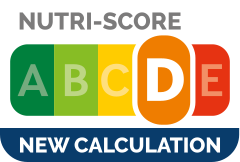 Lower nutritional quality
Nutri-Score data warning
Nutrient levels
Fat in moderate quantity (6.7%)
Saturated fat in low quantity (0.7%)
Sugars in low quantity (0.8%)
Salt in high quantity (1.8%)
Nutrition label

Nutrition facts
| Nutrition facts | As sold for 100 g / 100 ml | Compared to: Pizza dough |
|---|---|---|
| Energy | 1187 kJ (281 kcal) | 1,140.703 kJ (273 kcal) (+4%) |
| Fat | 6.7 g | 5.012 g (+34%) |
| Saturated fat | 0.7 g | 0.946 g (-26%) |
| Carbohydrates | 47 g | 46.608 g (+1%) |
| Sugars | 0.8 g | 1.993 g (-60%) |
| Dietary fiber | 3 g | ? |
| Proteins | 6.8 g | 7.629 g (-11%) |
| Salt | 1.8 g | 1.435 g (+25%) |
| Sodium | 0.72 g | 0.575 g (+25%) |
| Fruits, vegetables and legumes | ~ 0 % | ? |
Nutrition facts (Detailed data)
| Nutrition facts | As sold for 100 g / 100 ml | As sold Per 100 g (packaging) | As sold Per 100 g (estimate) |
|---|---|---|---|
| Energy | 1187 kJ (281 kcal) | 1187 kJ (283 kcal) | ~ 1306.72305555556 kJ (311 kcal) |
| Fat | 6.7 g | 6.7 g | ~ 12.4179059722222 g |
| Saturated fat | 0.7 g | 0.7 g | ~ 1.48721 g |
| Carbohydrates | 47 g | 47 g | ~ 39.1371625 g |
| Sugars | 0.8 g | 0.8 g | ~ 0.885688888888889 g |
| Dietary fiber | 3 g | 3 g | ~ 5.27835416666667 g |
| Proteins | 6.8 g | 6.8 g | ~ 8.23948486111111 g |
| Salt | 1.8 g | 1.8 g | ~ 0.980408013888889 g |
| Sodium | 0.72 g | 0.72 g | ~ 0.379399444444444 g |
| Fruits, vegetables and legumes | ~ 0 % | ? | ~ 0 % |
Ingredients
Ingredients image

Ingredients list
Ingredient information
Allergens
Ingredients analysis
No ingredients containing palm oil.
No non-vegan ingredients.
No non-vegetarian ingredients.
Food Processing
NOVA group
 Ultra-processed food and drink products
Elements that indicate the product is in NOVA group 4
How NOVA works
Additives
E1510 - Ethanol
Ethanol, also called alcohol, ethyl alcohol, grain alcohol, and drinking alcohol, is a chemical compound, a simple alcohol with the chemical formula C2H5OH. Its formula can be also written as CH3−CH2−OH or C2H5−OH (an ethyl group linked to a hydroxyl group), and is often abbreviated as EtOH. Ethanol is a volatile, flammable, colorless liquid with a slight characteristic odor. It is a psychoactive substance and is the principal type of alcohol found in alcoholic drinks. Ethanol is naturally produced by the fermentation of sugars by yeasts or via petrochemical processes, and is most commonly consumed as a popular recreational drug. It also has medical applications as an antiseptic and disinfectant. The compound is widely used as a chemical solvent, either for scientific chemical testing or in synthesis of other organic compounds, and is a vital substance used across many different kinds of manufacturing industries. Ethanol is also used as a clean-burning fuel source.
E341 - Calcium phosphates EFSA overexposure risk: highEmulsifierHumectantSequestrantStabiliserThickener
Calcium phosphate is a family of materials and minerals containing calcium ions (Ca2+) together with inorganic phosphate anions. Some so-called calcium phosphates contain oxide and hydroxide as well. They are white solids of nutritious value.
E500 - Sodium carbonatesStabiliserThickener
Sodium carbonates (E500) are compounds commonly used in food preparation as leavening agents, helping baked goods rise by releasing carbon dioxide when they interact with acids.
Often found in baking soda, they regulate the pH of food, preventing it from becoming too acidic or too alkaline. In the culinary world, sodium carbonates can also enhance the texture and structure of foods, such as noodles, by modifying the gluten network.
Generally recognized as safe, sodium carbonates are non-toxic when consumed in typical amounts found in food.
E500i - Sodium carbonateStabiliserThickener
No additive description is available yet.
Environment
Green-Score, origins bonus, and transportation impact are shown for Worldwide .
Green Score
Overall grade
 Very low environmental impact
About Green-Score
Current scope
Life cycle analysis
Average impact of the category
Pizza base, raw • Score: 90/100Life-cycle reference
Overall environmental impact by stage (PEF)
The overall environmental impact figure (PEF) comes from ADEME's Agribalyse database, for the category: Pizza base, raw. Source: ADEME Agribalyse Database.
| Stage | Impact |
|---|---|
| Agriculture | 34.8 % |
| Processing | 16.7 % |
| Packaging | 15.8 % |
| Transportation | 9.3 % |
| Distribution | 5.0 % |
| Consumption | 18.3 % |
Bonuses and maluses
Production system
Declared origins
Packaging impact
Green-Score for this product
Green-Score for this product
Final score: 95/100Final score breakdown
Carbon footprint
Carbon footprint
Climate impact by stage (CO2e)
The carbon emission figure comes from ADEME's Agribalyse database, for the category: Pizza base, raw. Source: ADEME Agribalyse Database.
| Stage | Impact |
|---|---|
| Agriculture | 26.3 % |
| Processing | 12.4 % |
| Packaging | 34.1 % |
| Transportation | 17.4 % |
| Distribution | 3.0 % |
| Consumption | 6.8 % |
Packaging
Packaging impact
Packaging components
| Shape | Material | Recycling | Impact |
|---|---|---|---|
| Unknown | Plastic | Unknown | High |
Declared packaging
Data precision
Transportation
Declared origins
Forest footprint
Forest footprint
Deforestation risk details
Data Source
Product data comes from Open Food Facts. Food Benchmark also adds translations, category comparisons and explanatory calculations.
The database is licensed under ODbL 1.0, individual contents under DbCL 1.0, and product photos under CC BY-SA 3.0.
Product added on March 5, 2017 at 10:28:21 AM UTC by openfoodfacts-contributors .
Last edit on March 17, 2026 at 10:46:39 AM UTC by new-nutrition-bot .
Product page also edited by claude-v, date-limite-app, fix-serving-size-bot, new-nutrition-bot, openfoodfacts-contributors, packbot, psine.