

Saladinettes, Salat Hellas
Labels
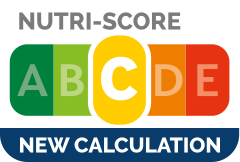 Moderate nutritional quality
 Ultra-processed food and drink products
 Green-Score not computed
Health
Nutrition
Label
Moderate nutritional qualityNutrient levels
Fat in moderate quantity (10.3%)
Saturated fat in moderate quantity (2.8%)
Sugars in low quantity (2.8%)
Salt in moderate quantity (1.36%)
Nutrition label

Nutrition facts
| Nutrition facts | As sold for 100 g / 100 ml |
|---|---|
| Energy | ~ 516.1 kJ (125 kcal) |
| FAT | 10.3 g |
| Saturated fat | 2.8 g |
| Carbohydrates | 3.6 g |
| Sugars | 2.8 g |
| Dietary fiber | 2 g |
| Proteins | 3.4 g |
| Salt | 1.36 g |
| Sodium | 0.54 g |
| Minerals | |
| Fruits, vegetables and legumes | ~ 40.66 % |
Nutrition facts (Detailed data)
| Nutrition facts | As sold for 100 g / 100 ml | As sold Per 100 g (packaging) | As sold Per 100 g (estimate) |
|---|---|---|---|
| Energy | ~ 516.1 kJ (125 kcal) | ? (125 kcal) | ? |
| FAT | 10.3 g | 10.3 g | ? |
| Saturated fat | 2.8 g | 2.8 g | ? |
| Carbohydrates | 3.6 g | 3.6 g | ? |
| Sugars | 2.8 g | 2.8 g | ? |
| Added sugars | ~ 0 g | ? | ~ 0 g |
| Dietary fiber | 2 g | 2 g | ? |
| Proteins | 3.4 g | 3.4 g | ? |
| Salt | 1.36 g | 1.36 g | ? |
| Sodium | 0.54 g | 0.54 g | ? |
| Minerals | |||
| Fruits, vegetables and legumes | ~ 40.66 % | ? | ~ 40.66 % |
Serving size
Estimated Activity Time
Approximate time needed to burn the energy in 100 g / 100 ml: 516 kJ. Reference adult weight: 70 kg. Energy density: Low.
Ingredients
Ingredients image

Ingredients list
Ingredient information
Allergens
Traces
Ingredients analysis
Palm oil content unknown
Contains non-vegan ingredients.
Unrecognized: de:lollo-bionda, de:lollo-rosso, de:kuhmilchkäse-in-salzlake
Vegetarian status unknown
Unrecognized: de:lollo-bionda, de:lollo-rosso, de:kuhmilchkäse-in-salzlake
Food Processing
NOVA group
Ultra-processed food and drink productsElements that indicate the product is in NOVA group 4
How NOVA works
Additives
E270 - Lactic acid
LACTIC ACID is an organic compound with the formula CH3CH(OH)CO2H. In the form of its conjugate base called lactate (this is thus different and kept as a separate ingredient). Lactic acid is chiral, consisting of two optical isomers. One is known as L-(+)-lactic acid or (S)-lactic acid and the other, its mirror image, is D-(−)-lactic acid or (R)-lactic acid in food the L-variant is used
E296 - Malic acid
MALIC ACID is an organic compound with the molecular formula C4H6O5. Malic acid has two stereoisomeric forms (L- and D-enantiomers), though only the L-isomer exists naturally.
E300 - Ascorbic acidAntioxidantSequestrant
No additive description is available yet.
E330 - Citric acidAntioxidantSequestrant
Citric acid is a natural organic acid found in citrus fruits such as lemons, oranges, and limes.
It is widely used in the food industry as a flavor enhancer, acidulant, and preservative due to its tart and refreshing taste.
Citric acid is safe for consumption when used in moderation and is considered a generally recognized as safe (GRAS) food additive by regulatory agencies worldwide.
E401 - sodium alginateCarrierEmulsifierHumectantSequestrantStabiliserThickener
No additive description is available yet.
E415 - Xanthan gumEmulsifierStabiliserThickener
Xanthan gum (E415) is a natural polysaccharide derived from fermented sugars, often used in the food industry as a thickening and stabilizing agent.
This versatile food additive enhances texture and prevents ingredient separation in a wide range of products, including salad dressings, sauces, and gluten-free baked goods.
It is considered safe for consumption even at high intake amounts.
E509 - Calcium chlorideStabiliserThickenerCoagulant
Calcium chloride is an inorganic compound, a salt with the chemical formula CaCl2. It is a colorless crystalline solid at room temperature, highly soluble in water. Calcium chloride is commonly encountered as a hydrated solid with generic formula CaCl2(H2O)x, where x = 0, 1, 2, 4, and 6. These compounds are mainly used for de-icing and dust control. Because the anhydrous salt is hygroscopic, it is used as a desiccant.
E954 - saccharin and its saltsSweetener
Sodium saccharin (benzoic sulfimide) is an artificial sweetener with effectively no food energy. It is about 300–400 times as sweet as sucrose but has a bitter or metallic aftertaste, especially at high concentrations. Saccharin is used to sweeten products such as drinks, candies, cookies, and medicines.
Environment
Green-Score, origins bonus, and transportation impact are shown for Worldwide .
Green Score
Overall grade
Unknown environmental impactAbout Green-Score
Current scope
Green-Score availability
Bonuses and maluses
Declared origins
Packaging impact
Packaging
Packaging impact
Data precision
Transportation
Declared origins
Forest footprint
Forest footprint
Ingredients linked to forest pressure
| Ingredient | Type | Percent in product | Forest footprint |
|---|---|---|---|
| Chicken EGG Yolk | Oeufs Importés | 0.00 % | 0.00 |
| Barn Eggs | Oeufs Importés | 25.00 % | 0.02 |
Data Source
Data presented on this page is sourced from the Open Food Facts database. This platform does not alter the original dataset; its purpose is solely to enhance data visualization and user accessibility.
Product added on January 24, 2018 at 6:34:26 PM UTC by kiliweb .
Last edit on March 17, 2026 at 8:36:42 PM UTC by new-nutrition-bot .
Product page also edited by anticultist, foodvisor, inf, kiliweb, macrofactor, mahlzahn, new-nutrition-bot, openfoodfacts-contributors, prepperapp, quentinbrd, roboto-app, teolemon, yuka.Ykw0SkRxQURnZGtxdE1ZYnpCUEo0czhrbHJ6MmNraVVjTnRQSVE9PQ, yuka.sY2b0xO6T85zoF3NwEKvlhN8CcLP-mPtEEPSt0KA_cmLN4XmQNxK-dWmOKs, yuka.sY2b0xO6T85zoF3NwEKvlhcZT8CAkjjPCRzUuWLT3_qWNIPERYtLx6_2Lag.