

Roomboter gevulde koeken
Health
Nutrition
Nutri-Score
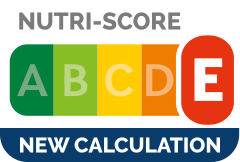 Lower nutritional quality
Nutri-Score data warning
Nutrient levels
Fat in moderate quantity (14.7%)
Saturated fat in high quantity (8.8%)
Sugars in high quantity (38.7%)
Salt in moderate quantity (0.4%)
Nutrition label

Nutrition facts
| Nutrition facts | As sold for 100 g / 100 ml | Compared to: Filled biscuits |
|---|---|---|
| Energy | 1705 kJ (406 kcal) | 1,965.814 kJ (469 kcal) (-13%) |
| Fat | 14.7 g | 19.583 g (-25%) |
| Saturated fat | 8.8 g | 8.525 g (+3%) |
| Carbohydrates | 61 g | 66.163 g (-8%) |
| Sugars | 38.7 g | 33.152 g (+17%) |
| Dietary fiber | 2.4 g | ? |
| Proteins | 6.3 g | 5.657 g (+11%) |
| Salt | 0.4 g | 0.52 g (-23%) |
| Sodium | 0.16 g | 0.208 g (-23%) |
| Fruits, vegetables and legumes | ~ 7.4 % | ? |
Nutrition facts (Detailed data)
| Nutrition facts | As sold for 100 g / 100 ml | As sold Per 100 g (packaging) | As sold Per 100 g (estimate) |
|---|---|---|---|
| Energy | 1705 kJ (406 kcal) | 1705 kJ (406 kcal) | ~ 1691.9784375 kJ (401 kcal) |
| Fat | 14.7 g | 14.7 g | ~ 14.540390625 g |
| Saturated fat | 8.8 g | 8.8 g | ~ 8.2671165625 g |
| Carbohydrates | 61 g | 61 g | ~ 68.062728125 g |
| Sugars | 38.7 g | 38.7 g | ~ 44.3459803125 g |
| Dietary fiber | 2.4 g | 2.4 g | ~ 2.984865625 g |
| Proteins | 6.3 g | 6.3 g | ~ 5.9288325 g |
| Salt | 0.4 g | 0.4 g | ~ 0.033248775 g |
| Sodium | 0.16 g | 0.16 g | ~ 0.00571027625 g |
| Fruits, vegetables and legumes | ~ 7.4 % | ? | ~ 7.4 % |
Ingredients
Ingredients image

Ingredients list
Ingredient information
Added sugars
Allergens
Ingredients analysis
Contains ingredients containing palm oil.
Contains non-vegan ingredients.
Unrecognized: en:invert-sugar, nl:amandelaroma, nl:e500-e503
Vegetarian status unknown
Unrecognized: en:invert-sugar, nl:amandelaroma, nl:e500-e503
Food Processing
NOVA group
 Ultra-processed food and drink products
Elements that indicate the product is in NOVA group 4
How NOVA works
Additives
E160a - caroteneColour
β-Carotene is an organic, strongly colored red-orange pigment abundant in plants and fruits. It is a member of the carotenes, which are terpenoids (isoprenoids), synthesized biochemically from eight isoprene units and thus having 40 carbons. Among the carotenes, β-carotene is distinguished by having beta-rings at both ends of the molecule. β-Carotene is biosynthesized from geranylgeranyl pyrophosphate.β-Carotene is the most common form of carotene in plants. When used as a food coloring, it has the E number E160a. The structure was deduced by Karrer et al. in 1930. In nature, β-carotene is a precursor (inactive form) to vitamin A via the action of beta-carotene 15,15'-monooxygenase.Isolation of β-carotene from fruits abundant in carotenoids is commonly done using column chromatography. It can also be extracted from the beta-carotene rich algae, Dunaliella salina. The separation of β-carotene from the mixture of other carotenoids is based on the polarity of a compound. β-Carotene is a non-polar compound, so it is separated with a non-polar solvent such as hexane. Being highly conjugated, it is deeply colored, and as a hydrocarbon lacking functional groups, it is very lipophilic.
E304 - Fatty acid esters of ascorbic acidAntioxidant
ASCORBYL PALMITATE is an ester formed from ascorbic acid and palmitic acid creating a fat-soluble form of vitamin C.
E307 - Alpha-tocopherol
α-Tocopherol is a type of vitamin E. It has E number "E307". Vitamin E exists in eight different forms, four tocopherols and four tocotrienols. All feature a chromane ring, with a hydroxyl group that can donate a hydrogen atom to reduce free radicals and a hydrophobic side chain which allows for penetration into biological membranes. Compared to the others, α-tocopherol is preferentially absorbed and accumulated in humans.
E420 - SorbitolHumectantSequestrantStabiliserSweetenerThickener
Sorbitol (), less commonly known as glucitol (), is a sugar alcohol with a sweet taste which the human body metabolizes slowly. It can be obtained by reduction of glucose, which changes the aldehyde group to a hydroxyl group. Most sorbitol is made from corn syrup, but it is also found in nature, for example in apples, pears, peaches, and prunes. It is converted to fructose by sorbitol-6-phosphate 2-dehydrogenase. Sorbitol is an isomer of mannitol, another sugar alcohol; the two differ only in the orientation of the hydroxyl group on carbon 2. While similar, the two sugar alcohols have very different sources in nature, melting points, and uses.
E482 - Calcium stearoyl-2-lactylate EFSA overexposure risk: highEmulsifierStabiliser
Calcium stearoyl-2-lactylate (calcium stearoyl lactylate or CSL) or E482 is a versatile, FDA approved food additive. It is one type of a commercially available lactylate. CSL is non-toxic, biodegradable, and typically manufactured using biorenewable feedstocks. Because CSL is a safe and highly effective food additive, it is used in a wide variety of products from baked goods and desserts to packaging.As described by the Food Chemicals Codex 7th edition, CSL is a cream-colored powder. CSL is currently manufactured by the esterification of stearic acid and lactic acid with partial neutralization using food-grade hydrated lime (calcium hydroxide). Commercial grade CSL is a mixture of calcium salts of stearoyl lactic acid, with minor proportions of other salts of related acids. The HLB for CSL is 5.1. It is slightly soluble in hot water. The pH of a 2% aqueous suspension is approximately 4.7.
E500 - Sodium carbonatesStabiliserThickener
Sodium carbonates (E500) are compounds commonly used in food preparation as leavening agents, helping baked goods rise by releasing carbon dioxide when they interact with acids.
Often found in baking soda, they regulate the pH of food, preventing it from becoming too acidic or too alkaline. In the culinary world, sodium carbonates can also enhance the texture and structure of foods, such as noodles, by modifying the gluten network.
Generally recognized as safe, sodium carbonates are non-toxic when consumed in typical amounts found in food.
Environment
Green-Score, origins bonus, and transportation impact are shown for Worldwide .
Green Score
Overall grade
 High environmental impact
About Green-Score
Current scope
Life cycle analysis
Average impact of the category
 Biscuit (cookie) • Score: 67/100
Life-cycle reference
Overall environmental impact by stage (PEF)
The overall environmental impact figure (PEF) comes from ADEME's Agribalyse database, for the category: Biscuit (cookie). Source: ADEME Agribalyse Database.
| Stage | Impact |
|---|---|
| Agriculture | 68.5 % |
| Processing | 10.1 % |
| Packaging | 15.5 % |
| Transportation | 4.5 % |
| Distribution | 1.5 % |
| Consumption | 0.0 % |
Bonuses and maluses
Declared origins
Threatened species risk
Packaging impact
Green-Score for this product
Green-Score for this product
Final score: 37/100Final score breakdown
Carbon footprint
Carbon footprint
Climate impact by stage (CO2e)
The carbon emission figure comes from ADEME's Agribalyse database, for the category: Biscuit (cookie). Source: ADEME Agribalyse Database.
| Stage | Impact |
|---|---|
| Agriculture | 63.5 % |
| Processing | 5.2 % |
| Packaging | 24.5 % |
| Transportation | 5.9 % |
| Distribution | 0.7 % |
| Consumption | 0.0 % |
Packaging
Packaging impact
Packaging materials
| Material | % | Packaging weight | Packaging weight per 100 g of product |
|---|---|---|---|
| Plastic | 100 % | 9.5 g | |
| Total | 100 % | 9.5 g |
Packaging components
| Shape | Material | Recycling | Impact |
|---|---|---|---|
| 1 BAG (300 g) | Plastic | Unknown | High |
| 1 Tray (300 g) | Plastic | Unknown | High |
Transportation
Declared origins
Forest footprint
Forest footprint
Ingredients linked to forest pressure
| Ingredient | Type | Percent in product | Forest footprint |
|---|---|---|---|
| Free Range EGG Yolk | Oeufs Importés | 1.59 % | 0.00 |
Data Source
Product data comes from Open Food Facts. Food Benchmark also adds translations, category comparisons and explanatory calculations.
The database is licensed under ODbL 1.0, individual contents under DbCL 1.0, and product photos under CC BY-SA 3.0.
Product added on August 11, 2018 at 7:45:23 AM UTC by kiliweb .
Last edit on March 17, 2026 at 10:08:29 AM UTC by new-nutrition-bot .
Product page also edited by aleene, annelotte, autorotate-bot, foodvisor, kiliweb, new-nutrition-bot, openfoodfacts-contributors, roboto-app, teolemon, yuka.C7dvGPKkNZA4BMfw8Kg1zmiASefSI8JSNycSog, yuka.YXI0L1BxWlIrOVlIcWZJRnBFMzB4KzE2elpHM1kxaUZGY2dKSVE9PQ, yuka.sY2b0xO6T85zoF3NwEKvlhBsaeKBiCnHbw3htWKS6PC1Db70aIFd_7nUKas.