

Noodles Sweet and Sour
Labels
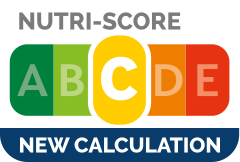 Moderate nutritional quality
 Ultra-processed food and drink products
 Green-Score not computed
Health
Nutrition
Label
Moderate nutritional qualityNutrient levels
Fat in low quantity (1.5%)
Saturated fat in low quantity (0.3%)
Sugars in moderate quantity (7.4%)
Salt in moderate quantity (0.708%)
Nutrition label

Nutrition facts
| Nutrition facts | As sold for 100 g / 100 ml |
|---|---|
| Energy | ~ 589.3 kJ (141 kcal) |
| FAT | 1.5 g |
| Saturated fat | 0.3 g |
| Carbohydrates | 28 g |
| Sugars | 7.4 g |
| Dietary fiber | ? |
| Proteins | 3.4 g |
| Salt | 0.71 g |
| Sodium | 0.28 g |
| Minerals | |
| Fruits, vegetables and legumes | ~ 8.45 % |
Nutrition facts (Detailed data)
| Nutrition facts | As sold for 100 g / 100 ml | As sold Per 100 g (packaging) | As sold Per 100 g (estimate) |
|---|---|---|---|
| Energy | ~ 589.3 kJ (141 kcal) | ? (141 kcal) | ? |
| FAT | 1.5 g | 1.5 g | ? |
| Saturated fat | 0.3 g | 0.3 g | ? |
| Carbohydrates | 28 g | 28 g | ? |
| Sugars | 7.4 g | 7.4 g | ? |
| Added sugars | ~ 7.25 g | ? | ~ 7.25 g |
| Dietary fiber | ? | ? | ? |
| Proteins | 3.4 g | 3.4 g | ? |
| Salt | 0.71 g | 0.71 g | ? |
| Sodium | 0.28 g | 0.28 g | ? |
| Minerals | |||
| Fruits, vegetables and legumes | ~ 8.45 % | ? | ~ 8.45 % |
Serving size
Estimated Activity Time
Approximate time needed to burn the energy in 100 g / 100 ml: 589 kJ. Reference adult weight: 70 kg. Energy density: Low.
Ingredients
Ingredients image

Ingredients list
Ingredient information
Allergens
Traces
Ingredients analysis
No ingredients containing palm oil.
Vegan status unknown
Unrecognized: fr:rapporte-au-produit-fini
Vegetarian status unknown
Unrecognized: fr:rapporte-au-produit-fini
Food Processing
NOVA group
Ultra-processed food and drink productsElements that indicate the product is in NOVA group 4
How NOVA works
Additives
E14XX - Modified StarchEmulsifierStabiliserThickener
No additive description is available yet.
E160c - Paprika extractColour
No additive description is available yet.
E270 - Lactic acid
LACTIC ACID is an organic compound with the formula CH3CH(OH)CO2H. In the form of its conjugate base called lactate (this is thus different and kept as a separate ingredient). Lactic acid is chiral, consisting of two optical isomers. One is known as L-(+)-lactic acid or (S)-lactic acid and the other, its mirror image, is D-(−)-lactic acid or (R)-lactic acid in food the L-variant is used
E307 - Alpha-tocopherol
α-Tocopherol is a type of vitamin E. It has E number "E307". Vitamin E exists in eight different forms, four tocopherols and four tocotrienols. All feature a chromane ring, with a hydroxyl group that can donate a hydrogen atom to reduce free radicals and a hydrophobic side chain which allows for penetration into biological membranes. Compared to the others, α-tocopherol is preferentially absorbed and accumulated in humans.
E330 - Citric acidAntioxidantSequestrant
Citric acid is a natural organic acid found in citrus fruits such as lemons, oranges, and limes.
It is widely used in the food industry as a flavor enhancer, acidulant, and preservative due to its tart and refreshing taste.
Citric acid is safe for consumption when used in moderation and is considered a generally recognized as safe (GRAS) food additive by regulatory agencies worldwide.
E339 - Sodium phosphatesEmulsifierHumectantPreservativeSequestrantStabiliserThickener
TRISODIUM PHOSPHATE is the inorganic compound with the chemical formula Na3PO4.
E500 - Sodium carbonatesStabiliserThickener
Sodium carbonates (E500) are compounds commonly used in food preparation as leavening agents, helping baked goods rise by releasing carbon dioxide when they interact with acids.
Often found in baking soda, they regulate the pH of food, preventing it from becoming too acidic or too alkaline. In the culinary world, sodium carbonates can also enhance the texture and structure of foods, such as noodles, by modifying the gluten network.
Generally recognized as safe, sodium carbonates are non-toxic when consumed in typical amounts found in food.
Environment
Green-Score, origins bonus, and transportation impact are shown for Worldwide .
Green Score
Overall grade
Unknown environmental impactAbout Green-Score
Current scope
Green-Score availability
Bonuses and maluses
Declared origins
Packaging impact
Packaging

Packaging impact
Packaging materials
| Material | % | Packaging weight | Packaging weight per 100 g of product |
|---|---|---|---|
| Paper or cardboard | 100 % | 28.6 g | 8.67 g |
| Plastic | |||
| Total | 100 % | 28.6 g | 8.67 g |
Declared packaging
Transportation
Manufacturing locations
Declared origins
Data Source
Data presented on this page is sourced from the Open Food Facts database. This platform does not alter the original dataset; its purpose is solely to enhance data visualization and user accessibility.
Product added on February 6, 2017 at 10:55:49 PM UTC by neptuno .
Last edit on March 17, 2026 at 8:28:59 PM UTC by new-nutrition-bot .
Product page also edited by bitnapper, chris2506, ecoscore-impact-estimator, guezguez-majed, kiliweb, lepetitleo, macrofactor, neptuno, new-nutrition-bot, openfoodfacts-contributors, packbot, quechoisir, roboto-app, scanbot, yuka.VElrcUw2a2hpOW9YeC9BQzVqbkl4c0pweGIrc0JqNlFPZThUSVE9PQ, yuka.sY2b0xO6T85zoF3NwEKvlmUfV_yCpw7kGwbTs1Kt6-WSL6f0Z-994IvzGqo, yuka.sY2b0xO6T85zoF3NwEKvlmhnDIOBjyqUbSLfxnOr1-ued6flbstNwaukFas.