

Space UFO's
Labels
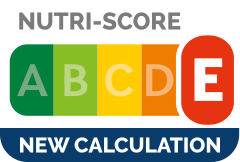 Bad nutritional quality
 Ultra-processed food and drink products
 Not computed
Health
Nutrition
Nutri-Score label
Bad nutritional qualityNutrient levels for 100 g
Fat in low quantity (?)
What you need to know
A high consumption of fat, especially saturated fats, can raise cholesterol, which increases the risk of heart diseases.
Recommendation: Limit the consumption of fat and saturated fat
Choose products with lower fat and saturated fat content.
Saturated fat in low quantity (?)
What you need to know
A high consumption of fat, especially saturated fats, can raise cholesterol, which increases the risk of heart diseases.
Recommendation: Limit the consumption of fat and saturated fat
Choose products with lower fat and saturated fat content.
Sugars in high quantity (?)
What you need to know
A high consumption of sugar can cause weight gain and tooth decay. It also augments the risk of type 2 diabetes and cardio-vascular diseases.
Recommendation: Limit the consumption of sugar and sugary drinks
Sugary drinks should be limited as much as possible. Choose products with lower sugar content.
Salt in moderate quantity (?)
What you need to know
A high consumption of salt (or sodium) can cause raised blood pressure, which can increase the risk of heart disease and stroke.
Recommendation: Limit the consumption of salt and salted food
Reduce the quantity of salt used when cooking. Limit the consumption of salty snacks.
Nutrition Facts
| Nutrition Facts | As sold for 100 g / 100 ml |
|---|---|
| Energy | ? |
| Fat | ? |
| Saturated fat | ? |
| Carbohydrates | ? |
| Sugars | ? |
| Dietary fiber | ? |
| Proteins | ? |
| Salt | ? |
| Sodium | ? |
Ingredients
Ingredients List
Ingredient Information
Food Processing
NOVA Group label
Ultra-processed food and drink productsElements that indicate the product is in the NOVA group 4:
- Additives: E100 - Curcumin
- Additives: E162 - Beetroot red
- Ingredients: Colour
- Ingredients: Dextrose
- Ingredients: Glucose
The NOVA classification assigns food products into 4 groups based on their degree of processing:
- Unprocessed or minimally processed foods
- Processed culinary ingredients
- Processed foods
- Ultra-processed food and drink products
Ingredients analysis
Palm oil free
No ingredients containing palm oil.
Vegan
Vegan status unknown
Vegetarian
No non-vegetarian ingredients.
Additives
E100 - CurcuminColour
No additive description is available yet.
E162 - Beetroot redColour
Betanin, or Beetroot Red, is a red glycosidic food dye obtained from beets; its aglycone, obtained by hydrolyzing away the glucose molecule, is betanidin. As a food additive, its E number is E162. The color of betanin depends on pH; between four and five it is bright bluish-red, becoming blue-violet as the pH increases. Once the pH reaches alkaline levels betanin degrades by hydrolysis, resulting in a yellow-brown color. Betanin is a betalain pigment, together with isobetanin, probetanin, and neobetanin. Other pigments contained in beet are indicaxanthin and vulgaxanthins.
E334 - L(+)-tartaric acidAntioxidantSequestrant
TARTARIC ACID is a white, crystalline organic acid that occurs naturally in many fruits, most notably in grapes, but also in bananas, tamarinds, and citrus
E500 - Sodium carbonatesStabiliserThickener
Sodium carbonates (E500) are compounds commonly used in food preparation as leavening agents, helping baked goods rise by releasing carbon dioxide when they interact with acids.
Often found in baking soda, they regulate the pH of food, preventing it from becoming too acidic or too alkaline. In the culinary world, sodium carbonates can also enhance the texture and structure of foods, such as noodles, by modifying the gluten network.
Generally recognized as safe, sodium carbonates are non-toxic when consumed in typical amounts found in food.
Environment
Environmental score label
Not computedCarbon footprint
No carbon footprint data is available for this product.
Packaging
Plastic, Bag
Transportation and origins
Origins of ingredients
No origin information provided.
Manufacturing places
No manufacturing place information provided.
Environmental labels
No environmental labels identified.
Data Source
Product added on April 16, 2017 at 10:57:21 AM UTC by openfoodfacts-contributors .
Last edit on March 17, 2026 at 6:20:01 PM UTC by new-nutrition-bot .
Product page also edited by beniben, inf, kiliweb, new-nutrition-bot, openfoodfacts-contributors, packbot, tacite-mass-editor, yuka.WjZrcENaMGh0TmRXcE04eG94RG4yNE54L0syeUJuMm1CT0V1SVE9PQ, yuka.YTQ0OUVvWWs5OFlEdWNBNDVCZVBwKzFiemJTRURGL3ZHdmd3SVE9PQ, yukafix.