ProductsMilbonaVla met vanillesmaak
Vla met vanillesmaak
Barcode 20046699
Milbona

Vla met vanillesmaak

1000 ml
BARCODE:20046699
CATEGORIES:Dairies, Desserts, Dairy Desserts, Creamy Puddings, Vanilla Creamy Puddings
LABELS:Animal Welfare, Fsc, Fsc Mix, Lait De Paturage
PACKAGING:Nl Z0816 Eg
COUNTRIES:France, Netherlands
STORES:Lidl

Labels

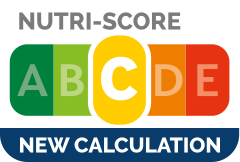
Nutri-Score
Nutri-ScoreModerate nutritional quality
NOVA Group
NOVA GroupUltra-processed food and drink products
Environmental Score
Environmental ScoreNot computed

Health

Nutrition

Label

CModerate nutritional quality

Nutrient levels

Fat in low quantity (2.9%)
What you need to know • A high consumption of fat, especially saturated fats, can raise cholesterol, which increases the risk of heart diseases. Recommendation: Limit the consumption of fat and saturated fat • Choose products with lower fat and saturated fat content. Source: National Health Service UK (NHS) - Fat: the facts
Saturated fat in moderate quantity (1.9%)
What you need to know • A high consumption of fat, especially saturated fats, can raise cholesterol, which increases the risk of heart diseases. Recommendation: Limit the consumption of fat and saturated fat • Choose products with lower fat and saturated fat content. Source: National Health Service UK (NHS) - Fat: the facts
Sugars in moderate quantity (9%)
What you need to know • A high consumption of sugar can cause weight gain and tooth decay. It also augments the risk of type 2 diabetes and cardio-vascular diseases. Recommendation: Limit the consumption of sugar and sugary drinks • Sugary drinks (such as sodas, fruit beverages, and fruit juices and nectars) should be limited as much as possible (no more than 1 glass a day). • Choose products with lower sugar content and reduce the consumption of products with added sugars. Source: National Health Service UK (NHS) - Sugar: the facts
Salt in low quantity (0.12%)
What you need to know • A high consumption of salt (or sodium) can cause raised blood pressure, which can increase the risk of heart disease and stroke. • Many people who have high blood pressure do not know it, as there are often no symptoms. • Most people consume too much salt (on average 9 to 12 grams per day), around twice the recommended maximum level of intake. Recommendation: Limit the consumption of salt and salted food • Reduce the quantity of salt used when cooking, and don't salt again at the table. • Limit the consumption of salty snacks and choose products with lower salt content. Source: World Health Organization (WHO) - Fact sheet - Salt reduction Source: National Health Service UK (NHS) - Salt: the facts

Nutrition label

Vla met vanillesmaak nutrition label

Nutrition facts

Nutrition factsAs sold for 100 ml
Energy371 kJ (88 kcal)
FAT2.9 g
Saturated fat1.9 g
Carbohydrates13 g
Sugars9 g
Dietary fiber0 g
Proteins2.5 g
Salt0.12 g
Sodium0.05 g
Minerals
Fruits, vegetables and legumes~ 0 %

Nutrition facts (Detailed data)

Nutrition factsAs sold for 100 mlAs sold Per 100 ml (packaging)As sold Per 100 g (estimate)
Energy371 kJ (88 kcal)371 kJ (88 kcal)?
FAT2.9 g2.9 g?
Saturated fat1.9 g1.9 g?
Carbohydrates13 g13 g?
Sugars9 g9 g?
Added sugars~ 4.5 g?~ 4.5 g
Dietary fiber0 g0 g?
Proteins2.5 g2.5 g?
Salt0.12 g0.12 g?
Sodium0.05 g0.05 g?
Minerals
Fruits, vegetables and legumes~ 0 %?~ 0 %

Serving size

150 ml

Estimated Activity Time

Approximate time needed to burn the energy in 100 g / 100 ml: 371 kJ. Reference adult weight: 70 kg. Energy density: Low.

Walking
22 min (~2,163 steps)
Swimming
13 min
Bicycling
10 min
Running
8 min

Ingredients

Ingredients image

Vla met vanillesmaak ingredients image

Ingredients list

milk, liquid milk solids (milk proteins, lactose, cream, water), sugar, modified starch (corn), corn starch, salt, thickener: carrageenan, colors: annatto, curcumin, flavor,

Ingredient information

Milk
61.2% (estimate)
Milk
19.4% (estimate)
Milk Proteins
9.7% (estimate)
Lactose
4.85% (estimate)
Cream
2.43% (estimate)
Water
2.43% (estimate)
Sugar
4.5% (estimate)
Modified Starch
4.5% (estimate)
Corn
4.5% (estimate)
Corn Starch
4.5% (estimate)
Salt
0.06% (estimate)
Thickener
0.06% (estimate)
E407
0.06% (estimate)
Colour
0.06% (estimate)
E160b
0.06% (estimate)
E100
0.06% (estimate)
Flavouring
5.66% (estimate)

Allergens

MilkMelkMelkeiwittenRoomMilk

Traces

Milk

Ingredients analysis

Palm oil free
Yes

No ingredients containing palm oil.

Vegan
No

Contains non-vegan ingredients.

Vegetarian
Unknown

Vegetarian status unknown


Food Processing

NOVA group

4Ultra-processed food and drink products

Elements that indicate the product is in NOVA group 4

Additives
E100 - Curcumin
Additives
E14XX - Modified Starch
Additives
E160b - Annatto
Additives
E407 - Carrageenan
Ingredients
Colour
Ingredients
Flavouring
Ingredients
Lactose
Ingredients
Milk Proteins
Ingredients
Thickener
Ingredients
Modified Starch

How NOVA works

The NOVA classification assigns food products into 4 groups based on their degree of processing: 1. Unprocessed or minimally processed foods 2. Processed culinary ingredients 3. Processed foods 4. Ultra-processed food and drink products

Additives

E100 - CurcuminColour

No additive description is available yet.

E14XX - Modified StarchEmulsifierStabiliserThickener

No additive description is available yet.

E160b - AnnattoColour

No additive description is available yet.

E407 - CarrageenanCarrierEmulsifierHumectantStabiliserThickener

Carrageenan (E407), derived from red seaweed, is widely employed in the food industry as a gelling, thickening, and stabilizing agent, notably in dairy and meat products.

It can exist in various forms, each imparting distinct textural properties to food.

However, its degraded form, often referred to as poligeenan, has raised health concerns due to its potential inflammatory effects and its classification as a possible human carcinogen (Group 2B) by the International Agency for Research on Cancer (IARC).

Nevertheless, food-grade carrageenan has been deemed safe by various regulatory bodies when consumed in amounts typically found in food.

Environment

Packaging

Nl Z0816 Eg

Packaging details

en:brick
1 unit(s) • en:brick • en:cardboard

Data Source

Data presented on this page is sourced from the Open Food Facts database. This platform does not alter the original dataset; its purpose is solely to enhance data visualization and user accessibility.

Product added on June 5, 2018 at 4:47:08 PM UTC by bram .

Last edit on March 17, 2026 at 3:06:53 PM UTC by new-nutrition-bot .

Product page also edited by aleene, autorotate-bot, bertusdendroef, bodysupport, bram, desan, inf, kiliweb, meloen61, new-nutrition-bot, nezs01, openfoodfacts-contributors, raphael0202, roboto-app, worldtest, yuka.YXJrUUM2b1l1K3NsbzhSbDVnanJwK3gvdzdtc2ZubWNOYkF6SUE9PQ.