

Holliday
Labels
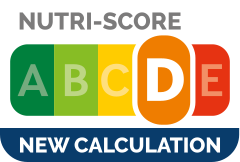 Poor nutritional quality
 Ultra-processed food and drink products
 Not computed
Health
Nutrition
Label
Poor nutritional qualityNutrient levels
Fat in low quantity (0%)
Saturated fat in low quantity (0%)
Sugars in high quantity (52%)
Salt in low quantity (0.1%)
Nutrition label

Nutrition facts
| Nutrition facts | As sold for 100 g / 100 ml |
|---|---|
| Energy | ~ 1,292 kJ (332 kcal) |
| FAT | 0 g |
| Saturated fat | 0 g |
| Carbohydrates | 76 g |
| Sugars | 52 g |
| Dietary fiber | ? |
| Proteins | 0 g |
| Salt | 0.1 g |
| Sodium | 0.04 g |
| Minerals | |
| Fruits, vegetables and legumes | ~ 0 % |
Nutrition facts (Detailed data)
| Nutrition facts | As sold for 100 g / 100 ml | As sold Per 100 g (packaging) | As sold Per 100 g (estimate) |
|---|---|---|---|
| Energy | ~ 1,292 kJ (332 kcal) | ? (332 kcal) | ? |
| FAT | 0 g | 0 g | ? |
| Saturated fat | 0 g | 0 g | ? |
| Carbohydrates | 76 g | 76 g | ? |
| Sugars | 52 g | 52 g | ? |
| Added sugars | ~ 0 g | ? | ~ 0 g |
| Dietary fiber | ? | ? | ? |
| Proteins | 0 g | 0 g | ? |
| Salt | 0.1 g | 0.1 g | ? |
| Sodium | 0.04 g | 0.04 g | ? |
| Minerals | |||
| Fruits, vegetables and legumes | ~ 0 % | ? | ~ 0 % |
Estimated Activity Time
Approximate time needed to burn the energy in 100 g / 100 ml: 1,292 kJ. Reference adult weight: 70 kg. Energy density: Moderate.
Ingredients
Ingredients image

Ingredients list
Ingredient information
Ingredients analysis
Palm oil content unknown
Unrecognized: en:a-croq-a-devorer-chewing-gum, en:macedoine-chewing-gungredients, en:sucre, en:sirop-de-glucose, en:gomme-base, en:lecithine-de-soja, en:aromes, en:acidifiant, en:e295, en:agents-d-enrobage, en:colcrants, en:curcumine, en:carmins, en:bleu-brillant-fcf, en:extrait-de-paprika
Contains non-vegan ingredients.
Unrecognized: en:a-croq-a-devorer-chewing-gum, en:sucre, en:sirop-de-glucose, en:lecithine-de-soja, en:aromes, en:e295, en:curcumine, en:carmins, en:bleu-brillant-fcf, en:extrait-de-paprika
Vegetarian status unknown
Unrecognized: en:a-croq-a-devorer-chewing-gum, en:sucre, en:sirop-de-glucose, en:lecithine-de-soja, en:aromes, en:e295, en:curcumine, en:carmins, en:bleu-brillant-fcf, en:extrait-de-paprika
Food Processing
NOVA group
Ultra-processed food and drink productsElements that indicate the product is in NOVA group 4
How NOVA works
Additives
E422 - GlycerolHumectantThickener
Glycerol (; also called glycerine or glycerin; see spelling differences) is a simple polyol compound. It is a colorless, odorless, viscous liquid that is sweet-tasting and non-toxic. The glycerol backbone is found in all lipids known as triglycerides. It is widely used in the food industry as a sweetener and humectant and in pharmaceutical formulations. Glycerol has three hydroxyl groups that are responsible for its solubility in water and its hygroscopic nature.
E901 - white and yellow beeswaxCarrierEmulsifierStabiliserThickener
Beeswax (cera alba) is a natural wax produced by honey bees of the genus Apis. The wax is formed into "scales" by eight wax-producing glands in the abdominal segments of worker bees, which discard it in or at the hive. The hive workers collect and use it to form cells for honey storage and larval and pupal protection within the beehive. Chemically, beeswax consists mainly of esters of fatty acids and various long-chain alcohols. Beeswax has long-standing applications in human food and flavoring. For example, it is used as a glazing agent or as a light/heat source. It is edible, in the sense of having similar negligible toxicity to plant waxes, and is approved for food use in most countries and the European Union under the E number E901. However, the wax monoesters in beeswax are poorly hydrolysed in the guts of humans and other mammals, so they have insignificant nutritional value. Some birds, such as honeyguides, can digest beeswax. Beeswax is the main diet of wax moth larvae.
E903 - Carnauba waxCarrier
Carnauba (; Portuguese: carnaúba [kaʁnɐˈubɐ]), also called Brazil wax and palm wax, is a wax of the leaves of the palm Copernicia prunifera (Synonym: Copernicia cerifera), a plant native to and grown only in the northeastern Brazilian states of Piauí, Ceará, Maranhão, Bahia, and Rio Grande do Norte. It is known as "queen of waxes" and in its pure state, usually comes in the form of hard yellow-brown flakes. It is obtained from the leaves of the carnauba palm by collecting and drying them, beating them to loosen the wax, then refining and bleaching the wax.
Environment
Environmental score label
Not computedCarbon footprint
No carbon footprint data is available for this product.
Packaging
No packaging information provided.
Transportation and origins
Origins of ingredients
No origin information provided.
Manufacturing places
No manufacturing place information provided.
Environmental labels
No environmental labels identified.
Data Source
Data presented on this page is sourced from the Open Food Facts database. This platform does not alter the original dataset; its purpose is solely to enhance data visualization and user accessibility.
Product added on March 21, 2018 at 1:28:03 PM UTC by kiliweb .
Last edit on March 17, 2026 at 1:18:09 PM UTC by foodless .
Product page also edited by foodless, halal-app-chakib, inf, kiliweb, off-replace-bot, openfoodfacts-contributors, roboto-app, scanbot, stive24, teolemon, thaialagata, yuka.IpN6ZoSkNNExGsbe1agu1gW6C97nH68AQ0EEog, yuka.RzVvSlRxa2kvOHNidmRvZ3hoVDdwOUIyenNPckJFNnBMdWxPSUE9PQ, yuka.sY2b0xO6T85zoF3NwEKvllZWC_3CpRT7Eibum2nbz8yVLZLMQc0py6b4EKs.