
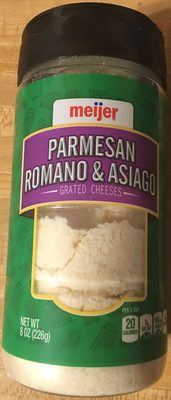
Parmesan Romano & Asiago Grated Cheeses
Labels
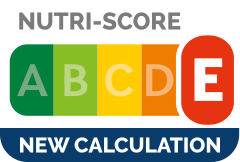 Bad nutritional quality
 Ultra-processed food and drink products
 Not computed
Health
Nutrition
Label
Bad nutritional qualityNutrient levels
Fat in moderate quantity (20%)
Saturated fat in high quantity (20%)
Sugars in low quantity (0%)
Salt in high quantity (5.08%)
Nutrition label

Nutrition facts
| Nutrition facts | As sold for 100 g / 100 ml |
|---|---|
| Energy | ~ 1,420 kJ (400 kcal) |
| FAT | 20 g |
| Saturated fat | 20 g |
| Trans fat | 0 g |
| Cholesterol | 0.1 g |
| Carbohydrates | 0 g |
| Sugars | 0 g |
| Dietary fiber | 0 g |
| Proteins | 40 g |
| Salt | 5.08 g |
| Sodium | 2.03 g |
| Vitamins | |
| Vitamin A | 0 g |
| Vitamin C | 0 g |
| Minerals | |
| Potassium | 0.2 g |
| Calcium | 1.2 g |
| Iron | 0 g |
| Fruits, vegetables and legumes | ~ 0 % |
Nutrition facts (Detailed data)
| Nutrition facts | As sold for 100 g / 100 ml | As sold Per 100 g (packaging) | As sold Per 100 g (estimate) |
|---|---|---|---|
| Energy | ~ 1,420 kJ (400 kcal) | ? (400 kcal) | ? |
| FAT | 20 g | 20 g | ? |
| Saturated fat | 20 g | 20 g | ? |
| Trans fat | 0 g | 0 g | ? |
| Cholesterol | 0.1 g | 0.1 g | ? |
| Carbohydrates | 0 g | 0 g | ? |
| Sugars | 0 g | 0 g | ? |
| Added sugars | ~ 0 g | ? | ~ 0 g |
| Dietary fiber | 0 g | 0 g | ? |
| Proteins | 40 g | 40 g | ? |
| Salt | 5.08 g | 5.08 g | ? |
| Sodium | 2.03 g | 2.03 g | ? |
| Vitamins | |||
| Vitamin A | 0 g | 0 g | ? |
| Vitamin C | 0 g | 0 g | ? |
| Minerals | |||
| Potassium | 0.2 g | 0.2 g | ? |
| Calcium | 1.2 g | 1.2 g | ? |
| Iron | 0 g | 0 g | ? |
| Fruits, vegetables and legumes | ~ 0 % | ? | ~ 0 % |
Serving size
Estimated Activity Time
Approximate time needed to burn the energy in 100 g / 100 ml: 1,420 kJ. Reference adult weight: 70 kg. Energy density: Moderate.
Ingredients
Ingredients image
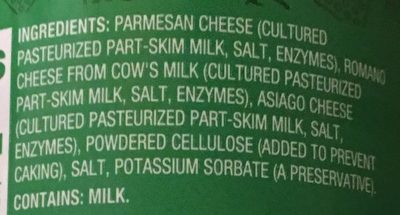
Ingredients list
Ingredient information
Allergens
Traces
Ingredients analysis
No ingredients containing palm oil.
Contains non-vegan ingredients.
Unrecognized: en:potassium-sorbate-to-protect-flavor
Vegetarian status unknown
Unrecognized: en:potassium-sorbate-to-protect-flavor
Food Processing
NOVA group
Ultra-processed food and drink productsElements that indicate the product is in NOVA group 4
How NOVA works
Additives
E460 - CelluloseCarrierEmulsifierHumectantStabiliserThickener
CELLULOSE is an organic compound with the formula (C6H10O5)n, a polysaccharide consisting of a linear chain of several hundred to many thousands of linked D-glucose units. Cellulose is used as emulsifier, thickener and stabilizer in processed foods. Cellulose powder is, for example, used in processed cheese to prevent caking inside the package.
E460ii - Powdered celluloseCarrierEmulsifierHumectantStabiliserThickener
No additive description is available yet.
Environment
Packaging
Packaging details
Data Source
Data presented on this page is sourced from the Open Food Facts database. This platform does not alter the original dataset; its purpose is solely to enhance data visualization and user accessibility.
Product added on November 6, 2016 at 10:50:58 PM UTC by openfoodfacts-contributors .
Last edit on March 17, 2026 at 1:30:33 PM UTC by new-nutrition-bot .
Product page also edited by aaronasachimp, beniben, inf, new-nutrition-bot, openfoodfacts-contributors, org-database-usda, packbot, scanbot, sm-games, yuka.sY2b0xO6T85zoF3NwEKvllQcD8aOgS_nGg3Tnk2p6dTSBM3PWvxu6JnkEqo, yuka.sY2b0xO6T85zoF3NwEKvlmVrQ-LlvgnHDizfhUvS_-iDHIy1Weopz6rfN6g.
Source List
- database-usda