

Funny swirl
Labels
 Not computed
 Ultra-processed food and drink products
 Green-Score not computed
Health
Nutrition
Nutrition label

Nutrition facts
| Nutrition facts | As sold for 100 g / 100 ml |
|---|---|
| Energy | ~ 1,726.8 kJ (408 kcal) |
| FAT | 6.1 g |
| Saturated fat | 6.1 g |
| Carbohydrates | 88.2 g |
| Sugars | 49.9 g |
| Dietary fiber | ? |
| Proteins | 0.1 g |
| Salt | 0 g |
| Sodium | 0 g |
| Minerals | |
| Fruits, vegetables and legumes | ~ 0 % |
Nutrition facts (Detailed data)
| Nutrition facts | As sold for 100 g / 100 ml | As sold Per 100 g (packaging) | As sold Per 100 g (estimate) |
|---|---|---|---|
| Energy | ~ 1,726.8 kJ (408 kcal) | ? (408 kcal) | ? |
| FAT | 6.1 g | 6.1 g | ? |
| Saturated fat | 6.1 g | 6.1 g | ? |
| Carbohydrates | 88.2 g | 88.2 g | ? |
| Sugars | 49.9 g | 49.9 g | ? |
| Added sugars | ~ 1.48 g | ? | ~ 1.48 g |
| Dietary fiber | ? | ? | ? |
| Proteins | 0.1 g | 0.1 g | ? |
| Salt | 0 g | 0 g | ? |
| Sodium | 0 g | 0 g | ? |
| Minerals | |||
| Fruits, vegetables and legumes | ~ 0 % | ? | ~ 0 % |
Estimated Activity Time
Approximate time needed to burn the energy in 100 g / 100 ml: 1,727 kJ. Reference adult weight: 70 kg. Energy density: Moderate.
Ingredients
Ingredients image
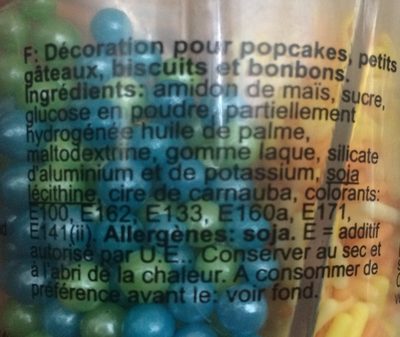
Ingredients list
Ingredient information
Ingredients analysis
Palm oil content unknown
Contains non-vegan ingredients.
Unrecognized: fr:decoration-pour-popcakes, fr:petits-aateaux, en:biscuit, fr:bonbons, fr:alucose-en-poudrai-partiellement-hydrogenee-huile-ae-palme, fr:f-1-maltoaextnne, fr:silicate-d0aiuminium-et-de-potassium, fr:ecithi-e-cire, fr:decarnauba, fr:colorants-e100, fr:ii, fr:e-7-additif-crise-naru-e, fr:sugar-decorations-qu-sec-et-alabri-db-la-chaleur, fr:a-conso-merde-pr-ferencosavent-le, fr:voir-fo-d
Contains non-vegetarian ingredients.
Unrecognized: fr:decoration-pour-popcakes, fr:petits-aateaux, en:biscuit, fr:bonbons, fr:alucose-en-poudrai-partiellement-hydrogenee-huile-ae-palme, fr:f-1-maltoaextnne, fr:silicate-d0aiuminium-et-de-potassium, fr:ecithi-e-cire, fr:decarnauba, fr:colorants-e100, fr:ii, fr:e-7-additif-crise-naru-e, fr:sugar-decorations-qu-sec-et-alabri-db-la-chaleur, fr:a-conso-merde-pr-ferencosavent-le, fr:voir-fo-d
Food Processing
NOVA group
Ultra-processed food and drink productsElements that indicate the product is in NOVA group 4
How NOVA works
Additives
E133 - Brilliant blue FCFColour
BRILLIANT BLUE FCF (Blue 1) is an organic compound classified as a blue triarylmethane dye, reflecting its chemical structure. Known under various commercial names, it is a colorant for foods and other substances.
E160a - caroteneColour
β-Carotene is an organic, strongly colored red-orange pigment abundant in plants and fruits. It is a member of the carotenes, which are terpenoids (isoprenoids), synthesized biochemically from eight isoprene units and thus having 40 carbons. Among the carotenes, β-carotene is distinguished by having beta-rings at both ends of the molecule. β-Carotene is biosynthesized from geranylgeranyl pyrophosphate.β-Carotene is the most common form of carotene in plants. When used as a food coloring, it has the E number E160a. The structure was deduced by Karrer et al. in 1930. In nature, β-carotene is a precursor (inactive form) to vitamin A via the action of beta-carotene 15,15'-monooxygenase.Isolation of β-carotene from fruits abundant in carotenoids is commonly done using column chromatography. It can also be extracted from the beta-carotene rich algae, Dunaliella salina. The separation of β-carotene from the mixture of other carotenoids is based on the polarity of a compound. β-Carotene is a non-polar compound, so it is separated with a non-polar solvent such as hexane. Being highly conjugated, it is deeply colored, and as a hydrocarbon lacking functional groups, it is very lipophilic.
E162 - Beetroot redColour
Betanin, or Beetroot Red, is a red glycosidic food dye obtained from beets; its aglycone, obtained by hydrolyzing away the glucose molecule, is betanidin. As a food additive, its E number is E162. The color of betanin depends on pH; between four and five it is bright bluish-red, becoming blue-violet as the pH increases. Once the pH reaches alkaline levels betanin degrades by hydrolysis, resulting in a yellow-brown color. Betanin is a betalain pigment, together with isobetanin, probetanin, and neobetanin. Other pigments contained in beet are indicaxanthin and vulgaxanthins.
E171 - Titanium dioxideColour
Titanium dioxide, also known as titanium(IV) oxide or titania, is the naturally occurring oxide of titanium, chemical formula TiO2. When used as a pigment, it is called titanium white, Pigment White 6 (PW6), or CI 77891. Generally, it is sourced from ilmenite, rutile and anatase. It has a wide range of applications, including paint, sunscreen and food coloring. When used as a food coloring, it has E number E171. World production in 2014 exceeded 9 million metric tons. It has been estimated that titanium dioxide is used in two-thirds of all pigments, and the oxide has been valued at $13.2 billion.
E904 - Shellac
Shellac is a resin secreted by the female lac bug, on trees in the forests of India and Thailand. It is processed and sold as dry flakes (pictured) and dissolved in alcohol to make liquid shellac, which is used as a brush-on colorant, food glaze and wood finish. Shellac functions as a tough natural primer, sanding sealant, tannin-blocker, odour-blocker, stain, and high-gloss varnish. Shellac was once used in electrical applications as it possesses good insulation qualities and it seals out moisture. Phonograph and 78 rpm gramophone records were made of it until they were replaced by vinyl long-playing records from the 1950s onwards. From the time it replaced oil and wax finishes in the 19th century, shellac was one of the dominant wood finishes in the western world until it was largely replaced by nitrocellulose lacquer in the 1920s and 1930s.
Environment
Green-Score, origins bonus, and transportation impact are shown for Worldwide .
Green Score
Overall grade
Unknown environmental impactAbout Green-Score
Current scope
Green-Score availability
Bonuses and maluses
Declared origins
Packaging impact
Packaging
Packaging impact
Data precision
Transportation
Declared origins
Data Source
Data presented on this page is sourced from the Open Food Facts database. This platform does not alter the original dataset; its purpose is solely to enhance data visualization and user accessibility.
Product added on November 2, 2017 at 10:57:25 AM UTC by kiliweb .
Last edit on March 16, 2026 at 10:58:30 PM UTC by new-nutrition-bot .
Product page also edited by kiliweb, moncef, naruyoko, new-nutrition-bot, openfoodfacts-contributors, yuka.HOF9IOOvP8UANfXX4YEK0CaAOf3aJN4EAEEWog, yuka.R1B3ZkxZVUl0NkpicGZRNjJTT04yWUpYeDZXQWQxcW9OZHNwSVE9PQ.