
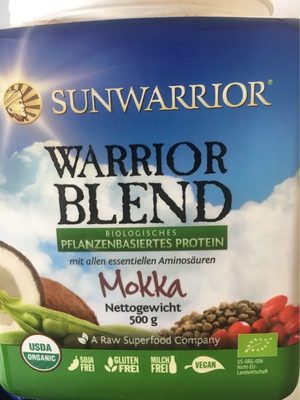
Warrior blend
Health
Nutrition
Nutri-Score data warning
Nutrition label

Nutrition facts
| Nutrition facts | As sold for 100 g / 100 ml |
|---|---|
| Energy | ~ 1360 kJ (360 kcal) |
| Fat | 0 g |
| Saturated fat | 0 g |
| Carbohydrates | 12 g |
| Sugars | 12 g |
| Dietary fiber | ? |
| Proteins | 68 g |
| Salt | 2.4 g |
| Sodium | 0.96 g |
| Fruits, vegetables and legumes | ~ 28.8461538461538 % |
Nutrition facts (Detailed data)
| Nutrition facts | As sold for 100 g / 100 ml | As sold Per 100 g (packaging) | As sold Per 100 g (estimate) |
|---|---|---|---|
| Energy | ~ 1360 kJ (360 kcal) | ? (360 kcal) | ? |
| Fat | 0 g | 0 g | ? |
| Saturated fat | 0 g | 0 g | ? |
| Carbohydrates | 12 g | 12 g | ? |
| Sugars | 12 g | 12 g | ? |
| Dietary fiber | ? | ? | ? |
| Proteins | 68 g | 68 g | ? |
| Salt | 2.4 g | 2.4 g | ? |
| Sodium | 0.96 g | 0.96 g | ? |
| Fruits, vegetables and legumes | ~ 28.8461538461538 % | ? | ~ 28.8461538461538 % |
Ingredients
Ingredients image

Ingredients list
Ingredient information
Ingredients analysis
No ingredients containing palm oil.
Unrecognized: de:firmeneigene-proteinmischung, de:hanfprotein, de:gojibeeren, de:mokkageschmack, de:guarkern, de:meeressalz, de:glykoside, de:au-biologischem-anbau
No non-vegan ingredients.
Unrecognized: de:hanfprotein, de:gojibeeren, de:mokkageschmack, de:guarkern, de:meeressalz, de:glykoside, de:au-biologischem-anbau
No non-vegetarian ingredients.
Unrecognized: de:hanfprotein, de:gojibeeren, de:mokkageschmack, de:guarkern, de:meeressalz, de:glykoside, de:au-biologischem-anbau
Food Processing
NOVA group
 Ultra-processed food and drink products
Elements that indicate the product is in NOVA group 4
How NOVA works
Additives
E960 - Steviol glycosides EFSA overexposure risk: moderateSweetener
Steviol glycosides are the chemical compounds responsible for the sweet taste of the leaves of the South American plant Stevia rebaudiana (Asteraceae) and the main ingredients (or precursors) of many sweeteners marketed under the generic name stevia and several trade names. They also occur in the related species Stevia phlebophylla (but in no other species of Stevia) and in the plant Rubus chingii (Rosaceae).Steviol glycosides from Stevia rebaudiana have been reported to be between 30 and 320 times sweeter than sucrose, although there is some disagreement in the technical literature about these numbers. They are heat-stable, pH-stable, and do not ferment. Additionally, they do not induce a glycemic response when ingested, because humans can not metabolize stevia. This makes them attractive as natural sugar substitutes for diabetics and other people on carbohydrate-controlled diets. Steviol glycosides stimulate the insulin secretion through potentiation of the β-cell, preventing high blood glucose after a meal. The acceptable daily intake (ADI) for steviol glycosides, expressed as steviol equivalents, has been established to be 4 mg/kg body weight/day, and is based on no observed effects of a 100 fold higher dose in a rat study.
Environment
Green-Score, origins bonus, and transportation impact are shown for Worldwide .
Green Score
Overall grade
 Unknown environmental impact
About Green-Score
Current scope
Green-Score availability
Bonuses and maluses
Production system
Declared origins
Packaging impact
Packaging
Packaging impact
Data precision
Transportation
Declared origins
Forest footprint
Forest footprint
Deforestation risk details
Data Source
Product data comes from Open Food Facts. Food Benchmark also adds translations, category comparisons and explanatory calculations.
The database is licensed under ODbL 1.0, individual contents under DbCL 1.0, and product photos under CC BY-SA 3.0.
Product added on August 14, 2017 at 8:26:33 AM UTC by kiliweb .
Last edit on March 17, 2026 at 9:33:40 AM UTC by new-nutrition-bot .
Product page also edited by alex-na, kiliweb, new-nutrition-bot, openfoodfacts-contributors, roboto-app.