
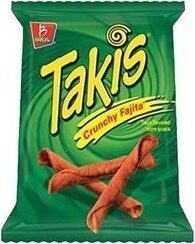
Takis crunchy fajita
Labels
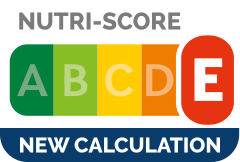 Bad nutritional quality
 Ultra-processed food and drink products
 Moderate environmental impact
Health
Nutrition
Serving Size
Nutri-Score label
Bad nutritional qualityNutrient levels for 100 g
Fat in high quantity (30 g, 30%)
What you need to know
A high consumption of fat, especially saturated fats, can raise cholesterol, which increases the risk of heart diseases.
Recommendation: Limit the consumption of fat and saturated fat
Choose products with lower fat and saturated fat content.
Saturated fat in high quantity (8.33 g, 8.33%)
What you need to know
A high consumption of fat, especially saturated fats, can raise cholesterol, which increases the risk of heart diseases.
Recommendation: Limit the consumption of fat and saturated fat
Choose products with lower fat and saturated fat content.
Sugars in low quantity (0 g, 0%)
What you need to know
A high consumption of sugar can cause weight gain and tooth decay. It also augments the risk of type 2 diabetes and cardio-vascular diseases.
Recommendation: Limit the consumption of sugar and sugary drinks
Sugary drinks should be limited as much as possible. Choose products with lower sugar content.
Salt in high quantity (2.25 g, 2.25%)
What you need to know
A high consumption of salt (or sodium) can cause raised blood pressure, which can increase the risk of heart disease and stroke.
Recommendation: Limit the consumption of salt and salted food
Reduce the quantity of salt used when cooking. Limit the consumption of salty snacks.
Nutrition Facts
| Nutrition Facts | As sold for 100 g / 100 ml | Per serving 13 PIECES (30 g) |
|---|---|---|
| Energy | 533 kcal | 160 kcal |
| Fat | 30 g | 9 g |
| Saturated fat | 8.33 g | 2.5 g |
| Carbohydrates | 56.67 g | 17 g |
| Sugars | 0 g | 0 g |
| Dietary fiber | 6.7 g | 2.01 g |
| Proteins | 6.67 g | 2 g |
| Salt | 2.25 g | 0.68 g |
| Sodium | 0.9 g | 0.27 g |
Ingredients
Ingredients List
Ingredient Information
Food Processing
NOVA Group label
Ultra-processed food and drink productsElements that indicate the product is in the NOVA group 4:
- Additives: E621 - Monosodium glutamate
- Ingredients: Colour
- Ingredients: Dextrose
- Ingredients: Flavouring
- Ingredients: Glucose
- Ingredients: Maltodextrin
The NOVA classification assigns food products into 4 groups based on their degree of processing:
- Unprocessed or minimally processed foods
- Processed culinary ingredients
- Processed foods
- Ultra-processed food and drink products
Ingredients analysis
Palm oil free
Contains ingredients containing palm oil.
Vegan
Contains non-vegan ingredients.
Unrecognized ingredients: en:corn-masa-flour, en:processed-with-lime, en:artificial, en:yellow-no, en:6-lake, en:red-no, en:40-lake-and-blue-no, en:1-lake
Vegetarian
Vegetarian status unknown
Unrecognized ingredients: en:corn-masa-flour, en:processed-with-lime, en:artificial, en:yellow-no, en:6-lake, en:red-no, en:40-lake-and-blue-no, en:1-lake
Additives
E1520 - Propylene GlycolEmulsifierHumectant
No additive description is available yet.
E319 - Tertiary-butylhydroquinone (tbhq)Antioxidant
tert-Butylhydroquinone (TBHQ, tertiary butylhydroquinone) is a synthetic aromatic organic compound which is a type of phenol. It is a derivative of hydroquinone, substituted with a tert-butyl group.
E320 - Butylated hydroxyanisole (bha)Antioxidant
Butylated hydroxyanisole (BHA) is an antioxidant consisting of a mixture of two isomeric organic compounds, 2-tert-butyl-4-hydroxyanisole and 3-tert-butyl-4-hydroxyanisole. It is prepared from 4-methoxyphenol and isobutylene. It is a waxy solid used as a food additive with the E number E320. The primary use for BHA is as an antioxidant and preservative in food, food packaging, animal feed, cosmetics, rubber, and petroleum products. BHA also is commonly used in medicines, such as isotretinoin, lovastatin, and simvastatin, among others.
E321 - Butylated hydroxytolueneAntioxidant
Butylated hydroxytoluene (BHT), also known as dibutylhydroxytoluene, is a lipophilic organic compound, chemically a derivative of phenol, that is useful for its antioxidant properties. European and U.S. regulations allow small amounts to be used as a food additive. In addition to this use, BHT is widely used to prevent oxidation in fluids (e.g. fuel, oil) and other materials where free radicals must be controlled.
E330 - Citric acidAntioxidantSequestrant
Citric acid is a natural organic acid found in citrus fruits such as lemons, oranges, and limes.
It is widely used in the food industry as a flavor enhancer, acidulant, and preservative due to its tart and refreshing taste.
Citric acid is safe for consumption when used in moderation and is considered a generally recognized as safe (GRAS) food additive by regulatory agencies worldwide.
E621 - Monosodium glutamateFlavour Enhancer
Monosodium glutamate (MSG), or E621, is the sodium salt of glutamic acid, an amino acid found naturally in many foods.
It is widely used as a flavor enhancer to provide an "umami" or savory taste to a variety of processed foods, including soups, snack chips, and frozen meals.
MSG is generally recognized as safe (GRAS) by food authorities. However, some people report sensitivity to MSG, experiencing short-term symptoms like headaches and flushing, though scientific studies have not shown a consistent link.
Environment
Environmental score label
Moderate environmental impactCarbon footprint
No carbon footprint data is available for this product.
Packaging
No packaging information provided.
Transportation and origins
Origins of ingredients
No origin information provided.
Manufacturing places
No manufacturing place information provided.
Environmental labels
No environmental labels identified.
Data Source
Product added on March 9, 2017 at 1:22:15 PM UTC by usda-ndb-import .
Last edit on December 16, 2023 at 8:12:59 AM UTC by foodless .
Product page also edited by foodless, kiliweb, org-database-usda, teolemon, usda-ndb-import, yuka.sY2b0xO6T85zoF3NwEKvlm53btyEogKUFTDRv02OmPuRNKbLQ9hC7LboLqs.
Source List
- usda-ndb
- database-usda