
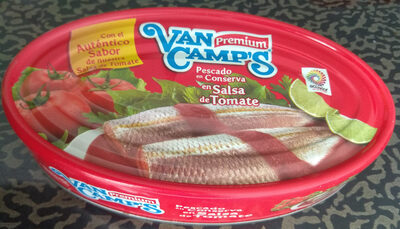
Pescado en Conserva en Salsa de Tomate
Health
Nutrition
Nutri-Score
 Good nutritional quality
Nutri-Score data warning
Nutrient levels
Fat in moderate quantity (9.09%)
Saturated fat in moderate quantity (2.36%)
Sugars in low quantity (1.82%)
Salt in moderate quantity (0.909%)
Nutrition label
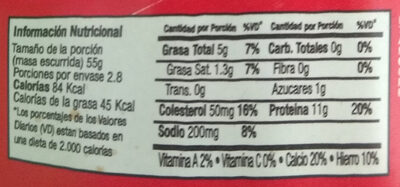
Nutrition facts
| Nutrition facts | As sold for 100 g / 100 ml | Compared to: Sardines in tomato sauce |
|---|---|---|
| Energy | ~ 707.272727272727 kJ (152 kcal) | 717.744 kJ (173 kcal) (-1%) |
| Fat | 9.09090909090909 g | 10.57 g (-14%) |
| Saturated fat | 2.36363636363636 g | 2.837 g (-17%) |
| Cholesterol | 0.0909090909090909 g | 51.683 mg (+76%) |
| Carbohydrates | 1.81818181818182 g | 1.707 g (+7%) |
| Sugars | 1.81818181818182 g | 0.883 g (+106%) |
| Added sugars | 0 g | 0.169 g (-100%) |
| Starch | 0 g | 0.109 g (-100%) |
| Dietary fiber | 0 g | ? |
| Proteins | 20 g | 17.149 g (+17%) |
| Salt | 0.909090909090909 g | 0.97 g (-6%) |
| Sodium | 0.363636363636364 g | 0.387 g (-6%) |
| Vitamin A | 0 g | 17.956 µg (-100%) |
| Vitamin E | 0 g | 2.218 mg (-100%) |
| Vitamin K | 0 g | ? |
| Vitamin C | 0 g | ? |
| Calcium | 0.472727272727273 g | 82.076 mg (+476%) |
| Phosphorus | 0 g | 192.991 mg (-100%) |
| Iron | 0 g | 1.266 mg (-100%) |
| Magnesium | 0 g | 28.57 mg (-100%) |
| Zinc | 0 g | 0.988 mg (-100%) |
| Copper | 0 g | 0.277 mg (-100%) |
| Manganese | 0 g | 0.232 mg (-100%) |
| Selenium | 0 g | 34.956 µg (-100%) |
| Caffeine | 0 g | ? |
| Fruits, vegetables and legumes | ~ 10.9375 % | ? |
| Choline | 0 g | 0 g |
Nutrition facts (Detailed data)
| Nutrition facts | As sold for 100 g / 100 ml | As sold Per serving (55 g) (packaging) | As sold Per 100 g (estimate) |
|---|---|---|---|
| Energy | ~ 707.272727272727 kJ (152 kcal) | ? (84 kcal) | ? |
| Fat | 9.09090909090909 g | 5 g | ? |
| Saturated fat | 2.36363636363636 g | 1.3 g | ? |
| Cholesterol | 0.0909090909090909 g | 0.05 g | ? |
| Carbohydrates | 1.81818181818182 g | 1 g | ? |
| Sugars | 1.81818181818182 g | 1 g | ? |
| Added sugars | 0 g | 0 g | ~ 1 g |
| Starch | 0 g | 0 g | ? |
| Dietary fiber | 0 g | 0 g | ? |
| Proteins | 20 g | 11 g | ? |
| Salt | 0.909090909090909 g | 0.5 g | ? |
| Sodium | 0.363636363636364 g | 0.2 g | ? |
| Vitamin A | 0 g | 0 g | ? |
| Vitamin E | 0 g | 0 g | ? |
| Vitamin K | 0 g | 0 g | ? |
| Vitamin C | 0 g | 0 g | ? |
| Calcium | 0.472727272727273 g | 0.26 g | ? |
| Phosphorus | 0 g | 0 g | ? |
| Iron | 0 g | 0 g | ? |
| Magnesium | 0 g | 0 g | ? |
| Zinc | 0 g | 0 g | ? |
| Copper | 0 g | 0 g | ? |
| Manganese | 0 g | 0 g | ? |
| Selenium | 0 g | 0 g | ? |
| Caffeine | 0 g | 0 g | ? |
| Fruits, vegetables and legumes | ~ 10.9375 % | ? | ~ 10.9375 % |
| Choline | 0 g | 0 g | ? |
Serving size
Ingredients
Ingredients image
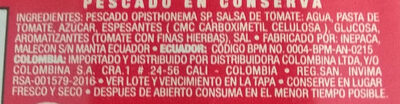
Ingredients list
Ingredient information
Added sugars
Ingredients analysis
No ingredients containing palm oil.
Vegan status unknown
Unrecognized: es:pescado-opisthonema-sp, es:cmc-carboximetil-celulosa, es:tomate-con-finas-hierbas
Vegetarian status unknown
Unrecognized: es:pescado-opisthonema-sp, es:cmc-carboximetil-celulosa, es:tomate-con-finas-hierbas
Food Processing
NOVA group
 Ultra-processed food and drink products
Elements that indicate the product is in NOVA group 4
How NOVA works
Additives
E466 - Sodium carboxy methyl celluloseEmulsifierHumectantStabiliserThickener
Carboxymethyl cellulose (CMC) or cellulose gum or tylose powder is a cellulose derivative with carboxymethyl groups (-CH2-COOH) bound to some of the hydroxyl groups of the glucopyranose monomers that make up the cellulose backbone. It is often used as its sodium salt, sodium carboxymethyl cellulose.
Environment
Green-Score, origins bonus, and transportation impact are shown for Worldwide .
Green Score
Overall grade
 High environmental impact
About Green-Score
Current scope
Life cycle analysis
Average impact of the category
 European pilchard or sardine, in tomato sauce, canned, drained • Score: 52/100
Life-cycle reference
Overall environmental impact by stage (PEF)
The overall environmental impact figure (PEF) comes from ADEME's Agribalyse database, for the category: European pilchard or sardine, in tomato sauce, canned, drained. Source: ADEME Agribalyse Database.
| Stage | Impact |
|---|---|
| Agriculture | 62.7 % |
| Processing | 6.7 % |
| Packaging | 25.0 % |
| Transportation | 4.3 % |
| Distribution | 1.3 % |
| Consumption | 0.0 % |
Bonuses and maluses
Origins of ingredients
Packaging impact
Green-Score for this product
Green-Score for this product
Final score: 33/100Final score breakdown
Carbon footprint
Carbon footprint
Climate impact by stage (CO2e)
The carbon emission figure comes from ADEME's Agribalyse database, for the category: European pilchard or sardine, in tomato sauce, canned, drained. Source: ADEME Agribalyse Database.
| Stage | Impact |
|---|---|
| Agriculture | 30.8 % |
| Processing | 13.1 % |
| Packaging | 45.3 % |
| Transportation | 10.3 % |
| Distribution | 0.8 % |
| Consumption | 0.0 % |
Packaging
Packaging impact
Data precision
Transportation
Origins of ingredients
Origins breakdown
| Origin | Percent of ingredients | Impact |
|---|---|---|
| Ecuador | 100 % | High |
Forest footprint
Forest footprint
Deforestation risk details
Data Source
Product data comes from Open Food Facts. Food Benchmark also adds translations, category comparisons and explanatory calculations.
The database is licensed under ODbL 1.0, individual contents under DbCL 1.0, and product photos under CC BY-SA 3.0.
Product added on December 10, 2018 at 12:36:02 AM UTC by date-limite-app .
Last edit on March 17, 2026 at 11:36:22 PM UTC by new-nutrition-bot .
Product page also edited by aleene, colaborador-anonimo, date-limite-app, foodless, gaellebourdonnec, icaicedo89, municorn-calorie-counter-app, new-nutrition-bot, openfoodfacts-contributors, teolemon.