

Sparkling artesian water 2yrs prod
Labels
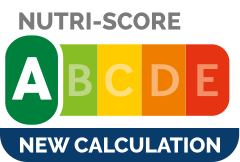 Very good nutritional quality
 Unprocessed or minimally processed foods
 Not computed
Health
Nutrition
Label
Very good nutritional qualityNutrient levels
Fat in low quantity (0%)
Saturated fat in low quantity (0%)
Sugars in low quantity (0%)
Salt in low quantity (0.02%)
Nutrition label
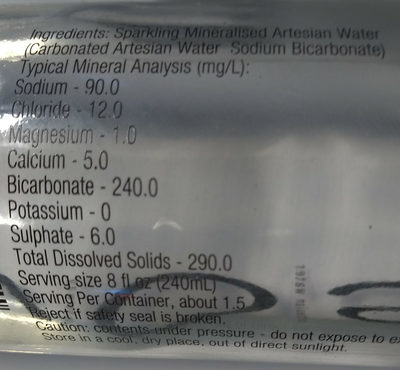
Nutrition facts
| Nutrition facts | As sold for 100 ml |
|---|---|
| Energy | ~ 0 kJ (0 kcal) |
| FAT | 0 g |
| Saturated fat | 0 g |
| Carbohydrates | 0 g |
| Sugars | 0 g |
| Dietary fiber | 0 g |
| Proteins | 0 g |
| Salt | 0.02 g |
| Sodium | 0.01 g |
| Minerals | |
| Fruits, vegetables and legumes | ~ 0 % |
Nutrition facts (Detailed data)
| Nutrition facts | As sold for 100 ml | As sold Per 100 ml (packaging) | As sold Per 100 g (estimate) |
|---|---|---|---|
| Energy | ~ 0 kJ (0 kcal) | ? (0 kcal) | ? |
| FAT | 0 g | 0 g | ? |
| Saturated fat | 0 g | 0 g | ? |
| Carbohydrates | 0 g | 0 g | ? |
| Sugars | 0 g | 0 g | ? |
| Added sugars | ~ 0 g | ? | ~ 0 g |
| Dietary fiber | 0 g | 0 g | ? |
| Proteins | 0 g | 0 g | ? |
| Salt | 0.02 g | 0.02 g | ? |
| Sodium | 0.01 g | 0.01 g | ? |
| Minerals | |||
| Fruits, vegetables and legumes | ~ 0 % | ? | ~ 0 % |
Serving size
Ingredients
Ingredients image

Ingredients list
Ingredient information
Ingredients analysis
No ingredients containing palm oil.
No non-vegan ingredients.
No non-vegetarian ingredients.
Food Processing
NOVA group
Unprocessed or minimally processed foodsHow NOVA works
Additives
E500 - Sodium carbonatesStabiliserThickener
Sodium carbonates (E500) are compounds commonly used in food preparation as leavening agents, helping baked goods rise by releasing carbon dioxide when they interact with acids.
Often found in baking soda, they regulate the pH of food, preventing it from becoming too acidic or too alkaline. In the culinary world, sodium carbonates can also enhance the texture and structure of foods, such as noodles, by modifying the gluten network.
Generally recognized as safe, sodium carbonates are non-toxic when consumed in typical amounts found in food.
E500ii - Sodium hydrogen carbonateStabiliserThickener
Sodium hydrogen carbonate, also known as E500ii, is a food additive commonly used as a leavening agent.
When added to recipes, it releases carbon dioxide gas upon exposure to heat or acids, causing dough to rise and resulting in a light, fluffy texture in baked goods.
It is generally recognized as safe (GRAS) by regulatory authorities when used in appropriate quantities and poses no significant health risks when consumed in typical food applications.
Environment
Environmental labels
Data Source
Data presented on this page is sourced from the Open Food Facts database. This platform does not alter the original dataset; its purpose is solely to enhance data visualization and user accessibility.
Product added on February 28, 2017 at 1:27:22 PM UTC by kiliweb .
Last edit on March 17, 2026 at 12:54:26 PM UTC by new-nutrition-bot .
Product page also edited by acuario, archanox, autorotate-bot, bentren, date-limite-app, elcoco, foodless, kiliweb, new-nutrition-bot, openfoodfacts-contributors, org-database-usda, scanbot, yuka.ZjVnT0ZwVlpwNmtnd1BBZDF4elA2TmxJbXNhNVFYbVVNYzQ3SUE9PQ.
Source List
- database-usda