

Morning Rounds Cranberry Orange
Labels
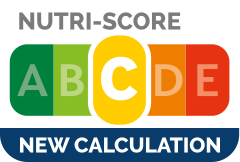 Moderate nutritional quality
 Ultra-processed food and drink products
 Not computed
Health
Nutrition
Label
Moderate nutritional qualityNutrient levels
Fat in low quantity (1%)
Saturated fat in low quantity (0%)
Sugars in moderate quantity (7%)
Salt in moderate quantity (0.475%)
Nutrition label

Nutrition facts
| Nutrition facts | As sold for 100 g / 100 ml |
|---|---|
| Energy | ~ 682 kJ (160 kcal) |
| FAT | 1 g |
| Saturated fat | 0 g |
| Trans fat | 0 g |
| Cholesterol | 0 g |
| Carbohydrates | 32 g |
| Sugars | 7 g |
| Added sugars | 3 g |
| Dietary fiber | 2 g |
| Proteins | 5 g |
| Salt | 0.48 g |
| Sodium | 0.19 g |
| Vitamins | |
| Vitamin D | 0 g |
| Minerals | |
| Potassium | 0.02 g |
| Calcium | 0.05 g |
| Iron | 0 g |
| Fruits, vegetables and legumes | ~ 0.48 % |
Nutrition facts (Detailed data)
| Nutrition facts | As sold for 100 g / 100 ml | As sold Per 100 g (packaging) | As sold Per serving (60 g) (packaging) | As sold Per 100 g (estimate) |
|---|---|---|---|---|
| Energy | ~ 682 kJ (160 kcal) | ? (160 kcal) | ? (160 kcal) | ? |
| FAT | 1 g | 1 g | 1 g | ? |
| Saturated fat | 0 g | 0 g | 0 g | ? |
| Trans fat | 0 g | 0 g | 0 g | ? |
| Cholesterol | 0 g | 0 g | 0 g | ? |
| Carbohydrates | 32 g | 32 g | 32 g | ? |
| Sugars | 7 g | 7 g | 7 g | ? |
| Added sugars | 3 g | 3 g | ? | ~ 0.28 g |
| Dietary fiber | 2 g | 2 g | 2 g | ? |
| Proteins | 5 g | 5 g | 5 g | ? |
| Salt | 0.48 g | 0.48 g | ? | ? |
| Sodium | 0.19 g | 0.19 g | 0.19 g | ? |
| Vitamins | ||||
| Vitamin D | 0 g | 0 g | ? | ? |
| Minerals | ||||
| Potassium | 0.02 g | 0.02 g | ? | ? |
| Calcium | 0.05 g | 0.05 g | ? | ? |
| Iron | 0 g | 0 g | ? | ? |
| Fruits, vegetables and legumes | ~ 0.48 % | ? | ? | ~ 0.48 % |
Serving size
Estimated Activity Time
Approximate time needed to burn the energy in 100 g / 100 ml: 682 kJ. Reference adult weight: 70 kg. Energy density: Low.
Ingredients
Ingredients list
Ingredient information
Allergens
Ingredients analysis
No ingredients containing palm oil.
No non-vegan ingredients.
Unrecognized: en:natural-dough-conditioner, en:vitamin-b-3, en:vitamin-b-1, en:orange-essential-oil, en:vitamin-b-3, en:vitamin-b-1
No non-vegetarian ingredients.
Unrecognized: en:natural-dough-conditioner, en:vitamin-b-3, en:vitamin-b-1, en:orange-essential-oil, en:vitamin-b-3, en:vitamin-b-1
Food Processing
NOVA group
Ultra-processed food and drink productsElements that indicate the product is in NOVA group 4
How NOVA works
Additives
E101 - RiboflavinColour
Riboflavin, also known as vitamin B2, is a vitamin found in food and used as a dietary supplement. Food sources include eggs, green vegetables, milk and other dairy product, meat, mushrooms, and almonds. Some countries require its addition to grains. As a supplement it is used to prevent and treat riboflavin deficiency and prevent migraines. It may be given by mouth or injection.It is nearly always well tolerated. Normal doses are safe during pregnancy. Riboflavin is in the vitamin B group. It is required by the body for cellular respiration.Riboflavin was discovered in 1920, isolated in 1933, and first made in 1935. It is on the World Health Organization's List of Essential Medicines, the most effective and safe medicines needed in a health system. Riboflavin is available as a generic medication and over the counter. In the United States a month of supplements costs less than 25 USD.
E1100 - Alpha-Amylase
An amylase () is an enzyme that catalyses the hydrolysis of starch into sugars. Amylase is present in the saliva of humans and some other mammals, where it begins the chemical process of digestion. Foods that contain large amounts of starch but little sugar, such as rice and potatoes, may acquire a slightly sweet taste as they are chewed because amylase degrades some of their starch into sugar. The pancreas and salivary gland make amylase (alpha amylase) to hydrolyse dietary starch into disaccharides and trisaccharides which are converted by other enzymes to glucose to supply the body with energy. Plants and some bacteria also produce amylase. As diastase, amylase was the first enzyme to be discovered and isolated (by Anselme Payen in 1833). Specific amylase proteins are designated by different Greek letters. All amylases are glycoside hydrolases and act on α-1,4-glycosidic bonds.
E330 - Citric acidAntioxidantSequestrant
Citric acid is a natural organic acid found in citrus fruits such as lemons, oranges, and limes.
It is widely used in the food industry as a flavor enhancer, acidulant, and preservative due to its tart and refreshing taste.
Citric acid is safe for consumption when used in moderation and is considered a generally recognized as safe (GRAS) food additive by regulatory agencies worldwide.
Environment
Environmental score label
Not computedCarbon footprint
No carbon footprint data is available for this product.
Packaging
No packaging information provided.
Transportation and origins
Origins of ingredients
No origin information provided.
Manufacturing places
No manufacturing place information provided.
Environmental labels
No environmental labels identified.
Data Source
Data presented on this page is sourced from the Open Food Facts database. This platform does not alter the original dataset; its purpose is solely to enhance data visualization and user accessibility.
Product added on March 9, 2017 at 9:50:39 AM UTC by usda-ndb-import .
Last edit on March 17, 2026 at 4:17:57 AM UTC by macrofactor .
Product page also edited by foodless, macrofactor, new-nutrition-bot, org-database-usda, org-label-non-gmo-project, pmpv02, roboto-app, usda-ndb-import.
Source List
- usda-ndb
- database-usda
- label-non-gmo-project