

Jardin Bio
Sauce Soja
BARCODE:03345979
CATEGORIES:Condiments, Sauces, Soy Sauces, Groceries
LABELS:Organic, Eu Organic, Fr Bio 01
COUNTRIES:France
Labels
Nutri-Score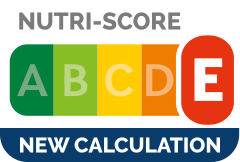 Bad nutritional quality
Bad nutritional qualityNOVA Group Not computed
Not computedEnvironmental Score Not computed
Not computedHealth
Nutrition
Label
Bad nutritional qualityNutrient levels
Fat in low quantity (0%)
What you need to know
• A high consumption of fat, especially saturated fats, can raise cholesterol, which increases the risk of heart diseases.
Recommendation: Limit the consumption of fat and saturated fat
• Choose products with lower fat and saturated fat content.
Source: National Health Service UK (NHS) - Fat: the facts
Saturated fat in low quantity (0%)
What you need to know
• A high consumption of fat, especially saturated fats, can raise cholesterol, which increases the risk of heart diseases.
Recommendation: Limit the consumption of fat and saturated fat
• Choose products with lower fat and saturated fat content.
Source: National Health Service UK (NHS) - Fat: the facts
Sugars in low quantity (1.4%)
What you need to know
• A high consumption of sugar can cause weight gain and tooth decay. It also augments the risk of type 2 diabetes and cardio-vascular diseases.
Recommendation: Limit the consumption of sugar and sugary drinks
• Sugary drinks (such as sodas, fruit beverages, and fruit juices and nectars) should be limited as much as possible (no more than 1 glass a day).
• Choose products with lower sugar content and reduce the consumption of products with added sugars.
Source: National Health Service UK (NHS) - Sugar: the facts
Salt in high quantity (13.9%)
What you need to know
• A high consumption of salt (or sodium) can cause raised blood pressure, which can increase the risk of heart disease and stroke.
• Many people who have high blood pressure do not know it, as there are often no symptoms.
• Most people consume too much salt (on average 9 to 12 grams per day), around twice the recommended maximum level of intake.
Recommendation: Limit the consumption of salt and salted food
• Reduce the quantity of salt used when cooking, and don't salt again at the table.
• Limit the consumption of salty snacks and choose products with lower salt content.
Source: World Health Organization (WHO) - Fact sheet - Salt reduction
Source: National Health Service UK (NHS) - Salt: the facts
Nutrition facts
| Nutrition facts | As sold for 100 g / 100 ml |
|---|---|
| Energy | 243 kcal (58 kcal) |
| FAT | 0 |
| Saturated fat | 0 |
| Carbohydrates | 5.6 |
| Sugars | 1.4 |
| Dietary fiber | ? |
| Proteins | 8.6 |
| Salt | 13.9 |
| Sodium | 5.56 g |
| Minerals | |
| Fruits, vegetables and legumes | ? |
Estimated Activity Time
Approximate time needed to burn the energy in 100 g / 100 ml: 1,017 kJ. Reference adult weight: 70 kg. Energy density: Moderate.
Walking
59 min (~5,928 steps)
Swimming
36 min
Bicycling
28 min
Running
21 min
Ingredients

Ingredients List
NO_INGREDIENTS_DATA
Ingredients analysis
Palm oil free
Unknown
Palm oil content unknown
Vegan
Unknown
Vegan status unknown
Vegetarian
Unknown
Vegetarian status unknown
Food Processing
NOVA group
NOVA group cannot be calculated because ingredients are missing.
How NOVA works
The NOVA classification assigns food products into 4 groups based on their degree of processing:
1. Unprocessed or minimally processed foods
2. Processed culinary ingredients
3. Processed foods
4. Ultra-processed food and drink products
Additives
No additives detected or data is missing.
Environment
Environmental labels
OrganicEu Organic
Data Source
Data presented on this page is sourced from the Open Food Facts database. This platform does not alter the original dataset; its purpose is solely to enhance data visualization and user accessibility.
Product added on May 14, 2018 at 6:14:48 PM UTC by kiliweb .
Last edit on August 23, 2023 at 7:54:01 PM UTC by roboto-app .
Product page also edited by autorotate-bot, kiliweb, openfoodfacts-contributors, roboto-app, teolemon, yuka.VGE0OEY0bFFoOEFicHZRYjgwbm45K0J5eE02NWRrZVpkL0VLSWc9PQ.