

Instant Noodles Chicken Curry Flavour
Health
Nutrition
Nutrition label

Nutrition facts
| Nutrition facts | As sold for 100 g / 100 ml | Compared to: Instant noodles |
|---|---|---|
| Energy | ~ 2018.75 kJ (475 kcal) | 1,163.504 kJ (279 kcal) (+74%) |
| Fat | 21.25 g | 10.115 g (+110%) |
| Saturated fat | 10 g | 4.337 g (+131%) |
| Carbohydrates | 62.5 g | 38.763 g (+61%) |
| Sugars | 2.5 g | 2.434 g (+3%) |
| Added sugars | 0 g | 1.033 g (-100%) |
| Starch | 0 g | 14.608 g (-100%) |
| Dietary fiber | ? | ? |
| Proteins | 10 g | 6.11 g (+64%) |
| Salt | 4 g | 2.364 g (+69%) |
| Sodium | 1.6 g | 0.946 g (+69%) |
| Vitamin A | 0 g | 12.885 µg (-100%) |
| Vitamin E | 0 g | 0.667 mg (-100%) |
| Vitamin K | 0 g | 0 µg |
| Vitamin C | 0 g | ? |
| Phosphorus | 0 g | 70.113 mg (-100%) |
| Iron | 0 g | 1.905 mg (-100%) |
| Magnesium | 0 g | 23.628 mg (-100%) |
| Zinc | 0 g | 0.632 mg (-100%) |
| Copper | 0 g | 0.095 mg (-100%) |
| Manganese | 0 g | 0.585 mg (-100%) |
| Selenium | 0 g | 2.917 µg (-100%) |
| Caffeine | 0 g | 0 mg |
| Fruits, vegetables and legumes | ~ 0.0188735961914048 % | ? |
| Choline | 0 g | 0 g |
Nutrition facts (Detailed data)
| Nutrition facts | As sold for 100 g / 100 ml | As sold Per serving (80 g) (packaging) | As sold Per 100 g (estimate) |
|---|---|---|---|
| Energy | ~ 2018.75 kJ (475 kcal) | ? (380 kcal) | ? |
| Fat | 21.25 g | 17 g | ? |
| Saturated fat | 10 g | 8 g | ? |
| Carbohydrates | 62.5 g | 50 g | ? |
| Sugars | 2.5 g | 2 g | ? |
| Added sugars | 0 g | 0 g | ~ 0.1453125 g |
| Starch | 0 g | 0 g | ? |
| Dietary fiber | ? | ? | ? |
| Proteins | 10 g | 8 g | ? |
| Salt | 4 g | 3.2 g | ? |
| Sodium | 1.6 g | 1.28 g | ? |
| Vitamin A | 0 g | 0 g | ? |
| Vitamin E | 0 g | 0 g | ? |
| Vitamin K | 0 g | 0 g | ? |
| Vitamin C | 0 g | 0 g | ? |
| Phosphorus | 0 g | 0 g | ? |
| Iron | 0 g | 0 g | ? |
| Magnesium | 0 g | 0 g | ? |
| Zinc | 0 g | 0 g | ? |
| Copper | 0 g | 0 g | ? |
| Manganese | 0 g | 0 g | ? |
| Selenium | 0 g | 0 g | ? |
| Caffeine | 0 g | 0 g | ? |
| Fruits, vegetables and legumes | ~ 0.0188735961914048 % | ? | ~ 0.0188735961914048 % |
| Choline | 0 g | 0 g | ? |
Serving size
Ingredients
Ingredients image
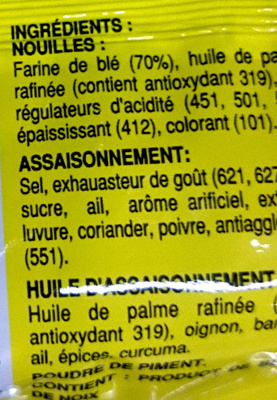
Ingredients list
Ingredient information
Added sugars
Allergens
Traces
Ingredients analysis
Contains ingredients containing palm oil.
Vegan status unknown
Unrecognized: en:contains-antioxidant-319, en:501, en:500, en:412, en:101, en:621, en:631, en:627, en:artificial-chicken-flavour, en:551, en:contains-antioxidant-306, en:candle-nut-garlic, en:330
Vegetarian status unknown
Unrecognized: en:contains-antioxidant-319, en:501, en:500, en:412, en:101, en:621, en:631, en:627, en:artificial-chicken-flavour, en:551, en:contains-antioxidant-306, en:candle-nut-garlic, en:330
Food Processing
NOVA group
 Ultra-processed food and drink products
Elements that indicate the product is in NOVA group 4
How NOVA works
Additives
E101 - RiboflavinColour
Riboflavin, also known as vitamin B2, is a vitamin found in food and used as a dietary supplement. Food sources include eggs, green vegetables, milk and other dairy product, meat, mushrooms, and almonds. Some countries require its addition to grains. As a supplement it is used to prevent and treat riboflavin deficiency and prevent migraines. It may be given by mouth or injection.It is nearly always well tolerated. Normal doses are safe during pregnancy. Riboflavin is in the vitamin B group. It is required by the body for cellular respiration.Riboflavin was discovered in 1920, isolated in 1933, and first made in 1935. It is on the World Health Organization's List of Essential Medicines, the most effective and safe medicines needed in a health system. Riboflavin is available as a generic medication and over the counter. In the United States a month of supplements costs less than 25 USD.
E306 - Tocopherol-rich extract
No additive description is available yet.
E330 - Citric acidAntioxidantSequestrant
Citric acid is a natural organic acid found in citrus fruits such as lemons, oranges, and limes.
It is widely used in the food industry as a flavor enhancer, acidulant, and preservative due to its tart and refreshing taste.
Citric acid is safe for consumption when used in moderation and is considered a generally recognized as safe (GRAS) food additive by regulatory agencies worldwide.
E500 - Sodium carbonatesStabiliserThickener
Sodium carbonates (E500) are compounds commonly used in food preparation as leavening agents, helping baked goods rise by releasing carbon dioxide when they interact with acids.
Often found in baking soda, they regulate the pH of food, preventing it from becoming too acidic or too alkaline. In the culinary world, sodium carbonates can also enhance the texture and structure of foods, such as noodles, by modifying the gluten network.
Generally recognized as safe, sodium carbonates are non-toxic when consumed in typical amounts found in food.
E501 - Potassium carbonatesStabiliser
Potassium carbonate (K2CO3) is a white salt, which is soluble in water (insoluble in ethanol) and forms a strongly alkaline solution. It can be made as the product of potassium hydroxide's absorbent reaction with carbon dioxide. It is deliquescent, often appearing a damp or wet solid. Potassium carbonate is used in the production of soap and glass.
E551 - Silicon dioxideCarrier
Silicon dioxide, also known as silica, silicic acid or silicic acid anydride is an oxide of silicon with the chemical formula SiO2, most commonly found in nature as quartz and in various living organisms. In many parts of the world, silica is the major constituent of sand. Silica is one of the most complex and most abundant families of materials, existing as a compound of several minerals and as synthetic product. Notable examples include fused quartz, fumed silica, silica gel, and aerogels. It is used in structural materials, microelectronics (as an electrical insulator), and as components in the food and pharmaceutical industries. Inhaling finely divided crystalline silica is toxic and can lead to severe inflammation of the lung tissue, silicosis, bronchitis, lung cancer, and systemic autoimmune diseases, such as lupus and rheumatoid arthritis. Uptake of amorphous silicon dioxide, in high doses, leads to non-permanent short-term inflammation, where all effects heal.
E621 - Monosodium glutamate EFSA overexposure risk: highFlavour Enhancer
Monosodium glutamate (MSG), or E621, is the sodium salt of glutamic acid, an amino acid found naturally in many foods.
It is widely used as a flavor enhancer to provide an "umami" or savory taste to a variety of processed foods, including soups, snack chips, and frozen meals.
MSG is generally recognized as safe (GRAS) by food authorities. However, some people report sensitivity to MSG, experiencing short-term symptoms like headaches and flushing, though scientific studies have not shown a consistent link.
E627 - Disodium guanylate
Disodium guanylate, also known as sodium 5'-guanylate and disodium 5'-guanylate, is a natural sodium salt of the flavor enhancing nucleotide guanosine monophosphate (GMP). Disodium guanylate is a food additive with the E number E627. It is commonly used in conjunction with glutamic acid. As it is a fairly expensive additive, it is not used independently of glutamic acid; if disodium guanylate is present in a list of ingredients but MSG does not appear to be, it is likely that glutamic acid is provided as part of another ingredient such as a processed soy protein complex. It is often added to foods in conjunction with disodium inosinate; the combination is known as disodium 5'-ribonucleotides. Disodium guanylate is produced from dried seaweed and is often added to instant noodles, potato chips and other snacks, savory rice, tinned vegetables, cured meats, and packaged soup.
E631 - Disodium inosinate
Disodium inosinate (E631) is the disodium salt of inosinic acid with the chemical formula C10H11N4Na2O8P. It is used as a food additive and often found in instant noodles, potato chips, and a variety of other snacks. Although it can be obtained from bacterial fermentation of sugars, it is often commercially prepared from animal sources.
Environment
Green-Score, origins bonus, and transportation impact are shown for Worldwide .
Green Score
Overall grade
 Low environmental impact
About Green-Score
Current scope
Life cycle analysis
Average impact of the category
 Asian noodles, flavoured, dehydrated • Score: 88/100
Life-cycle reference
Overall environmental impact by stage (PEF)
The overall environmental impact figure (PEF) comes from ADEME's Agribalyse database, for the category: Asian noodles, flavoured, dehydrated. Source: ADEME Agribalyse Database.
| Stage | Impact |
|---|---|
| Agriculture | 47.9 % |
| Processing | 24.5 % |
| Packaging | 19.1 % |
| Transportation | 6.5 % |
| Distribution | 2.3 % |
| Consumption | 0.0 % |
Bonuses and maluses
Origins of ingredients
Threatened species risk
Packaging impact
Green-Score for this product
Green-Score for this product
Final score: 63/100Final score breakdown
Carbon footprint
Carbon footprint
Climate impact by stage (CO2e)
The carbon emission figure comes from ADEME's Agribalyse database, for the category: Asian noodles, flavoured, dehydrated. Source: ADEME Agribalyse Database.
| Stage | Impact |
|---|---|
| Agriculture | 42.6 % |
| Processing | 14.8 % |
| Packaging | 30.5 % |
| Transportation | 10.8 % |
| Distribution | 1.2 % |
| Consumption | 0.0 % |
Packaging
Packaging impact
Packaging components
| Shape | Material | Recycling | Impact |
|---|---|---|---|
| Unknown | Plastic | Unknown | High |
Declared packaging
Data precision
Transportation
Manufacturing locations
Origins of ingredients
Origins breakdown
| Origin | Percent of ingredients | Impact |
|---|---|---|
| Indonesia | 100 % | High |
Forest footprint
Forest footprint
Deforestation risk details
Data Source
Product data comes from Open Food Facts. Food Benchmark also adds translations, category comparisons and explanatory calculations.
The database is licensed under ODbL 1.0, individual contents under DbCL 1.0, and product photos under CC BY-SA 3.0.
Product added on May 19, 2015 at 4:26:38 AM UTC by foodorigins .
Last edit on March 18, 2026 at 12:02:00 AM UTC by new-nutrition-bot .
Product page also edited by foodorigins, inf, kiliweb, macrofactor, municorn-calorie-counter-app, new-nutrition-bot, openfoodfacts-contributors, packbot, roboto-app, tbound2, upcbot, yuka.WXB0ZVRMVVlxY3RYdC9NQi9UUEszT0pMMjZhQVVqNnpDN1FMSVE9PQ, yuka.sY2b0xO6T85zoF3NwEKvlmdpS8LCjjnpbCXfuEPT_vSSIobIUdFqxqLwYqo.