ProductsMarks & SpencerChristmas Pudding
Christmas Pudding
Barcode 00888707
Marks & Spencer

Christmas Pudding

100 g e
BARCODE:00888707
COMMON NAME:Dessert de Noël avec des raisins secs, du cidre britannique, du rhum et du xérès
CATEGORIES:Desserts, Puddings, Christmas Puddings
LABELS:Green Dot
PACKAGING:Cardboard
ORIGIN:Vine Fruits From Turkey And Greece
MANUFACTURING:Royaume-Uni
COUNTRIES:France, United Kingdom
STORES:Marks & Spencer

Labels

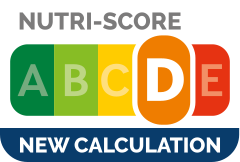
Nutri-Score
Nutri-ScorePoor nutritional quality
NOVA Group
NOVA GroupUltra-processed food and drink products
Green-Score
Green-ScoreGreen-Score not computed

Health

Nutrition

Label

DPoor nutritional quality

Nutrient levels

Fat in moderate quantity (4.9%)
What you need to know • A high consumption of fat, especially saturated fats, can raise cholesterol, which increases the risk of heart diseases. Recommendation: Limit the consumption of fat and saturated fat • Choose products with lower fat and saturated fat content. Source: National Health Service UK (NHS) - Fat: the facts
Saturated fat in moderate quantity (2.3%)
What you need to know • A high consumption of fat, especially saturated fats, can raise cholesterol, which increases the risk of heart diseases. Recommendation: Limit the consumption of fat and saturated fat • Choose products with lower fat and saturated fat content. Source: National Health Service UK (NHS) - Fat: the facts
Sugars in high quantity (47.3%)
What you need to know • A high consumption of sugar can cause weight gain and tooth decay. It also augments the risk of type 2 diabetes and cardio-vascular diseases. Recommendation: Limit the consumption of sugar and sugary drinks • Sugary drinks (such as sodas, fruit beverages, and fruit juices and nectars) should be limited as much as possible (no more than 1 glass a day). • Choose products with lower sugar content and reduce the consumption of products with added sugars. Source: National Health Service UK (NHS) - Sugar: the facts
Salt in low quantity (0.225%)
What you need to know • A high consumption of salt (or sodium) can cause raised blood pressure, which can increase the risk of heart disease and stroke. • Many people who have high blood pressure do not know it, as there are often no symptoms. • Most people consume too much salt (on average 9 to 12 grams per day), around twice the recommended maximum level of intake. Recommendation: Limit the consumption of salt and salted food • Reduce the quantity of salt used when cooking, and don't salt again at the table. • Limit the consumption of salty snacks and choose products with lower salt content. Source: World Health Organization (WHO) - Fact sheet - Salt reduction Source: National Health Service UK (NHS) - Salt: the facts

Nutrition label

Christmas Pudding nutrition label

Nutrition facts

Nutrition factsAs sold for 100 g / 100 ml
Energy1,414 kJ (323 kcal)
FAT4.9 g
Saturated fat2.3 g
Carbohydrates65.4 g
Sugars47.3 g
Dietary fiber3.2 g
Proteins2.6 g
Salt0.23 g
Sodium0.09 g
Minerals
Fruits, vegetables and legumes~ 48.75 %

Nutrition facts (Detailed data)

Nutrition factsAs sold for 100 g / 100 mlAs sold Per 100 g (packaging)As sold Per 100 g (estimate)
Energy1,414 kJ (323 kcal)1,414 kJ (323 kcal)?
FAT4.9 g4.9 g?
Saturated fat2.3 g2.3 g?
Carbohydrates65.4 g65.4 g?
Sugars47.3 g47.3 g?
Added sugars~ 38.76 g?~ 38.76 g
Dietary fiber3.2 g3.2 g?
Proteins2.6 g2.6 g?
Salt0.23 g0.23 g?
Sodium0.09 g0.09 g?
Minerals
Fruits, vegetables and legumes~ 48.75 %?~ 48.75 %

Serving size

100g

Estimated Activity Time

Approximate time needed to burn the energy in 100 g / 100 ml: 1,414 kJ. Reference adult weight: 70 kg. Energy density: Moderate.

Walking
82 min (~8,245 steps)
Swimming
50 min
Bicycling
38 min
Running
29 min

Ingredients

Ingredients image

Christmas Pudding ingredients image

Ingredients list

Raisins secs (37%) (Raisins de Smyrne Raisins · Raisins de Corinthe) Sucre Farine de blé contient Cluten (avec Farine de blé, Carbonate de calcium, Fer, Niacine, Thiamine) · Graisse végétale (Huile de palme Farine de riz · Huile de tournesol) · Eau - Cidre britannique (3%) · Rhum bruŋ (3%) · Humectant : Clycérol · Širop de Sucre · Sirop de sucre noir · Ecorce dorange · Xérès amontillado (1%) · Sirop de glucose-fructose Écorce de citron · Épices moulues (Coriandre Cannelle Graines de çarvi · Gingembre Noix de muscade Clous de girofle) · Sel · Levure · Émulsifiant : E471, E472e · Vinaigre Gluten de blé Čorrecteur d'acidité : Acide citrique · Huile de colza · Huile de palme · Agent de traitement de la farine : Acide ascorbique · Graisse de palme.

Ingredient information

Raisin
46.0%
Raisins De Smyme
30.67% (estimate)
Grape
7.67% (estimate)
Corinthian Raisins
7.67% (estimate)
Sugar
36.26% (estimate)
Wheat Flour
21.82% (estimate)
E170i
7.22% (estimate)
Rice Flour
3.61% (estimate)
Sunflower Oil
3.61% (estimate)
Cidre Britannique
3.0%
Dark Rum
3.0%
Humectant
2% (estimate)
E422
2% (estimate)
Sirop De Sucre Noir
2% (estimate)
Sugar Syrup
2% (estimate)
Orange Zest
2% (estimate)
Amontillado Sherry
1.0%
Glucose Syrup
0.5% (estimate)
Lemon Peel
0.5% (estimate)
Epices Moulues
0.5% (estimate)
Coriander
0.25% (estimate)
Clove
0.25% (estimate)
Salt
0.11% (estimate)
Powdered Almonds
0.11% (estimate)
Yeast
0.11% (estimate)
Palm Oil
0.11% (estimate)
Vinegar
0.11% (estimate)
Wheat Gluten
0.11% (estimate)
Emulsifier
0.11% (estimate)
E471
0.11% (estimate)
E472e
0.11% (estimate)
Colza Oil
0.11% (estimate)
Acidity Regulator
0.11% (estimate)
E330
0.11% (estimate)
Flour Treatment Agent
0.11% (estimate)
E300
0.11% (estimate)

Allergens

GlutenNuts

Traces

NutsPeanuts

Ingredients analysis

Palm oil free
No

Contains ingredients containing palm oil.

Vegan
Unknown

Vegan status unknown

Unrecognized: fr:raisins-de-smyme, fr:cidre-britannique, fr:sirop-de-sucre-noir

Vegetarian
Unknown

Vegetarian status unknown

Unrecognized: fr:raisins-de-smyme, fr:cidre-britannique, fr:sirop-de-sucre-noir


Food Processing

NOVA group

4Ultra-processed food and drink products

Elements that indicate the product is in NOVA group 4

Additives
E422 - Glycerol
Additives
E471 - Mono- and diglycerides of fatty acids
Additives
E472e - Mono- and diacetyltartaric acid esters of mono- and diglycerides of fatty acids
Ingredients
Emulsifier
Ingredients
Glucose
Ingredients
Glucose Syrup
Ingredients
Gluten
Ingredients
Humectant

How NOVA works

The NOVA classification assigns food products into 4 groups based on their degree of processing: 1. Unprocessed or minimally processed foods 2. Processed culinary ingredients 3. Processed foods 4. Ultra-processed food and drink products

Additives

E300 - Ascorbic acidAntioxidantSequestrant

No additive description is available yet.

E330 - Citric acidAntioxidantSequestrant

Citric acid is a natural organic acid found in citrus fruits such as lemons, oranges, and limes.

It is widely used in the food industry as a flavor enhancer, acidulant, and preservative due to its tart and refreshing taste.

Citric acid is safe for consumption when used in moderation and is considered a generally recognized as safe (GRAS) food additive by regulatory agencies worldwide.

E422 - GlycerolHumectantThickener

Glycerol (; also called glycerine or glycerin; see spelling differences) is a simple polyol compound. It is a colorless, odorless, viscous liquid that is sweet-tasting and non-toxic. The glycerol backbone is found in all lipids known as triglycerides. It is widely used in the food industry as a sweetener and humectant and in pharmaceutical formulations. Glycerol has three hydroxyl groups that are responsible for its solubility in water and its hygroscopic nature.

E471 - Mono- and diglycerides of fatty acidsEmulsifierStabiliser

Mono- and diglycerides of fatty acids (E471), are food additives commonly used as emulsifiers in various processed foods.

These compounds consist of glycerol molecules linked to one or two fatty acid chains, which help stabilize and blend water and oil-based ingredients. E471 enhances the texture and shelf life of products like margarine, baked goods, and ice cream, ensuring a smooth and consistent texture.

It is generally considered safe for consumption within established regulatory limits.

E472e - Mono- and diacetyltartaric acid esters of mono- and diglycerides of fatty acidsEmulsifierSequestrantStabiliser

No additive description is available yet.

Environment

Green-Score, origins bonus, and transportation impact are shown for Worldwide .

Green Score

Overall grade

UnknownUnknown environmental impact

About Green-Score

The Green-Score is an experimental score that summarizes the environmental impacts of food products.

Current scope

The Green-Score was initially developed for France and it is being extended to other European countries. The Green-Score formula is subject to change as it is regularly improved to make it more precise and better suited to each country. Select a country to include the full impact of transportation in the final score.

Green-Score availability

We could not compute the Green-Score of this product because some data is missing. A more precise category, ingredients list, origins or packaging data can unlock the computation.

Bonuses and maluses

Declared origins

Origins of ingredients are missing for this product. Ingredients need to be completed before the transportation bonus can be computed precisely.

Threatened species risk

Contains ingredients that may threaten species or ecosystems, such as palm oil.

Packaging impact

Packaging with a low impact Malus: -1 Packaging score: +92

Packaging

Christmas Pudding packaging image

Packaging impact

Packaging with a low impact Malus: -1 Packaging score: +92

Packaging materials

Material%Packaging weightPackaging weight per 100 g of product
Paper or cardboard
Total

Declared packaging

Cardboard

Data precision

The packaging information is not sufficiently precise to compute the most accurate packaging impact. Exact shapes and materials of all packaging components help improve the Green-Score.

Transportation

Manufacturing locations

Royaume-Uni

Declared origins

Origins of ingredients are missing for this product. Ingredients need to be completed before the transportation bonus can be computed precisely.

Data Source

Data presented on this page is sourced from the Open Food Facts database. This platform does not alter the original dataset; its purpose is solely to enhance data visualization and user accessibility.

Product added on December 15, 2014 at 9:55:22 PM UTC by openfoodfacts-contributors .

Last edit on March 17, 2026 at 10:54:09 PM UTC by new-nutrition-bot .

Product page also edited by chiendroopy, fgouget, kiliweb, new-nutrition-bot, openfoodfacts-contributors, packbot, roboto-app, segundo, tacite-mass-editor, yuka.RnJJeUZLTUNuTXNHcWZNZXhSSHB5czByMXBQMGIxbVNEK05QSUE9PQ, yuka.sY2b0xO6T85zoF3NwEKvlmNgdfnQ_BfbZiPkvmqw-NmWN5rQOfVbyJTLGao.