

Sicilian Lemon Curd
Labels
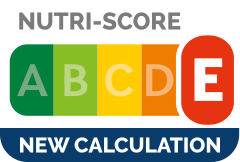 Bad nutritional quality
 Ultra-processed food and drink products
 Not computed
Health
Nutrition
Label
Bad nutritional qualityNutrient levels
Fat in moderate quantity (17.4%)
Saturated fat in high quantity (10.8%)
Sugars in high quantity (46.4%)
Salt in moderate quantity (0.62%)
Nutrition label

Nutrition facts
| Nutrition facts | As sold for 100 g / 100 ml |
|---|---|
| Energy | ~ 1,515.9 kJ (387 kcal) |
| FAT | 17.4 g |
| Saturated fat | 10.8 g |
| Carbohydrates | 48.4 g |
| Sugars | 46.4 g |
| Dietary fiber | ? |
| Proteins | 2.9 g |
| Salt | 0.62 g |
| Sodium | 0.25 g |
| Minerals | |
| Fruits, vegetables and legumes | ~ 2.81 % |
Nutrition facts (Detailed data)
| Nutrition facts | As sold for 100 g / 100 ml | As sold Per 100 g (packaging) | As sold Per 100 g (estimate) |
|---|---|---|---|
| Energy | ~ 1,515.9 kJ (387 kcal) | ? (387 kcal) | ? |
| FAT | 17.4 g | 17.4 g | ? |
| Saturated fat | 10.8 g | 10.8 g | ? |
| Carbohydrates | 48.4 g | 48.4 g | ? |
| Sugars | 46.4 g | 46.4 g | ? |
| Added sugars | ~ 36.5 g | ? | ~ 36.5 g |
| Dietary fiber | ? | ? | ? |
| Proteins | 2.9 g | 2.9 g | ? |
| Salt | 0.62 g | 0.62 g | ? |
| Sodium | 0.25 g | 0.25 g | ? |
| Minerals | |||
| Fruits, vegetables and legumes | ~ 2.81 % | ? | ~ 2.81 % |
Estimated Activity Time
Approximate time needed to burn the energy in 100 g / 100 ml: 1,516 kJ. Reference adult weight: 70 kg. Energy density: Moderate.
Ingredients
Ingredients image

Ingredients list
Ingredient information
Allergens
Ingredients analysis
No ingredients containing palm oil.
Contains non-vegan ingredients.
Unrecognized: fr:jus-de-citron-de-sicile-concentre
Vegetarian status unknown
Unrecognized: fr:jus-de-citron-de-sicile-concentre
Food Processing
NOVA group
Ultra-processed food and drink productsElements that indicate the product is in NOVA group 4
How NOVA works
Additives
E223 - Sodium metabisulphiteAntioxidantPreservative
SODIUM METABISULFITE or sodium pyrosulfite (IUPAC spelling; Br. E. sodium metabisulphite or sodium pyrosulphite) is an inorganic compound of chemical formula Na2S2O5.
E224 - Potassium metabisulphiteAntioxidantPreservative
POTASSIUM METABISULFITE, K2S2O5, also known as potassium pyrosulfite, is a white crystalline powder with a pungent sulfur odour. The main use for the chemical is as an antioxidant or chemical sterilant.
E406 - AgarCarrierEmulsifierHumectantStabiliserThickener
Agar (pronounced , sometimes ) or agar-agar is a jelly-like substance, obtained from red algae.Agar is a mixture of two components: the linear polysaccharide agarose, and a heterogeneous mixture of smaller molecules called agaropectin. It forms the supporting structure in the cell walls of certain species of algae, and is released on boiling. These algae are known as agarophytes, and belong to the Rhodophyta (red algae) phylum.Agar has been used as an ingredient in desserts throughout Asia, and also as a solid substrate to contain culture media for microbiological work. Agar can be used as a laxative, an appetite suppressant, a vegetarian substitute for gelatin, a thickener for soups, in fruit preserves, ice cream, and other desserts, as a clarifying agent in brewing, and for sizing paper and fabrics.The gelling agent in agar is an unbranched polysaccharide obtained from the cell walls of some species of red algae, primarily from tengusa (Gelidiaceae) and ogonori (Gracilaria). For commercial purposes, it is derived primarily from ogonori. In chemical terms, agar is a polymer made up of subunits of the sugar galactose.
Environment
Carbon footprint
Packaging
Packaging details
Transportation and origins
Data Source
Data presented on this page is sourced from the Open Food Facts database. This platform does not alter the original dataset; its purpose is solely to enhance data visualization and user accessibility.
Product added on March 8, 2014 at 8:28:53 PM UTC by teolemon .
Last edit on March 17, 2026 at 2:03:08 PM UTC by municorn-calorie-counter-app .
Product page also edited by beniben, fix-serving-size-bot, kiliweb, moon-rabbit, municorn-calorie-counter-app, naruyoko, packbot, remilk, tacite-mass-editor, teolemon, yuka.Ui9FaEVwMFFnS1Fya3NVVTl3L2w5ZXhxbXFLclkzL3FFTHNLSWc9PQ.