
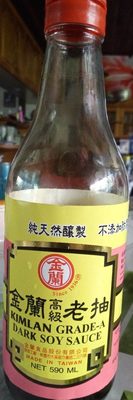
Kimlan Grade-A Dark Soy Sauce
Labels
 Not computed
 Not computed
 Not computed
Health
Nutrition
Nutrition label
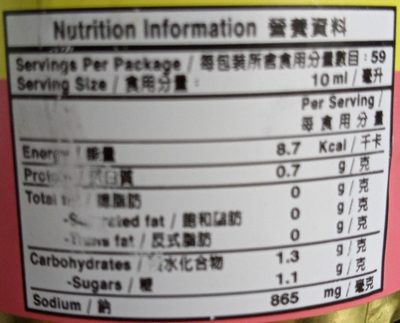
Nutrition facts
| Nutrition facts | As sold for 100 g / 100 ml |
|---|---|
| Energy | ~ 34 kJ (9 kcal) |
| FAT | 0 g |
| Saturated fat | 0 g |
| Carbohydrates | 1.3 g |
| Sugars | 1.1 g |
| Dietary fiber | ? |
| Proteins | 0.7 g |
| Salt | 0.87 g |
| Sodium | 0.35 g |
| Minerals | |
| Fruits, vegetables and legumes | ~ 20.83 % |
Nutrition facts (Detailed data)
| Nutrition facts | As sold for 100 g / 100 ml | As sold Per 100 g (packaging) | As sold Per 100 g (estimate) |
|---|---|---|---|
| Energy | ~ 34 kJ (9 kcal) | ? (9 kcal) | ? |
| FAT | 0 g | 0 g | ? |
| Saturated fat | 0 g | 0 g | ? |
| Carbohydrates | 1.3 g | 1.3 g | ? |
| Sugars | 1.1 g | 1.1 g | ? |
| Added sugars | ~ 0 g | ? | ~ 0 g |
| Dietary fiber | ? | ? | ? |
| Proteins | 0.7 g | 0.7 g | ? |
| Salt | 0.87 g | 0.87 g | ? |
| Sodium | 0.35 g | 0.35 g | ? |
| Minerals | |||
| Fruits, vegetables and legumes | ~ 20.83 % | ? | ~ 20.83 % |
Estimated Activity Time
Approximate time needed to burn the energy in 100 g / 100 ml: 34 kJ. Reference adult weight: 70 kg. Energy density: Low.
Ingredients
Ingredients image
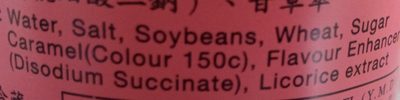
Ingredients list
Ingredient information
Allergens
Ingredients analysis
No ingredients containing palm oil.
Unrecognized: en:sugar-caramel, en:colour-150c, en:flaw-ur-enhancer, en:bisodium-succinate
Vegan status unknown
Unrecognized: en:colour-150c, en:bisodium-succinate
Vegetarian status unknown
Unrecognized: en:colour-150c, en:bisodium-succinate
Food Processing
NOVA group
How NOVA works
Additives
E363 - Succinic acid
Succinic acid () is a dicarboxylic acid with the chemical formula (CH2)2(CO2H)2. The name derives from Latin succinum, meaning amber. In living organisms, succinic acid takes the form of an anion, succinate, which has multiple biological roles as a metabolic intermediate being converted into fumarate by the enzyme succinate dehydrogenase in complex 2 of the electron transport chain which is involved in making ATP, and as a signaling molecule reflecting the cellular metabolic state. Succinate is generated in mitochondria via the tricarboxylic acid cycle (TCA), an energy-yielding process shared by all organisms. Succinate can exit the mitochondrial matrix and function in the cytoplasm as well as the extracellular space, changing gene expression patterns, modulating epigenetic landscape or demonstrating hormone-like signaling. As such, succinate links cellular metabolism, especially ATP formation, to the regulation of cellular function. Dysregulation of succinate synthesis, and therefore ATP synthesis, happens in some genetic mitochondrial diseases, such as Leigh syndrome, and Melas syndrome, and degradation can lead to pathological conditions, such as malignant transformation, inflammation and tissue injury.
Environment
Environmental score label
Not computedCarbon footprint
No carbon footprint data is available for this product.
Packaging
No packaging information provided.
Transportation and origins
Origins of ingredients
No origin information provided.
Manufacturing places
No manufacturing place information provided.
Environmental labels
No environmental labels identified.
Data Source
Data presented on this page is sourced from the Open Food Facts database. This platform does not alter the original dataset; its purpose is solely to enhance data visualization and user accessibility.
Product added on January 10, 2018 at 10:36:09 PM UTC by kiliweb .
Last edit on March 17, 2026 at 1:51:20 PM UTC by new-nutrition-bot .
Product page also edited by inf, kiliweb, new-nutrition-bot, openfoodfacts-contributors, yuka.WllNK0ZwWUkrY0lKbWMwSCtBakgzZWt2NkpLWFJrS3lOZklWSWc9PQ.