

BROWN SUGAR & HONEY BREAKFAST SAUSAGE
Labels
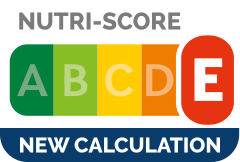 Bad nutritional quality
 Ultra-processed food and drink products
 Not computed
Health
Nutrition
Label
Bad nutritional qualityNutrient levels
Fat in high quantity (25.5%)
Saturated fat in high quantity (9.09%)
Sugars in moderate quantity (7.27%)
Salt in high quantity (2%)
Nutrition label

Nutrition facts
| Nutrition facts | As sold for 100 g / 100 ml |
|---|---|
| Energy | ~ 1,343.64 kJ (327 kcal) |
| FAT | 25.45 g |
| Saturated fat | 9.09 g |
| Trans fat | 0 g |
| Cholesterol | 0.06 g |
| Carbohydrates | 7.27 g |
| Sugars | 7.27 g |
| Added sugars | 7.27 g |
| Starch | 0 g |
| Dietary fiber | 0 g |
| Proteins | 16.36 g |
| Salt | 2 g |
| Sodium | 0.8 g |
| Vitamins | |
| Vitamin D | 0 g |
| Minerals | |
| Potassium | 0.25 g |
| Calcium | 0.04 g |
| Iron | 0.04 g |
| Fruits, vegetables and legumes | ~ 0 % |
| Choline | 0 g |
Nutrition facts (Detailed data)
| Nutrition facts | As sold for 100 g / 100 ml | As sold Per 100 g (packaging) | As sold Per serving (55 g) (packaging) | As sold Per 100 g (estimate) |
|---|---|---|---|---|
| Energy | ~ 1,343.64 kJ (327 kcal) | ? (327 kcal) | ? (180 kcal) | ? |
| FAT | 25.45 g | ? | 14 g | ? |
| Saturated fat | 9.09 g | ? | 5 g | ? |
| Trans fat | 0 g | ? | 0 g | ? |
| Cholesterol | 0.06 g | ? | 0.04 g | ? |
| Carbohydrates | 7.27 g | ? | 4 g | ? |
| Sugars | 7.27 g | ? | 4 g | ? |
| Added sugars | 7.27 g | 7.27 g | 4 g | ~ 3.86 g |
| Starch | 0 g | ? | 0 g | ? |
| Dietary fiber | 0 g | ? | 0 g | ? |
| Proteins | 16.36 g | ? | 9 g | ? |
| Salt | 2 g | ? | 1.1 g | ? |
| Sodium | 0.8 g | ? | 0.44 g | ? |
| Vitamins | ||||
| Vitamin D | 0 g | ? | 0 g | ? |
| Minerals | ||||
| Potassium | 0.25 g | ? | 0.14 g | ? |
| Calcium | 0.04 g | ? | 0.02 g | ? |
| Iron | 0.04 g | ? | 0.02 g | ? |
| Fruits, vegetables and legumes | ~ 0 % | ? | ? | ~ 0 % |
| Choline | 0 g | ? | 0 g | ? |
Serving size
Estimated Activity Time
Approximate time needed to burn the energy in 100 g / 100 ml: 1,344 kJ. Reference adult weight: 70 kg. Energy density: Moderate.
Ingredients
Ingredients list
Ingredient information
Allergens
Ingredients analysis
No ingredients containing palm oil.
Contains non-vegan ingredients.
Unrecognized: en:cellulose-gel, en:collagen-casing
Contains non-vegetarian ingredients.
Unrecognized: en:cellulose-gel, en:collagen-casing
Food Processing
NOVA group
Ultra-processed food and drink productsElements that indicate the product is in NOVA group 4
How NOVA works
Additives
E310 - Propyl gallateAntioxidant
Propyl gallate, or propyl 3,4,5-trihydroxybenzoate is an ester formed by the condensation of gallic acid and propanol. Since 1948, this antioxidant has been added to foods containing oils and fats to prevent oxidation. As a food additive, it is used under the E number E310.
E320 - Butylated hydroxyanisole (bha)Antioxidant
Butylated hydroxyanisole (BHA) is an antioxidant consisting of a mixture of two isomeric organic compounds, 2-tert-butyl-4-hydroxyanisole and 3-tert-butyl-4-hydroxyanisole. It is prepared from 4-methoxyphenol and isobutylene. It is a waxy solid used as a food additive with the E number E320. The primary use for BHA is as an antioxidant and preservative in food, food packaging, animal feed, cosmetics, rubber, and petroleum products. BHA also is commonly used in medicines, such as isotretinoin, lovastatin, and simvastatin, among others.
E330 - Citric acidAntioxidantSequestrant
Citric acid is a natural organic acid found in citrus fruits such as lemons, oranges, and limes.
It is widely used in the food industry as a flavor enhancer, acidulant, and preservative due to its tart and refreshing taste.
Citric acid is safe for consumption when used in moderation and is considered a generally recognized as safe (GRAS) food additive by regulatory agencies worldwide.
E422 - GlycerolHumectantThickener
Glycerol (; also called glycerine or glycerin; see spelling differences) is a simple polyol compound. It is a colorless, odorless, viscous liquid that is sweet-tasting and non-toxic. The glycerol backbone is found in all lipids known as triglycerides. It is widely used in the food industry as a sweetener and humectant and in pharmaceutical formulations. Glycerol has three hydroxyl groups that are responsible for its solubility in water and its hygroscopic nature.
E621 - Monosodium glutamateFlavour Enhancer
Monosodium glutamate (MSG), or E621, is the sodium salt of glutamic acid, an amino acid found naturally in many foods.
It is widely used as a flavor enhancer to provide an "umami" or savory taste to a variety of processed foods, including soups, snack chips, and frozen meals.
MSG is generally recognized as safe (GRAS) by food authorities. However, some people report sensitivity to MSG, experiencing short-term symptoms like headaches and flushing, though scientific studies have not shown a consistent link.
Environment
Environmental score label
Not computedCarbon footprint
No carbon footprint data is available for this product.
Packaging
No packaging information provided.
Transportation and origins
Origins of ingredients
No origin information provided.
Manufacturing places
No manufacturing place information provided.
Environmental labels
No environmental labels identified.
Data Source
Data presented on this page is sourced from the Open Food Facts database. This platform does not alter the original dataset; its purpose is solely to enhance data visualization and user accessibility.
Product added on March 9, 2017 at 9:32:51 AM UTC by usda-ndb-import .
Last edit on March 17, 2026 at 11:42:25 AM UTC by municorn-calorie-counter-app .
Product page also edited by macrofactor, municorn-calorie-counter-app, org-database-usda, roboto-app, usda-ndb-import.
Source List
- usda-ndb
- database-usda