
Sesame Premium Buns
Labels
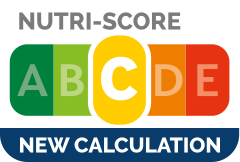 Moderate nutritional quality
 Ultra-processed food and drink products
 Not computed
Health
Nutrition
Serving Size
Nutri-Score label
Moderate nutritional qualityNutrient levels for 100 g
Fat in moderate quantity (?)
What you need to know
A high consumption of fat, especially saturated fats, can raise cholesterol, which increases the risk of heart diseases.
Recommendation: Limit the consumption of fat and saturated fat
Choose products with lower fat and saturated fat content.
Saturated fat in low quantity (?)
What you need to know
A high consumption of fat, especially saturated fats, can raise cholesterol, which increases the risk of heart diseases.
Recommendation: Limit the consumption of fat and saturated fat
Choose products with lower fat and saturated fat content.
Sugars in moderate quantity (?)
What you need to know
A high consumption of sugar can cause weight gain and tooth decay. It also augments the risk of type 2 diabetes and cardio-vascular diseases.
Recommendation: Limit the consumption of sugar and sugary drinks
Sugary drinks should be limited as much as possible. Choose products with lower sugar content.
Salt in moderate quantity (?)
What you need to know
A high consumption of salt (or sodium) can cause raised blood pressure, which can increase the risk of heart disease and stroke.
Recommendation: Limit the consumption of salt and salted food
Reduce the quantity of salt used when cooking. Limit the consumption of salty snacks.
Nutrition Facts
| Nutrition Facts | As sold for 100 g / 100 ml | Per serving 1 bun (74 g) |
|---|---|---|
| Energy | ? | ? |
| Fat | ? | ? |
| Saturated fat | ? | ? |
| Carbohydrates | ? | ? |
| Sugars | ? | ? |
| Dietary fiber | ? | ? |
| Proteins | ? | ? |
| Salt | ? | ? |
| Sodium | ? | ? |
Ingredients
Ingredients List
Ingredient Information
Food Processing
NOVA Group label
Ultra-processed food and drink productsElements that indicate the product is in the NOVA group 4:
- Additives: E415 - Xanthan gum
- Additives: E481 - Sodium stearoyl-2-lactylate
The NOVA classification assigns food products into 4 groups based on their degree of processing:
- Unprocessed or minimally processed foods
- Processed culinary ingredients
- Processed foods
- Ultra-processed food and drink products
Ingredients analysis
Palm oil free
Palm oil content unknown
Vegan
Vegan status unknown
Unrecognized ingredients: en:vital-wheat-gluten, en:mold-inhibitor, en:annatto-which-impart-color
Vegetarian
Vegetarian status unknown
Unrecognized ingredients: en:vital-wheat-gluten, en:mold-inhibitor, en:annatto-which-impart-color
Additives
E282 - calcium propionatePreservative
CALCIUM PROPIONATE has the formula Ca(C2H5COO)2. Calcium propionate is used as a preservative in a wide variety of products, including but not limited to:bread, other baked goods, processed meat, whey, and other dairy products.
E300 - Ascorbic acidAntioxidantSequestrant
No additive description is available yet.
E341 - Calcium phosphatesEmulsifierHumectantSequestrantStabiliserThickener
Calcium phosphate is a family of materials and minerals containing calcium ions (Ca2+) together with inorganic phosphate anions. Some so-called calcium phosphates contain oxide and hydroxide as well. They are white solids of nutritious value.
E341i - Monocalcium phosphateEmulsifierHumectantSequestrantStabiliserThickener
No additive description is available yet.
E415 - Xanthan gumEmulsifierStabiliserThickener
Xanthan gum (E415) is a natural polysaccharide derived from fermented sugars, often used in the food industry as a thickening and stabilizing agent.
This versatile food additive enhances texture and prevents ingredient separation in a wide range of products, including salad dressings, sauces, and gluten-free baked goods.
It is considered safe for consumption even at high intake amounts.
E481 - Sodium stearoyl-2-lactylateEmulsifierStabiliser
Sodium stearoyl-2-lactylate (sodium stearoyl lactylate or SSL) is a versatile, FDA approved food additive used to improve the mix tolerance and volume of processed foods. It is one type of a commercially available lactylate. SSL is non-toxic, biodegradable, and typically manufactured using biorenewable feedstocks. Because SSL is a safe and highly effective food additive, it is used in a wide variety of products ranging from baked goods and desserts to pet foods.As described by the Food Chemicals Codex 7th edition, SSL is a cream-colored powder or brittle solid. SSL is currently manufactured by the esterification of stearic acid with lactic acid and partially neutralized with either food-grade soda ash (sodium carbonate) or caustic soda (concentrated sodium hydroxide). Commercial grade SSL is a mixture of sodium salts of stearoyl lactylic acids and minor proportions of other sodium salts of related acids. The HLB for SSL is 10-12. SSL is slightly hygroscopic, soluble in ethanol and in hot oil or fat, and dispersible in warm water. These properties are the reason that SSL is an excellent emulsifier for fat-in-water emulsions and can also function as a humectant.
E516 - Calcium sulphateSequestrantStabiliser
Calcium sulfate (or calcium sulphate) is the inorganic compound with the formula CaSO4 and related hydrates. In the form of γ-anhydrite (the anhydrous form), it is used as a desiccant. One particular hydrate is better known as plaster of Paris, and another occurs naturally as the mineral gypsum. It has many uses in industry. All forms are white solids that are poorly soluble in water. Calcium sulfate causes permanent hardness in water.
E517 - Ammonium sulphate
Ammonium sulfate (American English and international scientific usage; ammonium sulphate in British English); (NH4)2SO4, is an inorganic salt with a number of commercial uses. The most common use is as a soil fertilizer. It contains 21% nitrogen and 24% sulfur.
Environment
Environmental score label
Not computedCarbon footprint
No carbon footprint data is available for this product.
Packaging
No packaging information provided.
Transportation and origins
Origins of ingredients
No origin information provided.
Manufacturing places
No manufacturing place information provided.
Environmental labels
No environmental labels identified.
Data Source
Product added on March 10, 2017 at 10:17:57 AM UTC by usda-ndb-import .
Last edit on March 17, 2026 at 6:56:45 PM UTC by municorn-calorie-counter-app .
Product page also edited by inf, macrofactor, municorn-calorie-counter-app, new-nutrition-bot, org-database-usda, usda-ndb-import.
Source List
- usda-ndb
- database-usda