

Cherry mini snack pies
Health
Nutrition
Nutri-Score
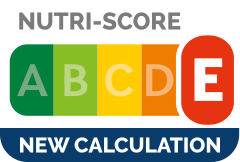 Lower nutritional quality
Nutri-Score data warning
Nutrient levels
Fat in moderate quantity (13.3%)
Saturated fat in moderate quantity (3.54%)
Sugars in high quantity (27%)
Salt in moderate quantity (1.08%)
Nutrition label

Nutrition facts
| Nutrition facts | As sold for 100 g / 100 ml | Compared to: Cakes |
|---|---|---|
| Energy | ~ 1415.69 kJ (336 kcal) | 1,677.634 kJ (400 kcal) (-16%) |
| Fat | 13.27 g | 19.2 g (-31%) |
| Saturated fat | 3.54 g | 7.1 g (-50%) |
| Monounsaturated fat | 2.65 g | 6.704 g (-60%) |
| Polyunsaturated fat | 5.31 g | 2.79 g (+90%) |
| Trans fat | 0 g | 0.04 g (-100%) |
| Cholesterol | 0 g | 55.094 mg (-100%) |
| Carbohydrates | 51.33 g | 50.004 g (+3%) |
| Sugars | 27 g | 27.701 g (-3%) |
| Dietary fiber | 0.88 g | ? |
| Proteins | 2.65 g | 5.463 g (-51%) |
| Salt | 1.0789 g | 0.58 g (+86%) |
| Sodium | 0.43156 g | 0.232 g (+86%) |
| Potassium | 0.054 g | 171.21 mg (-68%) |
| Calcium | 0.005 g | 43.546 mg (-89%) |
| Iron | 0.00088 g | 1.456 mg (-40%) |
| Fruits, vegetables and legumes | ~ 6.77101700394243 % | ? |
Nutrition facts (Detailed data)
| Nutrition facts | As sold for 100 g / 100 ml | As sold Per 100 g (packaging) | As sold Per 100 g (estimate) |
|---|---|---|---|
| Energy | ~ 1415.69 kJ (336 kcal) | ? (336 kcal) | ~ 981.042368570964 kJ (231 kcal) |
| Fat | 13.27 g | 13.27 g | ~ 4.94644027144821 g |
| Saturated fat | 3.54 g | 3.54 g | ~ 0.141176211886936 g |
| Monounsaturated fat | 2.65 g | 2.65 g | ? |
| Polyunsaturated fat | 5.31 g | 5.31 g | ? |
| Trans fat | 0 g | 0 g | ? |
| Cholesterol | 0 g | 0 g | ~ 0 g |
| Carbohydrates | 51.33 g | 51.33 g | ~ 50.8970685040509 g |
| Sugars | 27 g | 27 g | ~ 14.3505215341073 g |
| Dietary fiber | 0.88 g | 0.88 g | ~ 4.32188969364873 g |
| Proteins | 2.65 g | 2.65 g | ~ 7.06721060293692 g |
| Salt | 1.0789 g | 1.0789 g | ~ 0.0357530014603226 g |
| Sodium | 0.43156 g | 0.43156 g | ~ 0.00237061896995262 g |
| Potassium | 0.054 g | 0.054 g | ~ 0.253420762702094 g |
| Calcium | 0.005 g | 0.005 g | ~ 0.0296614230516222 g |
| Iron | 0.00088 g | 0.00088 g | ~ 0.00210576764707212 g |
| Fruits, vegetables and legumes | ~ 6.77101700394243 % | ? | ~ 6.77101700394243 % |
Serving size
Ingredients
Ingredients list
Ingredient information
Added sugars
Allergens
Ingredients analysis
Contains ingredients containing palm oil.
Vegan status unknown
Unrecognized: en:with-propionic, en:vitamin-c-palmitate
Vegetarian status unknown
Unrecognized: en:with-propionic, en:vitamin-c-palmitate
Food Processing
NOVA group
 Ultra-processed food and drink products
Elements that indicate the product is in NOVA group 4
How NOVA works
Additives
E129 - Allura red EFSA overexposure risk: noColour
Allura Red AC is a red azo dye that goes by several names, including FD&C Red 40. It is used as a food dye and has the E number E129. It is usually supplied as its red sodium salt, but can also be used as the calcium and potassium salts. These salts are soluble in water. In solution, its maximum absorbance lies at about 504 nm.
E211 - Sodium benzoate EFSA overexposure risk: highPreservative
SODIUM BENZOATE is a substance which has the chemical formula NaC7H5O2
E226 - Calcium sulphite EFSA overexposure risk: high
Calcium sulfite, or calcium sulphite, is a chemical compound, the calcium salt of sulfite with the formula CaSO3·x(H2O). Two crystalline forms are known, the hemihydrate and the tetrahydrate, respectively CaSO3·½(H2O) and CaSO3·4(H2O). All forms are white solids. It is most notable as the product of flue-gas desulfurization.
E281 - Sodium propionatePreservative
Sodium propanoate or SODIUM PROPIONATE is the sodium salt of propionic acid.
E306 - Tocopherol-rich extract
No additive description is available yet.
E330 - Citric acidAntioxidantSequestrant
Citric acid is a natural organic acid found in citrus fruits such as lemons, oranges, and limes.
It is widely used in the food industry as a flavor enhancer, acidulant, and preservative due to its tart and refreshing taste.
Citric acid is safe for consumption when used in moderation and is considered a generally recognized as safe (GRAS) food additive by regulatory agencies worldwide.
E338 - Phosphoric acid EFSA overexposure risk: highAntioxidantSequestrant
Phosphoric acid (also known as orthophosphoric acid or phosphoric(V) acid) is a weak acid with the chemical formula H3PO4. Orthophosphoric acid refers to phosphoric acid, which is the IUPAC name for this compound. The prefix ortho- is used to distinguish the acid from related phosphoric acids, called polyphosphoric acids. Orthophosphoric acid is a non-toxic acid, which, when pure, is a solid at room temperature and pressure. The conjugate base of phosphoric acid is the dihydrogen phosphate ion, H2PO−4, which in turn has a conjugate base of hydrogen phosphate, HPO2−4, which has a conjugate base of phosphate, PO3−4. Phosphates are essential for life.The most common source of phosphoric acid is an 85% aqueous solution; such solutions are colourless, odourless, and non-volatile. The 85% solution is a syrupy liquid, but still pourable. Although phosphoric acid does not meet the strict definition of a strong acid, the 85% solution is acidic enough to be corrosive. Because of the high percentage of phosphoric acid in this reagent, at least some of the orthophosphoric acid is condensed into polyphosphoric acids; for the sake of labeling and simplicity, the 85% represents H3PO4 as if it were all in the ortho form. Dilute aqueous solutions of phosphoric acid exist in the ortho form.
E406 - AgarCarrierEmulsifierHumectantStabiliserThickener
Agar (pronounced , sometimes ) or agar-agar is a jelly-like substance, obtained from red algae.Agar is a mixture of two components: the linear polysaccharide agarose, and a heterogeneous mixture of smaller molecules called agaropectin. It forms the supporting structure in the cell walls of certain species of algae, and is released on boiling. These algae are known as agarophytes, and belong to the Rhodophyta (red algae) phylum.Agar has been used as an ingredient in desserts throughout Asia, and also as a solid substrate to contain culture media for microbiological work. Agar can be used as a laxative, an appetite suppressant, a vegetarian substitute for gelatin, a thickener for soups, in fruit preserves, ice cream, and other desserts, as a clarifying agent in brewing, and for sizing paper and fabrics.The gelling agent in agar is an unbranched polysaccharide obtained from the cell walls of some species of red algae, primarily from tengusa (Gelidiaceae) and ogonori (Gracilaria). For commercial purposes, it is derived primarily from ogonori. In chemical terms, agar is a polymer made up of subunits of the sugar galactose.
E415 - Xanthan gumEmulsifierStabiliserThickener
Xanthan gum (E415) is a natural polysaccharide derived from fermented sugars, often used in the food industry as a thickening and stabilizing agent.
This versatile food additive enhances texture and prevents ingredient separation in a wide range of products, including salad dressings, sauces, and gluten-free baked goods.
It is considered safe for consumption even at high intake amounts.
E466 - Sodium carboxy methyl celluloseEmulsifierHumectantStabiliserThickener
Carboxymethyl cellulose (CMC) or cellulose gum or tylose powder is a cellulose derivative with carboxymethyl groups (-CH2-COOH) bound to some of the hydroxyl groups of the glucopyranose monomers that make up the cellulose backbone. It is often used as its sodium salt, sodium carboxymethyl cellulose.
E471 - Mono- and diglycerides of fatty acidsEmulsifierStabiliser
Mono- and diglycerides of fatty acids (E471), are food additives commonly used as emulsifiers in various processed foods.
These compounds consist of glycerol molecules linked to one or two fatty acid chains, which help stabilize and blend water and oil-based ingredients. E471 enhances the texture and shelf life of products like margarine, baked goods, and ice cream, ensuring a smooth and consistent texture.
It is generally considered safe for consumption within established regulatory limits.
Environment
Green-Score, origins bonus, and transportation impact are shown for Worldwide .
Green Score
Overall grade
 Unknown environmental impact
About Green-Score
Current scope
Green-Score availability
Bonuses and maluses
Declared origins
Threatened species risk
Packaging impact
Packaging
Packaging impact
Data precision
Transportation
Declared origins
Forest footprint
Forest footprint
Deforestation risk details
Data Source
Product data comes from Open Food Facts. Food Benchmark also adds translations, category comparisons and explanatory calculations.
The database is licensed under ODbL 1.0, individual contents under DbCL 1.0, and product photos under CC BY-SA 3.0.
Product added on September 25, 2019 at 9:13:57 AM UTC by kiliweb .
Last edit on March 17, 2026 at 9:56:17 AM UTC by new-nutrition-bot .
Product page also edited by ecoscore-impact-estimator, inf, kiliweb, new-nutrition-bot, org-database-usda, yuka.RnJzQklvTUtnZGxVcThjZSt4N0YyK2tyekkrRWMzeWxMK1VSSWc9PQ, yuka.sY2b0xO6T85zoF3NwEKvlmZHQtHFsBDJGAbfwV209N2EFrm3f8BQvZrLIas, yuka.sY2b0xO6T85zoF3NwEKvlmxbXeXk-yPpO0Tnv0CW3tiPFISyPftf_4LxIqs.
Source List
- database-usda